近视镜

Search documents
验光单怎么看?一起来解锁“视力密码”
Xin Lang Cai Jing· 2026-01-05 23:52
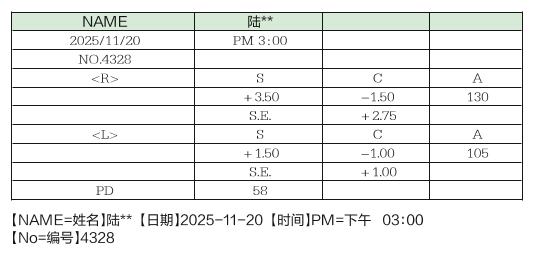
Core Viewpoint - The article provides a detailed explanation of the components of an eye prescription, helping individuals understand the significance of various symbols and numbers on the prescription sheet. Group 1: Eye Identification - The prescription distinguishes between the right eye (R) and left eye (L), with R representing the right eye and L representing the left eye, which is crucial for accurate vision correction [2][3][4]. - Mixing up the data for the right and left eyes can lead to severe eye strain and worsen vision problems [5]. Group 2: Sphere Degree (S) - The sphere degree (S) indicates the degree of myopia or hyperopia, with a "-" sign representing myopia and a "+" sign representing hyperopia [6][7]. - The unit for sphere degree is diopters (DS), and a normal range for adults is ±0.50DS [8][9]. Group 3: Cylinder Degree (C) and Axis (A) - Cylinder degree (C) indicates the degree of astigmatism, while the axis (A) specifies the direction of astigmatism, measured in degrees from 0 to 180° [10][11]. - The unit for cylinder degree is diopters (DC), and a cylinder degree greater than 0.50DC typically requires corrective lenses [12][14]. Group 4: Spherical Equivalent (SE) - The spherical equivalent (SE) is a key indicator of overall refractive status, calculated using the formula: sphere degree + 1/2 cylinder degree [15][16]. Group 5: Pupillary Distance (PD) - Pupillary distance (PD) is essential for comfortable lens fitting, with a normal range for adults being 55-70mm [17][18]. - Accurate measurement of PD is critical to avoid discomfort and visual distortion [19]. Group 6: Important Reminders - The prescription data should be analyzed in conjunction with age, medical history, and visual habits for accurate assessment [20]. - Children require specific considerations for eye exams, including the need for dilation and frequent re-evaluations due to rapid vision changes [21][23]. - It is advised to retain the prescription for future reference, as it may fade over time, and to avoid purchasing glasses online without proper fitting [24][25].

5月“科学”流言榜发布 这几条骗了我们好多年……
Yang Shi Xin Wen· 2025-05-30 01:19
Group 1 - The common misconception that electric vehicles cannot be driven in the rain due to electric shock risks is debunked. Electric vehicles are designed with waterproof and leak-proof features, typically rated IP67 or higher, ensuring safety during rain [2][5] - All electric vehicles must pass rigorous water immersion tests as per the national safety standards, which include driving in water up to 100mm deep at a speed of 20km/h for at least 500 meters [2] - Additional safety mechanisms in electric vehicles include waterproof circuits and automatic disconnection of high-voltage power in case of anomalies, emphasizing that driving in rain is safe as long as general driving safety is observed [5] Group 2 - The belief that swimming right after eating can lead to leg cramps is clarified. Cramps are more commonly caused by electrolyte imbalance, muscle fatigue, or inadequate warm-up rather than blood flow diversion to the digestive system [6][9] - It is suggested that light meals do not require a waiting period before swimming, while heavier meals should allow for a 30 to 60-minute interval to avoid discomfort [9] - Proper warm-up, hydration, and awareness of individual health conditions are recommended to prevent cramps during swimming [10][11][12] Group 3 - The myth that early use of glasses can worsen children's myopia is addressed. The progression of myopia is linked to eye shape changes rather than the use of corrective lenses [13][18] - Children should be encouraged to have regular eye check-ups and maintain visual health records to manage myopia effectively [18] Group 4 - The claim that removing polyps can lead to more polyps is refuted. Timely removal of certain types of polyps is crucial due to their potential cancer risk, and removal does not cause an increase in polyps [19][24] - New polyps found after removal may be previously undetected or a result of incomplete removal, not a consequence of the removal process itself [24] Group 5 - The notion that shaving facial hair makes it grow back thicker is a common misconception. The thickness of hair is determined by the structure of hair follicles, which is influenced by genetics and hormones, not shaving [25][29] - The perception of increased thickness after shaving is due to the blunt edge of newly cut hair, not an actual change in hair characteristics [29] Group 6 - The belief that drinking vinegar or swallowing food can help dislodge fish bones stuck in the throat is misleading. These methods are ineffective and can potentially worsen the situation by pushing the bone deeper [34][38] - If a fish bone is lodged, it is advised to cough forcefully or seek medical attention if there is significant pain or discomfort [38] Group 7 - The idea that tea residue is beneficial for maintaining teapots is incorrect. Tea residue can harbor harmful substances and microorganisms, affecting both the teapot's integrity and health [39][43] - Regular cleaning of teapots is essential to prevent the accumulation of tea residue and maintain the quality of the tea [43]