Apache RocketMQ

Search documents
后端架构新范式!阿里云专家亲揭:用RocketMQ彻底搞定多Agent异步协同难题
AI科技大本营· 2025-10-30 10:55
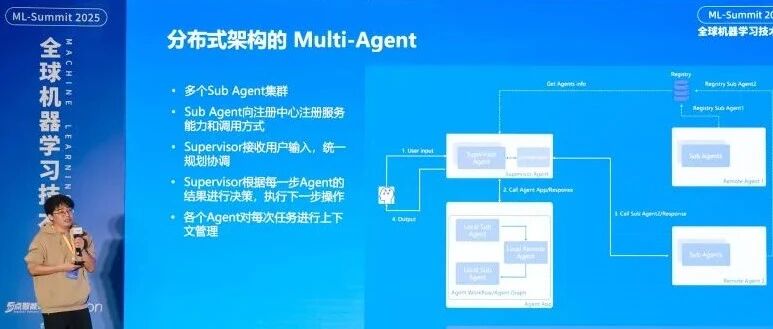
Core Insights - The article discusses the evolution of AI towards Agentic AI, emphasizing the shift from passive response to proactive decision-making and execution, leading to the development of Multi-Agent architectures [4][5] - It highlights the importance of agent capability discovery and task closure for efficient collaboration among agents, which is essential for achieving high reliability and effectiveness in task execution [5][6] Agent Capability Discovery - Agent capability discovery involves dynamic registration of agent abilities and allows a Supervisor Agent to query and select appropriate Sub Agents for task execution, enhancing autonomy and scalability [6] - This mechanism is compared to traditional microservices service discovery, focusing on semantic capability and intent-driven matching, which is crucial for intelligent division of labor [6] Task Collaboration - In a large model-driven multi-agent system, agents collaborate, compete, or divide tasks to complete complex objectives, with the Supervisor Agent coordinating the efforts of specialized agents [7] - Effective communication mechanisms are necessary for high-efficiency collaboration, with different communication modes offering various trade-offs in flexibility, scalability, control, and performance [7][8] Asynchronous Communication Mechanisms - The article examines asynchronous communication scenarios using a publish/subscribe model, where Sub Agents send results back to the Supervisor Agent, which requires a feedback mechanism to ensure task closure [8][9] - Various communication methods are discussed, including polling, point-to-point invocation, and the publish/subscribe model, each with its advantages and drawbacks [8][9] RocketMQ Features for Agentic AI - RocketMQ introduces new features such as semantic Topics and Lite-Topics to facilitate asynchronous communication and dynamic decision-making among agents [10][11] - The evolution of Topics from simple data channels to semantic carriers allows for intention-driven collaboration, enhancing the discoverability and expressiveness of agent capabilities [11][12] Lite-Topic Consumption Model - Lite-Topics are designed for lightweight message transmission and dynamic subscription relationships, supporting granular resource isolation and asynchronous result feedback [13][14] - The event-driven message distribution model, utilizing InterestSet and ReadySet, transforms traditional polling into precise wake-up calls, improving efficiency in personalized subscription scenarios [20][21] Building Asynchronous Multi-Agent Systems - The architecture enables asynchronous retrieval of Sub Agent results through dynamic subscription to Lite-Topics, ensuring task closure within the Supervisor Agent cluster [21][22] - The integration of semantic Topics for agent capability registration and discovery creates an efficient asynchronous collaboration framework, enhancing task orchestration and decision-making processes [24][25] Conclusion - The innovative architecture based on RocketMQ's publish/subscribe model effectively supports task orchestration, result feedback, and multi-round decision-making in Multi-Agent scenarios, providing a viable technical path for building reliable and controllable asynchronous intelligent agent collaboration systems [27]