Attention Residuals技术

Search documents
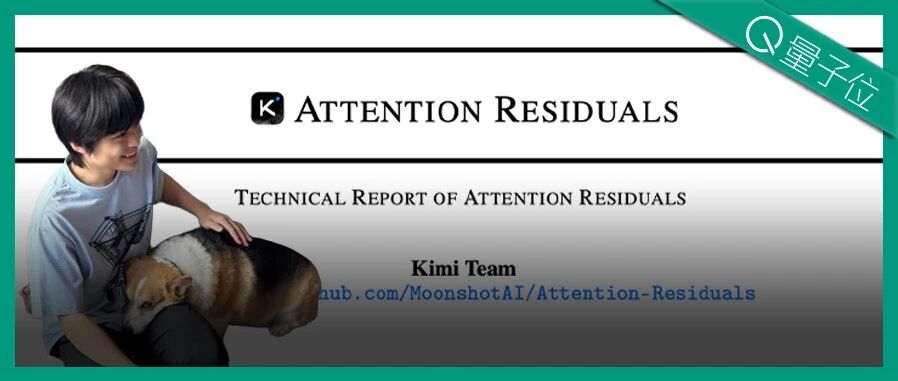
Kimi新架构让马斯克叹服!17岁高中生作者一战成名
量子位· 2026-03-17 06:10
Core Insights - The article discusses the development of a new technique called Attention Residuals by the Kimi team, which innovatively applies attention mechanisms to residual connections in deep learning models, enhancing their efficiency and performance [1][6][26]. Group 1: Attention Residuals Technique - The Kimi team transformed the traditional residual network by applying attention mechanisms, allowing the model to selectively recall information from previous layers, thus improving the model's ability to focus on relevant data [2][12]. - This new method was validated on the Kimi Linear 48B model, resulting in a 25% increase in training efficiency with less than a 2% increase in inference latency [6][22]. - The implementation of Attention Residuals is a drop-in replacement for existing residual connections, requiring no modifications to other parts of the network [26]. Group 2: Performance Metrics - The Kimi Linear model demonstrated superior performance across various tasks, achieving better results in mathematical reasoning and code generation compared to baseline models [24][25]. - Specific performance improvements included a rise in MMLU scores from 73.5 to 74.6 and GSM8K scores from 81.7 to 82.4, showcasing the effectiveness of the new technique [25]. Group 3: Challenges and Solutions - The article highlights the "PreNorm dilution problem," where equal weight contributions from all layers dilute the significance of earlier information, making it difficult to retrieve relevant data [9][10]. - To address the computational complexity of full attention residuals, the team introduced Block AttnRes, which compresses outputs from multiple layers into a single vector, reducing complexity from O(L²) to O(L·B) [15][20]. Group 4: Team and Collaboration - The paper features a notable collaboration, including a 17-year-old co-author, Nathan Chen, who has garnered attention from prominent figures in the tech industry, such as Elon Musk and Andreessen Horowitz [3][31][34]. - Nathan's journey from a high school hackathon participant to a contributor in advanced AI research exemplifies the potential for young talent in the field [36][53].