BCZY712陶瓷

Search documents
巧施“内力”,攻克非对称陶瓷膜致密化难题 | 科技前线
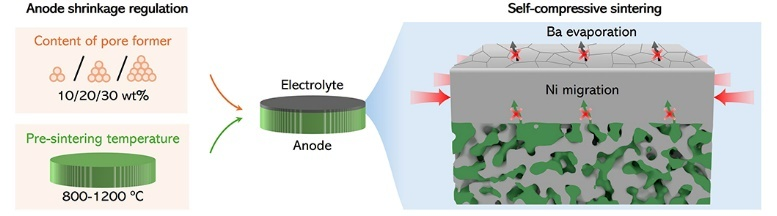
Xin Lang Cai Jing· 2026-01-21 12:21
Core Viewpoint - The research team from the Dalian Institute of Chemical Physics, Chinese Academy of Sciences, has proposed a novel self-compression stress strategy for the preparation of asymmetric ceramic membranes, which aims to achieve high performance, low cost, and low-temperature manufacturing in gas separation and energy conversion applications [1][2]. Group 1: Challenges and Innovations - Asymmetric ceramic membranes face cracking and warping due to mismatched shrinkage behaviors of the porous support and dense functional layer during high-temperature sintering [1]. - The team has introduced a revolutionary approach by utilizing the shrinkage difference between the porous support and the functional film as a driving force for densification, effectively turning a challenge into an advantage [3]. Group 2: Application and Results - The innovative strategy has been applied to the promising proton-conducting solid oxide fuel cell system, using BCZY712 ceramic as the core electrolyte layer, known for its excellent proton conductivity [5]. - By adjusting two key parameters—porosity control and pre-sintering temperature—the team successfully achieved densification of the BCZY712 ceramic asymmetric membrane at a significantly reduced temperature of 1300°C, reaching a relative density of approximately 99% [5][6]. Group 3: Advantages of the New Strategy - The self-compression strategy is compatible with existing ceramic sintering processes and does not require complex equipment, fundamentally mitigating intrinsic damage caused by high-temperature sintering [6]. - Compared to traditional high-temperature sintered batteries, the new strategy shows significant material advantages, including a reduction in barium volatilization, a substantial decrease in key element loss on the electrolyte surface, and a 73% to 89% reduction in nickel migration from the support [6]. - The precise maintenance of chemical composition has led to performance improvements, with peak power density of single cells increasing by 89% and proton conductivity of the electrolyte improving by 151%, demonstrating excellent long-term operational stability [6].