Cubic Boron Nitride

Search documents
2025年全球超硬材料行业技术发展与分析——拥抱产能,迎接创新
Qian Zhan Wang· 2025-08-12 08:56
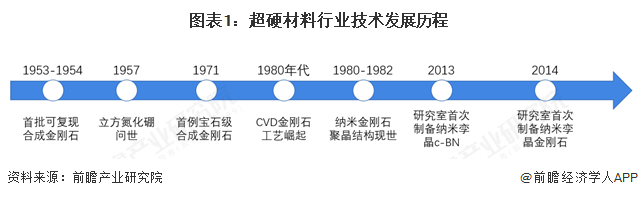
Core Viewpoint - By 2025, the global superhard materials industry will exhibit a development pattern characterized by "dual-track technological competition and diversified application expansion," with the research and development of nanocrystalline diamond and new superhard compounds becoming the technological high ground. The industry is accelerating its transition towards emerging fields such as semiconductors and quantum computing [1]. Technological Development - The technological development of superhard materials dates back to the 1950s, beginning with the successful synthesis of diamonds using high-pressure high-temperature (HPHT) techniques. The first controllable synthetic diamonds were produced by ASEA in Sweden and GE in the USA in 1953 and 1954, respectively [2]. - The introduction of chemical vapor deposition (CVD) technology in the 1980s allowed for the low-pressure synthesis of diamond films, expanding material options for electronic devices, thermal management, and precision machining [2]. - Recent advancements in nanocrystalline structures have significantly enhanced the performance of superhard materials, with nanocrystalline diamonds achieving Vickers hardness levels of 180-200 GPa, making them one of the hardest known synthetic materials [4]. Research Trends - Between 2020 and 2025, a total of 1,758 effective documents were collected, with 1,078 focusing on diamonds and 687 on cubic boron nitride (cBN), indicating a significantly higher research interest in diamonds compared to cBN [7]. - The core technologies in the superhard materials industry are concentrated in material synthesis processes, structural optimization methods, and multifunctional composites [8]. Industry Dynamics - The main synthesis technologies in the superhard materials industry are HPHT and CVD, each suited for different applications. HPHT focuses on yield and cost control, while CVD offers unique advantages in electronics, optics, and high-end cutting tools [8]. - The industry is moving towards a collaborative evolution of high strength, high toughness, multifunctionality, and low cost, supporting the deep expansion of superhard materials in aerospace, precision machining, and electronic devices [10]. Emerging Applications - The development trend indicates that CVD technology is advancing towards larger sizes, higher quality, and lower costs, particularly in the production of single crystal diamonds. New unconventional synthesis methods, such as liquid-phase and microwave plasma methods, are also emerging [11]. - Research on diamond applications in emerging fields such as semiconductors, quantum computing, high-power optics, and water treatment is rapidly growing, becoming a new frontier in research [11]. Competitive Landscape - While Western countries maintain a lead in high-pressure equipment and the stability of HPHT/CVD processes, China is quickly narrowing the gap. In the field of nanocrystalline cBN and diamonds, foreign achievements are more pronounced, but breakthroughs are expected from Chinese teams by 2025 [11][12]. - China has strong global competitiveness in supply chains and raw materials, although it may face risks related to low-end product exports due to supply chain concentration [12].