Fresh Food Delivery Service

Search documents
刚被美团用7.17亿美元收购,叮咚买菜创始人梁昌霖辞任CEO,CTO离职!王松接任CEO,他曾任职于饿了么、盒马鲜生等企业
Sou Hu Cai Jing· 2026-03-10 05:29
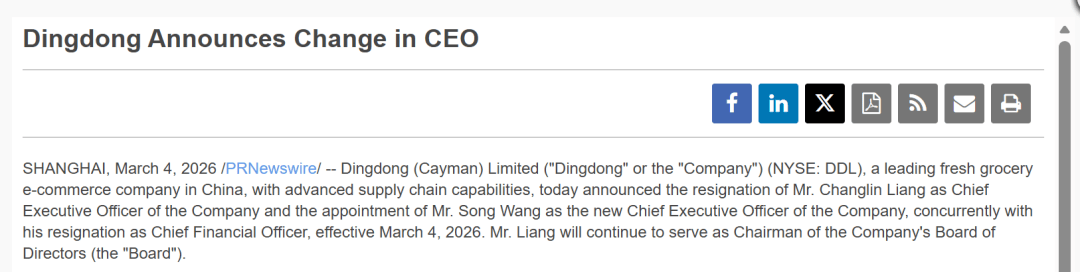
Core Viewpoint - Dingdong Maicai has appointed Wang Song as the new CEO, succeeding founder Liang Changlin, who will remain as chairman of the board. This leadership change comes shortly after Meituan's acquisition of Dingdong Maicai's China business for $717 million, marking a significant integration into Meituan's ecosystem [1][2]. Group 1: Management Changes - Liang Changlin has resigned as CEO and appointed Wang Song, who has nearly four years of core management experience at Dingdong Maicai, as the new CEO effective immediately [1]. - Wang Song has held various key positions, including Senior Vice President, CFO, and Chairman of Dingdong Guyu, demonstrating a comprehensive understanding of the company's operations [1][6]. - Dingdong Maicai's CTO Jiang Xu will resign by the end of March for personal reasons, with responsibilities being taken over by the existing executive team [1]. Group 2: Business Model and Market Position - Dingdong Maicai operates using a front warehouse model, primarily in the Yangtze River Delta region, which involves establishing warehouses near communities for efficient last-mile delivery [4][6]. - The company has expanded significantly since its entry into the fresh food e-commerce market in 2017, with the number of front warehouses reaching 1,400 by the end of 2021, covering 37 cities [6]. - Despite achieving revenue growth, Dingdong Maicai remains a regional player due to high operational costs associated with the front warehouse model [6][12]. Group 3: Financial Performance - In the fourth quarter of 2025, Dingdong Maicai reported revenue of 6.2426 billion yuan, a year-on-year increase of 5.7%, and a GMV of 6.7032 billion yuan, up 2.4% year-on-year [9]. - The company reported a GAAP net profit of 33.6 million yuan, a decline of 63.3% year-on-year, and a non-GAAP net profit of 50.8 million yuan, down 56.5% year-on-year [9]. - Following the acquisition by Meituan, Dingdong Maicai plans to use most of the proceeds for share buybacks and/or dividends [9]. Group 4: Competitive Landscape - The acquisition by Meituan is seen as a strategic move to enhance Dingdong Maicai's competitive position in the increasingly crowded instant retail market, where major players like Alibaba and JD.com are also heavily investing [11][12]. - Dingdong Maicai has established strong supply chain capabilities, with over 85% of fresh produce sourced directly and operates 12 self-owned factories and 2 self-owned farms [11]. - The company faces challenges in maintaining profitability, with net profit margins between 1.2% and 1.5%, and competition from Meituan's Xiaoxiang Supermarket and Hema [12].


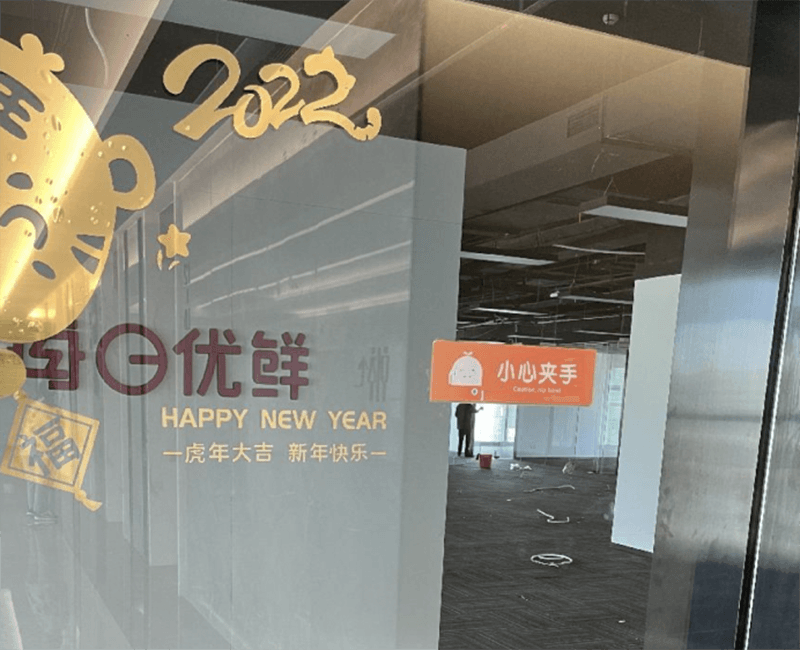
股价暴跌 97% 却活成模范盈利选手,叮咚买菜打响“江浙沪保卫战”
Sou Hu Cai Jing· 2025-11-24 09:04
Core Insights - The article discusses the contrasting fates of two major players in the fresh food e-commerce sector in China: Dingdong Maicai and Meiri Youxian, highlighting the challenges and strategies in the industry [1][3][10]. Group 1: Company Performance - Dingdong Maicai reported a revenue of 6.66 billion yuan for Q3 2025, a year-on-year increase of 1.9%, with a GMV of 7.27 billion yuan, up 0.1% [2][5]. - The company achieved its first quarterly profit under both GAAP and Non-GAAP standards in Q4 2022, and in Q3 2025, it reported a net profit of 100 million yuan under Non-GAAP standards, with a net profit margin of 1.5% [9][20]. - In contrast, Meiri Youxian's revenue growth stagnated, with a reported revenue of 6.95 billion yuan in 2021, and it faced significant losses, leading to its eventual closure of most operations [5][8]. Group 2: Strategic Shifts - Dingdong Maicai has adopted a strategy of focusing on fewer, high-value customers rather than competing on price, which has led to a more sustainable business model [2][18]. - The company has significantly reduced its operational footprint, closing numerous warehouses in less profitable regions and concentrating its efforts in the Jiangsu-Zhejiang-Shanghai area, where it has established a strong market presence [9][12][13]. - The shift to a "small but beautiful" strategy has resulted in a slowdown in revenue growth but has improved profitability metrics, indicating a more cautious and refined approach to market expansion [10][19]. Group 3: Market Dynamics - The fresh food e-commerce sector is characterized by intense competition, with major players like Alibaba, JD, and Meituan intensifying their efforts in instant retail, which has impacted Dingdong Maicai's user base [2][15]. - The industry's previous focus on rapid expansion and market share has been challenged by the inherent difficulties in achieving profitability within the fresh food segment, leading to a reevaluation of business models [10][21]. - Dingdong Maicai's operational efficiency has improved, with a fulfillment cost rate of 21.5% in Q3 2025, down from 49.9% in 2019, reflecting better management of logistics and order density [12][20].