Independent Energy Storage

Search documents
三峡能源:2025年总发电量762.61亿千瓦时,较上年同期增长5.99%
Xin Lang Cai Jing· 2026-01-09 08:02
Core Viewpoint - The company reported a total power generation of 19.507 billion kilowatt-hours in Q4 2025, reflecting a year-on-year increase of 0.92% [1] Group 1: Power Generation Performance - The total power generation for the year 2025 reached 76.261 billion kilowatt-hours, which is a 5.99% increase compared to the previous year [1] - Wind power generation in Q4 2025 was 13.238 billion kilowatt-hours, up by 2.33% year-on-year [1] - Solar power generation in Q4 2025 was 6.092 billion kilowatt-hours, showing a year-on-year increase of 1.70% [1] - Independent energy storage generation in Q4 2025 was 1.77 billion kilowatt-hours, down by 13.24% year-on-year [1] Group 2: Cumulative Power Generation Breakdown - Cumulative wind power generation for 2025 was 47.921 billion kilowatt-hours, reflecting a 6.08% increase from the previous year [1] - Cumulative solar power generation for 2025 was 27.654 billion kilowatt-hours, which is an 8.87% increase year-on-year [1] - Cumulative independent energy storage generation for 2025 was 0.686 billion kilowatt-hours, showing a significant year-on-year increase of 22.94% [1]

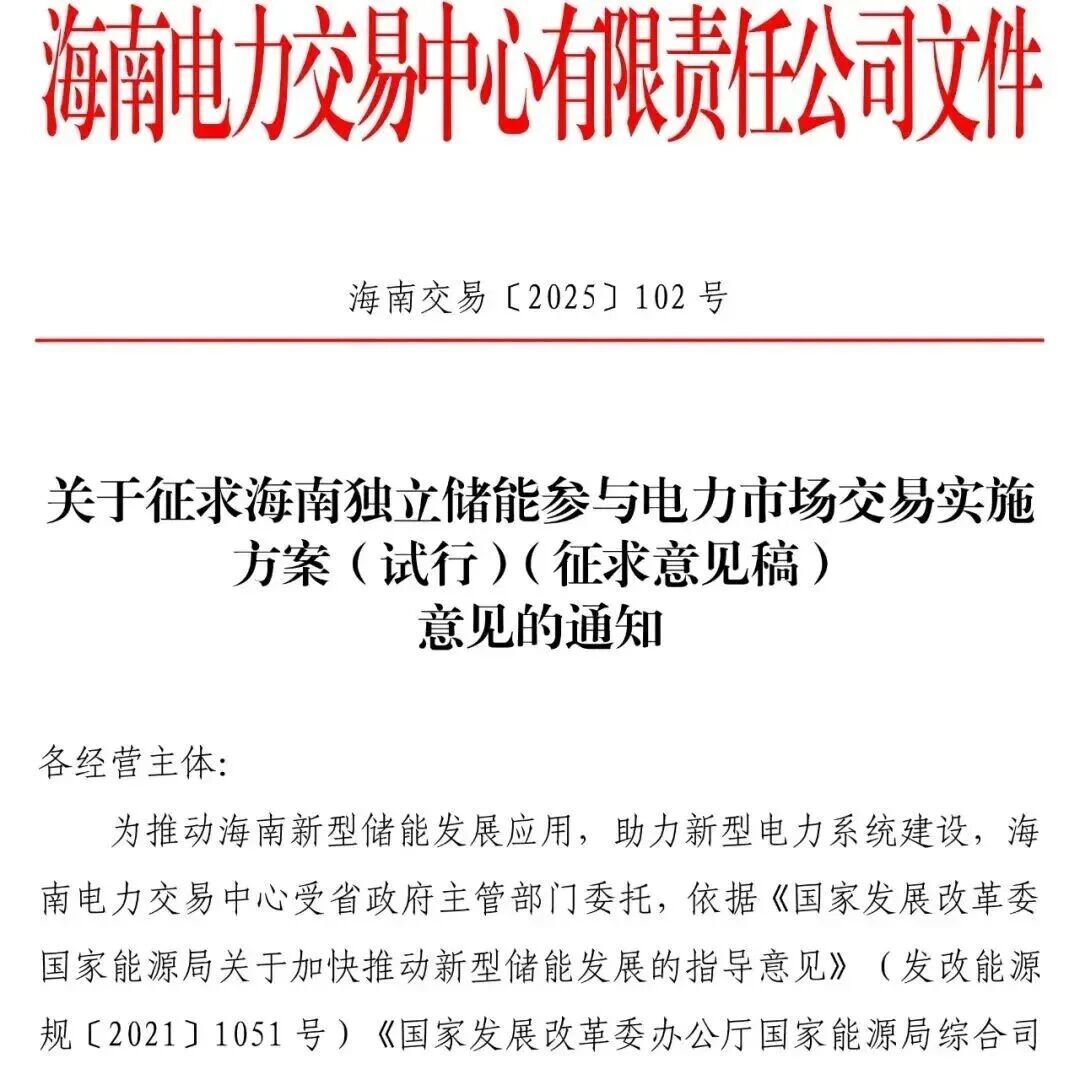
海南独立储能参与现货,纳入“两个细则”,给予充电补偿
中关村储能产业技术联盟· 2025-09-23 11:00
Core Viewpoint - The article discusses the implementation plan for independent energy storage participation in the electricity market in Hainan, aiming to promote the development of new energy storage and enhance the flexibility of the power system [10][12]. Group 1: Overall Requirements - The plan aims to accelerate the development of new energy storage in Hainan, establish a market mechanism suitable for energy storage participation, and ensure reasonable returns for energy storage while enhancing the power system's flexibility [12][10]. Group 2: Market Access and Registration - Independent energy storage must meet specific access conditions, including having an independent measurement and control system, a rated power of 5 megawatts or more, and the ability to sustain charging and discharging for at least 1 hour [16][14]. - Registration requires independent energy storage enterprises to provide basic information and technical parameters, including rated charging/discharging power and energy conversion efficiency [19][18]. Group 3: Medium and Long-term Energy Trading - Independent energy storage can participate in various trading cycles, including annual, monthly, and weekly, but is not allowed to engage in green electricity trading or grid agency purchases [21][22]. - Charging and discharging units are limited to one-way trading, with discharging units only allowed to sell and charging units only allowed to buy [22][23]. Group 4: Spot Energy Trading - Independent energy storage must declare its participation in the spot energy market through the trading system, choosing between "quantity without price" or "quantity with price" methods [27][26]. - The clearing of the day-ahead market aims to maximize social benefits, forming a planned curve and time-based pricing for independent energy storage [28][29]. Group 5: Auxiliary Service Trading - Independent energy storage can participate in the Southern Region's auxiliary service market according to relevant trading rules, with the option to choose between auxiliary service and spot market participation during the initial phase [31][33]. - Compensation for charging during peak adjustment periods will be calculated based on market clearing results or dispatch requirements [34][33]. Group 6: Trading Settlement - The energy trading fees for independent energy storage are divided into two settlement units based on charging and discharging volumes, with different settlement methods for medium-long term and spot market transactions [35][36]. - In the spot market, the energy fees are settled daily, incorporating various components such as market deviation fees and return fees [36][37].