
Mantis

Search documents
Jeffs' Brands: KeepZone AI Moving Forward with Expansion of Global Distribution Network for AI-Integrated Security Technologies
Globenewswire· 2026-01-27 21:02
Core Insights - Jeffs' Brands Ltd is pivoting into the global homeland security sector through its subsidiary KeepZone AI Inc, focusing on AI-driven solutions for security [1][7] - KeepZone is establishing a global distribution network for advanced security technologies, aiming to provide comprehensive security ecosystems to address modern threats [2][4] Strategic Collaborations - KeepZone has secured exclusive and non-exclusive agreements with various companies to enhance its technology portfolio, including: - Scanary Ltd for AI-radar systems capable of screening 25,000 people per hour [5] - Zorronet Ltd for an AI-based autonomous Security Operations Center platform [5] - RT LTA Systems Ltd for aerial intelligence systems with over 7 million operational hours [5] - Beesense Sensors Systems Ltd for multi-sensor ISR products [5] - STI Ltd for advanced under-vehicle scanners and threat detection tools [5] - Anti-Drone Systems for counter-unmanned aerial systems [5] Market Position and Growth Potential - KeepZone has transitioned to early-stage commercial traction, focusing on North America, Europe, and the Middle East, with plans to explore further opportunities as the homeland security market is expected to grow significantly through the 2030s [4][6] - The company has successfully conducted a live pilot for checkpoint-free weapon screening and received its first commercial purchase order for a counter-drone solution [5][6] Strategic Rationale for Investors - The pivot diversifies Jeffs' Brands' portfolio into a high-growth sector, leveraging collaborations to build a competitive, AI-integrated portfolio [6] - Early revenue generation and high-profile opportunities, such as the FIFA World Cup, position the company for scalable contracts, potentially driving recurring revenue and enhancing shareholder value [6]



Jeffs' Brands: KeepZone AI Enters into Non-Exclusive Reseller Agreement with Beesense Sensors Systems, Expanding Defense and Security Solutions Across Canada and Mexico
Globenewswire· 2026-01-21 12:32
Core Viewpoint - Jeffs' Brands Ltd is expanding into the global homeland security sector through its subsidiary KeepZone AI Inc, which has entered a reseller agreement with Beesense Sensors Systems Ltd to market and sell advanced multi-sensor technology solutions in Canada and Mexico [1][2][4]. Group 1: Company Overview - Jeffs' Brands is a data-driven e-commerce company that has recently pivoted into the homeland security sector, aiming to deliver comprehensive security ecosystems for critical infrastructure worldwide [5]. - The company leverages its expertise in data-driven operations to capitalize on the significant growth potential of the homeland security market [5]. Group 2: Agreement Details - The non-exclusive reseller agreement allows KeepZone to promote, market, sell, and provide support for Beesense products, including the Firefly, Mantis, and BEE series, which are designed for land, air, and maritime ISR applications [2][3]. - This collaboration is expected to enhance KeepZone's security solutions portfolio and strengthen its presence in the North American defense and security sectors [4].

上海交大团队让AI机器人拥有视觉预见力
Xin Lang Cai Jing· 2026-01-15 14:19
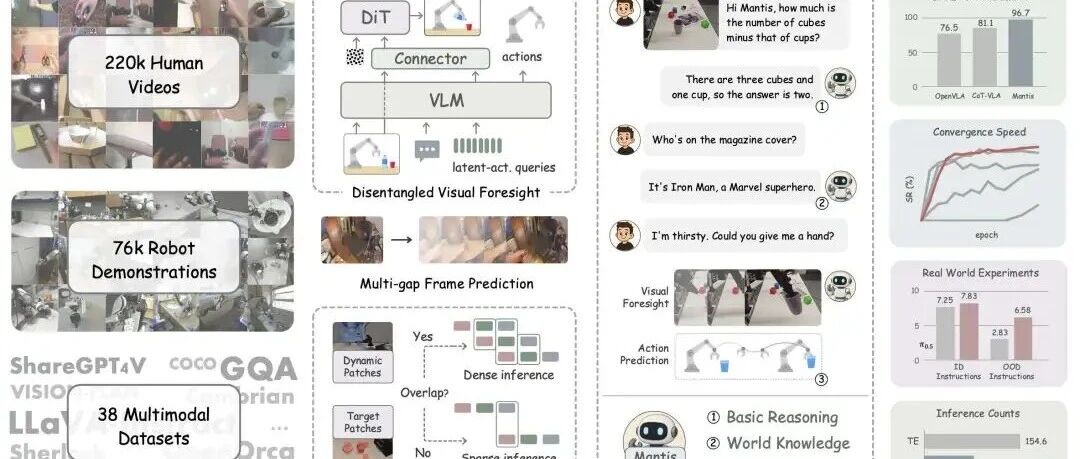
Core Viewpoint - The research conducted by a collaboration of institutions including Shanghai Jiao Tong University and Bosch has developed a new framework called Mantis, which enhances robot learning by enabling them to predict future actions, significantly improving their efficiency and performance in complex tasks [3][4][8]. Group 1: Mantis Framework - Mantis introduces a "decoupled visual foresight" capability, separating the tasks of "seeing the future" and "performing actions" to optimize each task's effectiveness [4][9]. - The framework employs a technique called "latent action queries," which helps robots identify necessary actions from current and future scenes, enhancing their learning process [4][6]. Group 2: Training Methodology - Mantis utilizes a progressive training approach, starting with observing human operation videos, then integrating real robot operation data, and finally incorporating language understanding training [5][6]. - This method allows robots to learn from simpler tasks before advancing to more complex ones, akin to how children learn [5]. Group 3: Performance Metrics - In tests on the LIBERO simulation platform, Mantis achieved a success rate of 96.7%, outperforming several advanced systems like OpenVLA and π0 [6][9]. - Mantis demonstrated a significantly faster learning speed, achieving results in a few training cycles compared to traditional methods that require many more [6][9]. Group 4: Real-World Testing - The research team conducted real-world tests across three scenarios to validate Mantis's capabilities, showing superior performance in understanding world knowledge, basic reasoning, and intent comprehension [7]. - Mantis exhibited strong generalization abilities, particularly in handling novel instructions, outperforming the leading open-source model π0.5 [7]. Group 5: Future Implications - The development of Mantis signifies a new direction in robotics, balancing operational skills with language comprehension, which is crucial for future integration into human life [8]. - The potential applications of robots with visual foresight span various sectors, including household chores, healthcare, manufacturing, and service industries, promising more precise and efficient assistance [8].


别让vision拖累VLA中的action!
具身智能之心· 2025-12-20 01:02
Core Insights - The article discusses the challenges and advancements in Visual-Language-Action (VLA) models used in robotics, particularly focusing on the limitations of existing models that rely on low-dimensional sparse action signals to supervise high-dimensional dense visual inputs, which restricts overall performance [6][9]. Research Background - VLA models have shown significant progress but still face issues due to the mismatch between action supervision signals and visual inputs, leading to underutilization of the model's representation capabilities [6]. - The introduction of a visual prediction mechanism is proposed to enhance action generation by predicting future visual states, although high-dimensional visual states often contain redundant information that complicates the training process [8]. Proposed Solutions - Decoupled Visual Forecasting (DVF) is introduced to alleviate the burden on the backbone network by automatically capturing implicit actions and enhancing explicit action generation [7]. - A progressive pre-training approach is suggested to gradually integrate different modalities, introducing language supervision to retain the understanding and reasoning capabilities of the VLA backbone [7]. - Adaptive Temporal Ensemble (ATE) is proposed to dynamically adjust the integration strength during inference, reducing computational costs while maintaining action stability [14]. Architecture Design - The DVF method incorporates implicit action queries and a separate diffusion DVF head, allowing the model to focus on frame-to-frame differences rather than predicting complete future frames [10]. - A progressive training scheme is designed to introduce visual, language, and action information in phases to avoid competition between modalities and achieve stable optimization [10]. Experimental Analysis - Mantis, the proposed model, outperforms existing baseline methods in three out of four tasks on the LIBERO benchmark, achieving the highest average success rate of 96.7% [16][18]. - The convergence speed of Mantis is significantly faster compared to traditional visual prediction methods like UnifiedVLA [20]. - Experiments demonstrate the effectiveness of language supervision in retaining the backbone's capabilities, with Mantis outperforming in both in-domain and out-of-domain instruction tasks [20]. Team Introduction - The research team, SJTU Deng Lab, focuses on generative models and large language models, collaborating with renowned institutions and maintaining a strong research output in top-tier journals and conferences [23].
LightPath (LPTH) FY Conference Transcript
2025-08-13 20:00
Summary of LightPath Technologies (LPTH) FY Conference Call - August 13, 2025 Company Overview - **Industry**: Photonics and Optics, specifically focusing on infrared and thermal imaging [2][3] - **Business Transition**: Shift from component supplier to complete camera systems provider, with a strong emphasis on defense applications [3][5] Core Points and Arguments - **Market Positioning**: LightPath is positioning itself as a leader in infrared imaging, particularly in defense, moving away from telecom and commercial markets [3][14] - **Revenue Shift**: - Defense revenue has increased from 8% to 60% of total revenue over five years, while revenue from China has decreased from 35% to less than 5% [14][17] - The U.S. now accounts for over 70% of total revenue, indicating a significant strategic pivot towards defense [17][18] - **Vertical Integration**: - LightPath has developed a unique value proposition by owning the supply of optical materials, particularly Black Diamond glass, which replaces germanium [6][7] - This vertical integration secures supply chains and differentiates LightPath's products from competitors [8][9] Product Innovations - **Black Diamond Glass**: - Developed from materials originally designed at the Naval Research Laboratories, offering significant advantages over germanium, including reduced weight, size, and cost [9][10][11] - Capable of multispectral imaging, allowing for the combination of multiple camera functions into fewer units, enhancing performance in defense applications [12][13] - **Counter UAS Market**: - LightPath has seen approximately $10 million in new orders for cameras specifically designed for counter UAS applications, highlighting a growing market opportunity [19][20] Strategic Partnerships and Contracts - **Exclusive Licensing**: LightPath holds an exclusive license for Black Diamond glass from the U.S. Navy, which includes rights for future materials [22][23] - **SPEAR Program Contract**: - A significant contract to install infrared cameras on naval vessels, expected to generate $10 million to $20 million annually over the program's lifetime [26][27] Financial Outlook - **Cash Position**: The company is currently in a strong cash position, with plans to double in size post-G5 acquisition, and does not foresee immediate cash needs [37][40] - **Capital Expenditure**: - Scaling up production for cameras requires minimal investment, estimated at $250,000 to $500,000 for doubling production capacity [52][53] - Investment in glass production may require $2 million to $3 million, but overall capital needs are manageable compared to previous models [53][54] Additional Insights - **Technological Advantages**: Black Diamond glass offers superior optomechanical performance, particularly in varying temperature conditions, which is critical for airborne systems [33][35][36] - **Cultural Fit in Acquisitions**: The acquisition of G5 was driven by a strong cultural fit and shared vision, facilitating smoother integration and collaboration [41][42] This summary encapsulates the key points discussed during the LightPath Technologies FY conference call, highlighting the company's strategic direction, product innovations, and financial outlook.

FBR (FBR) Update / Briefing Transcript
2025-08-13 01:00
Summary of FBR (FBR) Update / Briefing August 12, 2025 Company Overview - **Company**: FBR (FBR) - **Industry**: Robotics and Automation in Construction Key Highlights 1. **Reduction in Annual Burn Rate**: FBR has successfully reduced its annual burn rate to approximately $10 million to $12 million [1] 2. **Funding Arrangements**: Secured funding arrangements totaling up to $22 million, including a facility from GEM for $20 million and a recent capital raise of $1 million [2] 3. **Product Launches**: Introduction of a new product called Mantis, a large welding robot, and ongoing development of Hadrian robots [3][11] Sales and Market Developments 1. **Hadrian Robot Sales**: An MOU has been established to sell a Hadrian robot to Habitat NT for $7.8 million, targeting the construction sector in Northern Territory [4][5] 2. **Market Demand**: Increased demand for construction due to government grants and defense infrastructure projects, leading to a shortage of brick and block layers [5][6] 3. **Global Interest**: Significant inbound interest in Hadrian sales from various regions including Australia, the USA, UK, UAE, and Indonesia [7] Strategic Partnerships 1. **Collaboration with Samsung Heavy Industries**: Engaged in an engineering services agreement to automate shipbuilding processes, with phase one expected to be completed this calendar year [8][10] 2. **Focus on Automation**: Samsung Heavy Industries is looking to automate various aspects of their operations, which aligns with FBR's technology offerings [9] Product Development 1. **Mantis Features**: Mantis is designed for heavy fabrication industries, featuring an eight-meter reach and the ability to work in multiple zones simultaneously [13][14] 2. **Target Markets for Mantis**: Aimed at industries such as mining, shipbuilding, and defense, with potential applications in large-scale fabrications [12][16] 3. **Future Developments**: Plans to explore larger versions of Mantis and other applications in the steel industry [40] Financial Strategy 1. **Self-Funding Intent**: FBR aims for new product offerings like Mantis to be self-funding, utilizing existing resources and teams [28] 2. **Sales Pipeline Development**: Focus on converting leads into sales to achieve cash flow positivity, with a strong emphasis on sustainable growth [41][45] 3. **Funding for Expansion**: Plans to use existing funding arrangements to support the commissioning of additional Hadrian robots and development projects [37] Market Positioning 1. **Target Market for Hadrian**: FBR is targeting a range of builders, from small to large, to address the housing crisis in Australia and globally [23][25] 2. **Wall as a Service Model**: Exploring a service model where Hadrian robots are contracted out rather than sold, particularly appealing to mid-sized builders [25][27] Challenges and Risks 1. **Sales Cycle**: The lengthy sales cycle for capital equipment like Hadrian robots may delay cash flow positivity [44] 2. **Dependence on Third Parties**: Future phases of projects and sales are contingent on third-party decisions and market conditions [30][56] Conclusion FBR is strategically positioned to capitalize on the growing demand for automation in construction through innovative products like Hadrian and Mantis, while navigating funding and market challenges to achieve sustainable growth and profitability.
FBR (FBR) Earnings Call Presentation
2025-08-05 22:00
Financial Highlights - FBR secured an A$20 million Share Subscription Facility from GEM Global Yield (GGY)[4, 16] - Peak Asset Management was appointed as corporate advisor[4] - The company aims to reduce its annual burn rate from approximately A$35 million to around A$10 million in FY26[4] - GGY to be granted 450 million options exercisable at $0.01 with a three year term[16] Operational Milestones - Near-term catalysts include the commissioning and sale of H04 to Habitat NT and the delivery of Phase 1 with Samsung Heavy Industries[4] - FBR intends to supply Habitat with 'H04', with commissioning expected to be complete in H2 CY2025[30] - Initial purchase order for one Hadrian X unit at A$7.8 million, with a deposit of A$780,000 paid to FBR[31] - FBR executed an Engineering Service Agreement with Samsung Heavy Industries (SHI) to deliver the first phase of a shipbuilding automation project, and 10-year exclusive dealing relationship for Phase 1 deliverables, FBR will be paid US$150,000 plus expenses for Phase 1[33] Market Position and Technology - FBR's market capitalization was A$34.4 million as of July 31, 2025[10] - HSBC Custody Nominees (Australia) Limited holds 20.11% of the units, representing 1,144,193,237 units[13] - The commercial model for Mantis will be direct machine sales, including through distribution and referral partners, with the base model being offered at A$990,000[36]