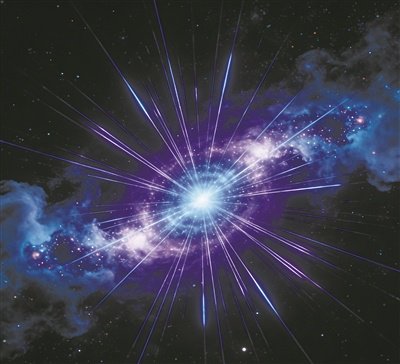
MeerKAT射电望远镜阵列

Search documents
最明亮最遥远的微波激射现象发现信号源自距地球约80亿光年星系
Xin Lang Cai Jing· 2026-02-24 23:26
Core Viewpoint - Astronomers have observed the brightest and most distant instance of a phenomenon known as microwave maser, originating from a galaxy approximately 8 billion light-years away, identified as H1429-0028, resulting from the collision and merger of two galaxies [3][4]. Group 1: Discovery and Mechanism - The microwave maser phenomenon is generated similarly to lasers, where specific materials, such as hydroxyl ions, are excited to high energy states and release photons of the same frequency when triggered by incoming photons, forming a coherent light beam [3]. - During the galaxy merger, a significant amount of interstellar gas is compressed, triggering new star formation and releasing intense radiation, which excites hydroxyl ions to high energy levels [3][4]. Group 2: Observational Techniques - The observation was conducted by a team from the University of Pretoria using the MeerKAT radio telescope array, which consists of 64 interconnected radio telescopes that capture faint cosmic signals [4]. - The team detected an exceptionally strong emission signal at a frequency of 1667 MHz, clearly indicating the microwave maser process [4]. Group 3: Significance and Future Prospects - The intensity of the discovered microwave maser is a new record, with a brightness approximately 100,000 times that of the total luminosity of the Sun, and the energy is highly concentrated in a narrow microwave frequency band [4]. - This phenomenon may exceed previously observed "giant masers" in nearby galaxies and could be classified as a new type of "giant maser," indicating that such phenomena require extreme environments like galaxy mergers to occur [4]. - The development of next-generation sensitive radio telescopes, such as the Square Kilometer Array in South Africa, is expected to enable astronomers to discover more similar microwave maser phenomena in the deeper universe, providing critical insights into the physical conditions of galaxy formation and mergers [4].