Modular Construction

Search documents
Can FIX's Backlog and Data Center Demand Fuel Growth in 2026?
ZACKS· 2026-03-05 15:51
Core Insights - Comfort Systems USA (FIX) is entering 2026 with a strong backlog and growth profile, driven by technology infrastructure projects and modular expansion [1][3][5] Backlog and Revenue Visibility - Comfort Systems exited 2025 with a record backlog of approximately $11.9 billion, representing a 99% year-over-year increase and nearly double the prior year's level on a same-store basis [3][11] - The backlog consists of legally binding commitments tied to ongoing projects, enhancing revenue visibility into 2026 and beyond [4][11] Technology Infrastructure Focus - Technology-related projects, particularly data centers, accounted for 45% of 2025 revenue, with industrial markets making up 67% of total revenue [5][11] - Continued strength in technology bookings and a robust pipeline for larger modular and data center projects extend into 2027 and 2028, stabilizing multi-year revenue cadence [6] Modular Construction Growth - Modular construction contributed 18% of 2025 revenue and is a significant driver of backlog growth [8][11] - The company plans to expand modular capacity from approximately 3 million to 4 million square feet by the end of 2026, with investments in Texas and North Carolina [8] Profitability and Cash Flow - The gross margin improved from 21% in 2024 to 24.1% in 2025, with fourth-quarter gross margin rising to 25.5% [12] - Operating cash flow reached $1.19 billion in 2025, and free cash flow was $1.04 billion, supporting reinvestment and shareholder returns [13] Shareholder Returns and Capital Deployment - The quarterly dividend was increased to 70 cents per share, and over $200 million of stock was repurchased in 2025 [14] - Management emphasized buybacks, mergers and acquisitions, and rising dividends as core strategies for 2026, supported by a strong balance sheet [14] 2026 Growth Outlook - Management anticipates 2026 growth to be front-half weighted, with same-store revenue growth expected to moderate to the mid- to high-teens range [15] - A portion of fourth-quarter 2025 modular bookings is expected to be executed primarily in 2027, which may affect near-term growth optics [16]



麦肯锡:到2040年,最具盈利前景的18个行业……
Sou Hu Cai Jing· 2025-04-01 03:08
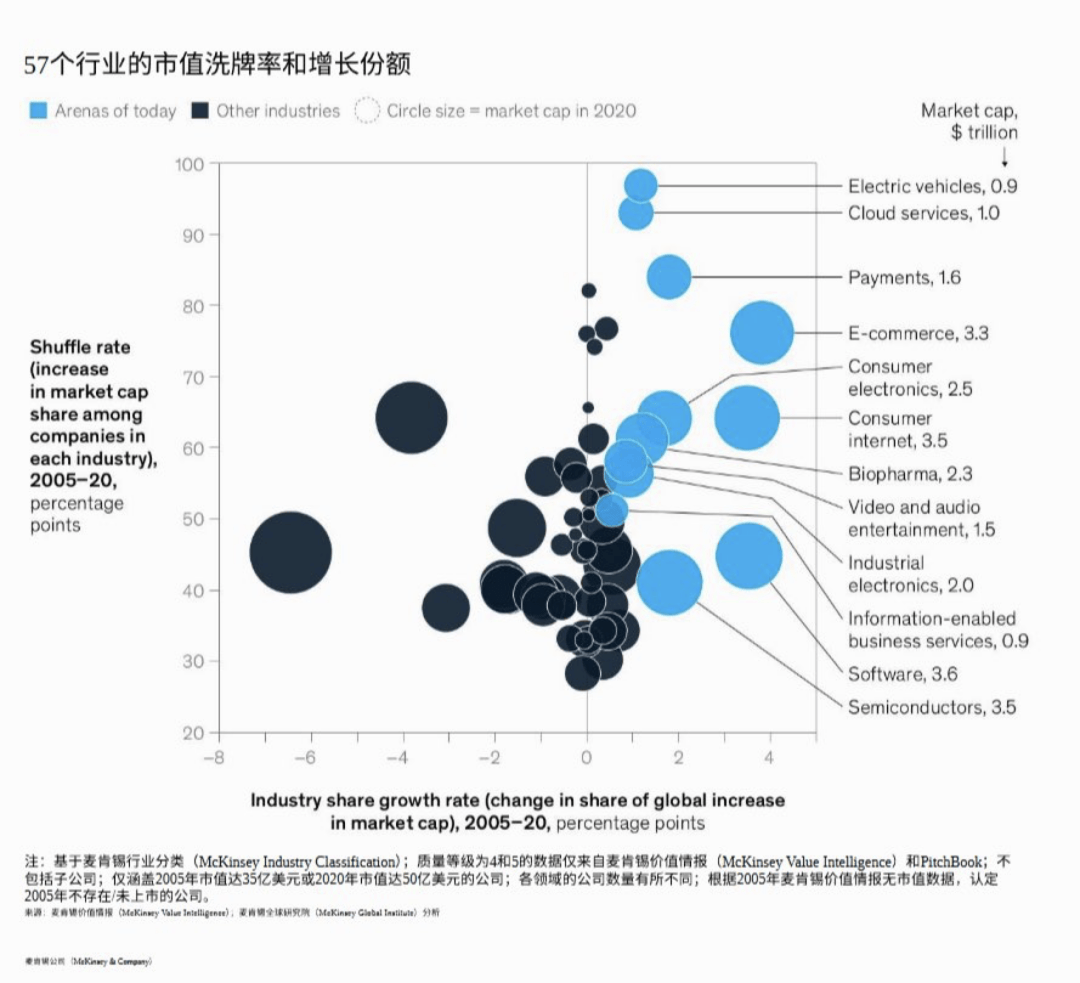
Core Insights - The future 15 years are critical for determining the new global economic order [3] - Growth will be highly concentrated in a few "arena" industries rather than being evenly distributed [4] - The top 12 performing sectors from 2005 to 2020 accounted for half of global economic profits by 2020, leading to the emergence of numerous companies with market capitalizations exceeding $50 billion [4] Group 1: Key Drivers of "Arenas" - "Arenas" are defined as dynamic ecosystems characterized by high growth and high vitality, driven by technological breakthroughs, investment upgrades, and market expansion [7] - The rise of these "super tracks" is fueled by three deep-seated forces: 1. Technological and business model transformations, such as cloud computing, AI, and autonomous driving, fundamentally reshape products and services [8] 2. Gradual investment opportunities that yield significant returns and sustained competitive advantages through technological upgrades and data accumulation [9] 3. Massive or emerging market demands driven by global digitalization and energy transitions [10] Group 2: Competitive Landscape - The coupling of these three forces creates a positive feedback mechanism, leading to an "upgrading competition model" where companies must continuously invest to avoid obsolescence [11] - The report identifies 18 key arenas poised for growth, including: 1. E-commerce, projected to reach a retail market penetration of 27% to 38% by 2040, up from approximately 20% [15] 2. Electric vehicles, expected to account for over 50% of global passenger car sales by 2040 [17] 3. Cloud services, with a compound annual growth rate of 17% from 2005 to 2020 [19] 4. Semiconductors, anticipated to grow at 6%-8% annually over the next decade [21] 5. AI software and services, among others [23] Group 3: Emerging Sectors - The report highlights additional sectors such as digital advertising, streaming video, shared autonomous vehicles, and the space economy, all of which are experiencing significant growth [25][27][29][31] - Cybersecurity is increasingly viewed as a strategic investment area due to the rising costs associated with cyberattacks [33] - The battery market is projected to see electric vehicles dominate with an 80% share by 2040, driven by advancements in battery technology [35] - The gaming industry is expected to see 40% of the global population as gamers by 2030, indicating a shift towards content industrialization and social immersion [36] Group 4: Strategic Implications - The key insight from McKinsey's report is that future competitiveness will depend on the structure of these arenas rather than traditional industry labels [47] - For entrepreneurs, the challenge lies in entering the right arena and building a compounding mechanism [47] - Investors should shift their decision-making logic from selecting companies to betting on arena structures [47] - Policymakers and developers must focus on creating ecosystems that can nurture future arenas, which is becoming a more valuable strategic task than mere investment attraction [47]