
National Savings Certificates

Search documents
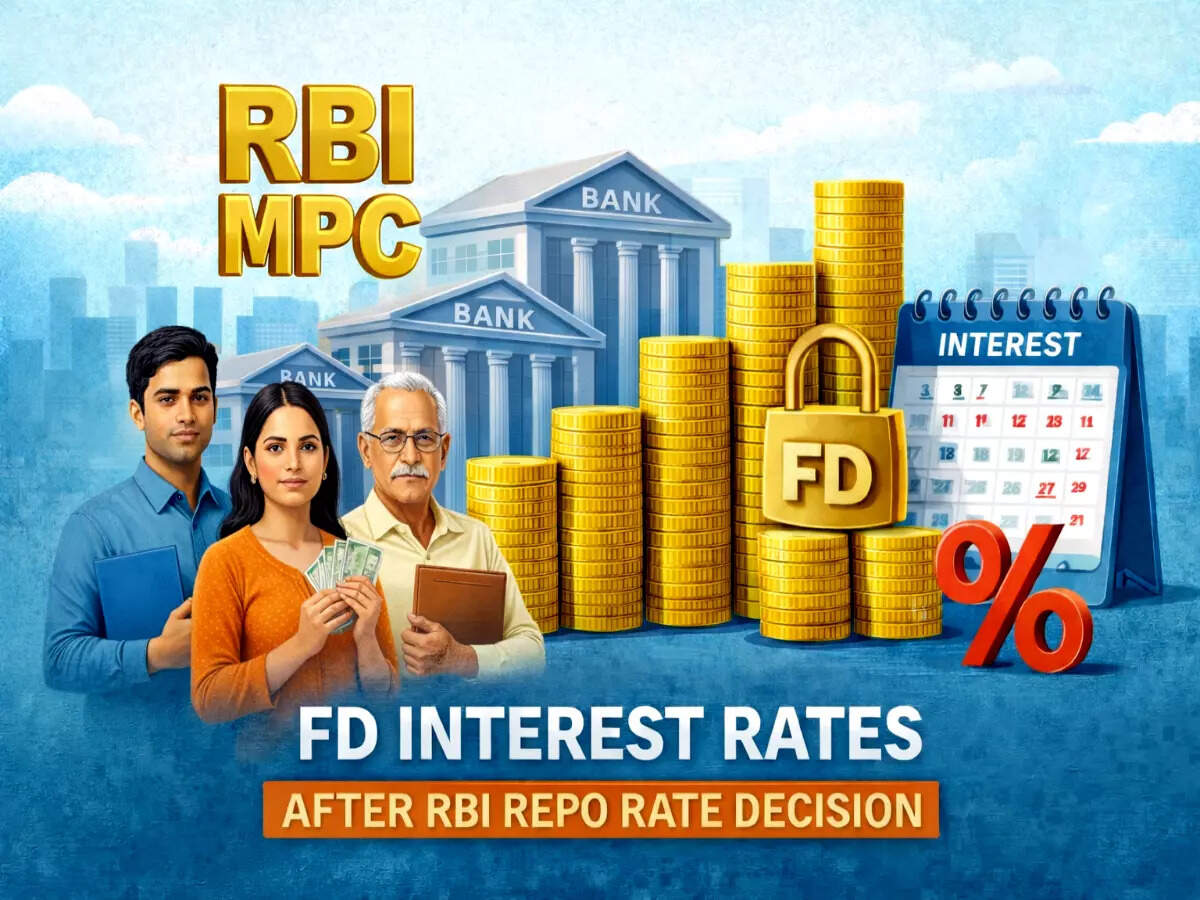
FD investors breathe easy as RBI pauses rates; how to lock in your investments for better returns
The Economic Times· 2026-02-06 04:33
Core Viewpoint - The Reserve Bank of India (RBI) has decided to maintain the repo rate at 5.25%, which is expected to keep fixed deposit (FD) interest rates stable, following a previous cut of 125 basis points in 2025 [1][4][27]. Monetary Policy and Repo Rate - The RBI did not cut the repo rate this time due to controlled inflation, higher rates offered by small savings schemes, and a stable 10-year government security bond yield around 6.651% [4][27]. - Future repo rate cuts are possible if inflation, competitive interest rates, and the bond yield change [5][27]. Fixed Deposit Interest Rates - Public sector banks are currently offering a maximum FD rate of 7%, private sector banks are offering up to 7.20%, and small finance banks (SFBs) are offering the highest rate of 7.90% [11][27]. - The transmission of previous repo rate cuts is not yet complete, and some banks may still lower FD rates [2][27]. Investment Schemes - The RBI's floating rate bond offers an interest rate of 8.05%, while various small savings schemes provide rates over 7%, including the Senior Citizen Savings Scheme and the Sukanya Samriddhi Account [13][14][27]. Factors Influencing FD Rates - FD rates are influenced by the demand and supply of money, RBI policy rates, liquidity, credit demand, inflation expectations, and competition among banks and non-banking financial companies (NBFCs) [16][17][18]. - Higher inflation typically leads to increased FD rates as savers demand higher returns, while lower inflation can result in rate cuts [19][20]. Investor Guidance - Conservative investors are advised to ladder FDs and prioritize capital protection, while moderate investors may consider adding equities and short-duration bonds [28]. - In the event of falling FD rates, investors should avoid panic withdrawals and focus on credible banks under RBI oversight [25][28].

Security vs Growth: CA Nitin Kaushik shares PM Modi's assets to highlight the trap most Indians blindly follow while investing
The Economic Times· 2025-09-23 09:08
Core Insights - Prime Minister Modi's declared assets as of March 31, 2025, total ₹3.43 crore, primarily in fixed deposits, indicating a preference for security over growth [1][3] - A Chartered Accountant warns that following Modi's investment strategy could lead to wealth stagnation, emphasizing the importance of aggressive investment for wealth growth [2][3] - The CA advises diversifying investments between fixed deposits for security and equities or systematic investment plans (SIPs) for growth, highlighting the detrimental effects of inflation on idle money [3] Summary by Categories Assets Declaration - PM Modi's assets include ₹3.26 crore in fixed deposits with the State Bank of India, ₹9.74 lakh in National Savings Certificates and post office deposits, and ₹3.1 lakh in gold rings, with no investments in equities, mutual funds, bonds, or real estate [1][3] Investment Mindset - The CA critiques the mindset reflected in Modi's asset allocation, suggesting that prioritizing safety over growth can lead to stagnation in personal wealth [2][3] - The CA emphasizes that the difference between earning 6.5% versus 12-15% over a decade can significantly impact wealth accumulation, potentially doubling it [2] Investment Strategy Recommendations - The CA recommends not waiting for perfect timing or risk-free options and suggests splitting investments between fixed deposits for security and equities or SIPs for growth [3] - The CA warns that inflation can erode the value of money kept idle in banks, even if perceived as "safe" [3]
