PGE (Platinum Group Elements)

Search documents
Azimut and KGHM Expand the High-Grade Nickel-PGE Perseus Zone, Kukamas Property, James Bay Region, Quebec
Globenewswire· 2026-02-26 11:30
Core Viewpoint - Azimut Exploration Inc. has announced positive results from its 2025 diamond drilling program on the Kukamas Property, indicating significant nickel and platinum group element (PGE) mineralization, which enhances the property's exploration potential [2][3]. Drilling Program Results - The 2025 drilling program included 14 holes totaling 3,803.8 meters, aimed at expanding nickel-PGE sulphide mineralization in the Perseus Zone and testing new targets along a 1.6-kilometer komatiite trend [4]. - Notable drilling highlights include: - Hole KUK25-010: 1.41% Ni, 0.85 g/t PGE over 15.25 m [6] - Hole KUK25-012: 1.77% Ni, 1.04 g/t PGE over 7.5 m [6] - Hole KUK25-013: 4.27% Ni, 2.63 g/t PGE over 8.6 m [6] Property and Joint Venture Details - KGHM International Ltd has acquired a 50% interest in the Kukamas Property and has opted to enter a second phase to earn an additional 20% interest through further funding [3][18]. - The Kukamas Property spans 41 kilometers with a total area of 337.8 square kilometers, benefiting from significant infrastructure [12]. Geological Context - The Perseus Main Zone is characterized by high nickel content and is defined over a strike extent of 135 meters and a vertical depth of 100 meters [7]. - The geological context suggests substantial exploration potential for additional mineralized zones, with similarities to Kambalda-type deposits known for high-grade nickel [10][11]. Future Plans - A 2026 work program is being prepared, with details to be announced soon, indicating ongoing exploration efforts [3].
Azimut Advances Major Fortin Antimony-Gold Zone, Wabamisk Property, James Bay Region, Québec
Globenewswire· 2026-01-21 05:01
Core Viewpoint - Azimut Exploration Inc. has initiated a new diamond drilling program of at least 5,000 meters on the Fortin antimony-gold zone, which is evolving into one of Canada's largest antimony-bearing mineralized systems, with significant exploration and metallurgical testing underway [2][3][4]. Drilling Program - The new drilling program aims to explore the Fortin Zone at depth for potential gold enrichment related to antimony-gold vertical zonation, with a preliminary 3D modeling of the mineralized body in progress [4]. - A total of 86 holes have been drilled on the Fortin Zone and surrounding targets since its discovery in 2024, with 35 holes (5,890 meters) drilled in the second phase, showing promising results [3][7]. Assay Results - In the second phase, 29 holes (83%) returned antimony mineralization with grades above 0.2% Sb, including 19 holes with gold grades above 0.5 g/t Au [7]. - Notable assay results include: - Hole WS25-74: 0.24% Sb over 23.5 m, including 1.33% Sb over 2.05 m [7] - Hole WS25-67: 0.89% Sb, 0.65 g/t Au over 41.9 m, including 1.05% Sb, 1.88 g/t Au over 13.5 m [9]. Metallurgical Tests and Market Studies - SGS Canada has been commissioned to conduct initial metallurgical tests on the mineralized material from the Fortin Zone and assess global market demand for antimony products [5][18]. Geological Context - The Fortin Zone is associated with a massive albitic stratiform hydrothermal alteration zone, with evidence of strong albitic alteration and a multi-kilometre lateral continuity suggesting a significant vertical extent [13][14]. - Antimony-rich systems are rare in Archean settings in Québec, and the mineralized zone may transition to a deeper gold-rich zone, highlighting its geological significance [16]. Strategic Importance - Antimony is recognized as a critical mineral by various governments, with significant supply shortages impacting its market. The price volatility and supply chain concerns emphasize the importance of diversifying sources outside of China, which dominates global production [18]. - The Wabamisk Property, covering 356 km², is strategically located in a prospective belt in the James Bay region, enhancing its exploration potential for both antimony and gold [19][20].

Class 1 Nickel Commences 2025 Exploration Program at the River Valley PGE-Cu-Ni Project, Ontario, Canada
Globenewswire· 2025-07-09 11:30
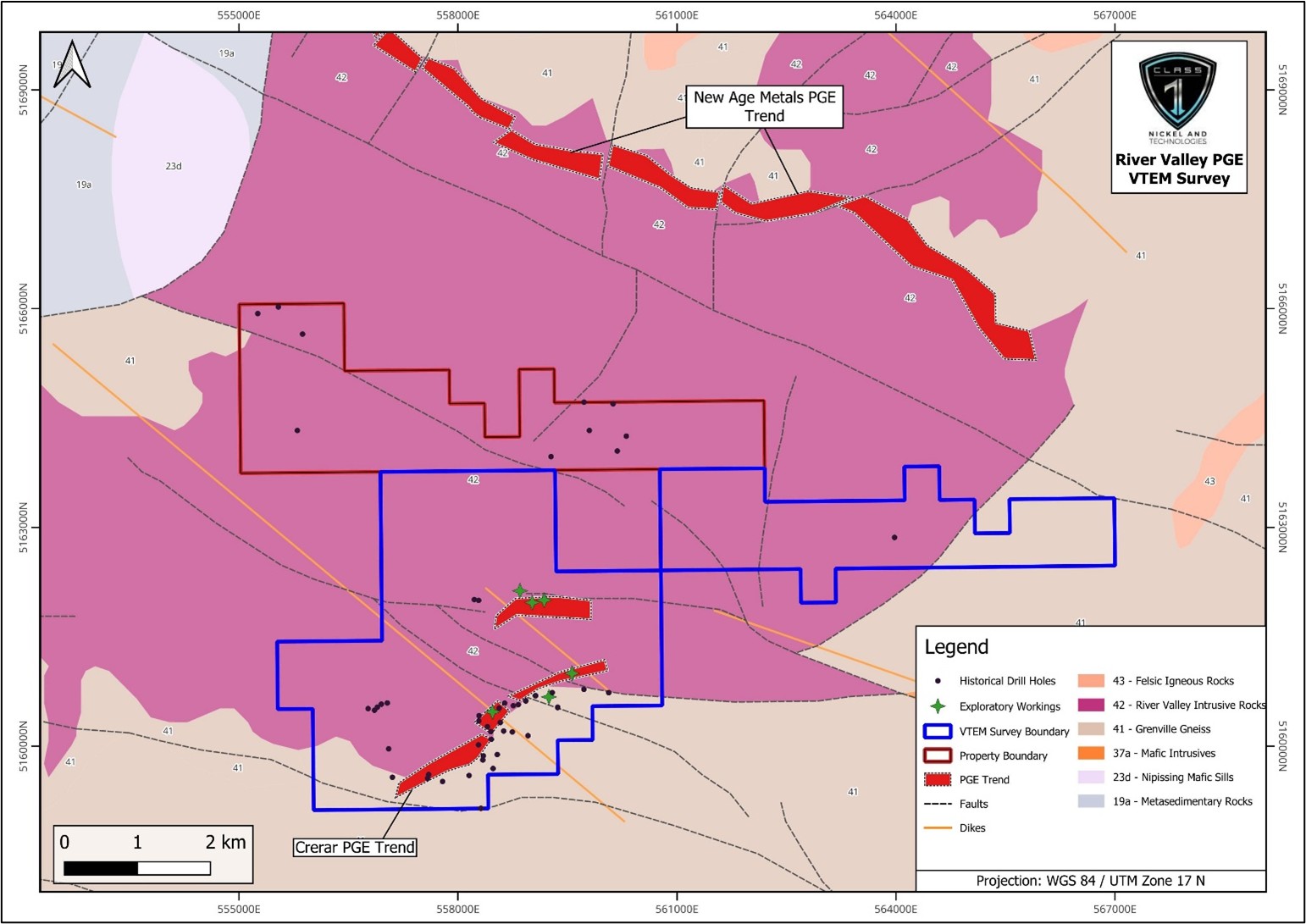
Core Viewpoint - Class 1 Nickel and Technologies Limited has launched its 2025 summer exploration program at the River Valley PGE-Cu-Ni Project, which is expected to enhance its portfolio focused on critical minerals such as PGE, copper, and nickel [1][4]. Group 1: Exploration Program Details - The 2025 field exploration program will focus on geological mapping, sampling, and ground-truthing of targets identified from a recent 254 line-kilometer VTEM™ Plus survey [2][10]. - The exploration will include detailed examination of known sulphide occurrences and will report results as they become available [2][10]. - The program aims to validate geophysical targets developed from the VTEM™ Plus survey, particularly along the Crerar PGE Trend [3][10]. Group 2: Project Overview - The River Valley PGE-Cu-Ni Project spans approximately 2,916 hectares and is located about 65 kilometers northeast of Sudbury, Ontario, featuring known PGE-bearing sulphide mineralization [1][4]. - The project is underlain by gabbroic to anorthositic rocks of the Paleoproterozoic River Valley Intrusion, with a focus on targeting productive Marginal and Inclusion-Bearing zones [4][14]. - The project is strategically positioned near the advanced River Valley Palladium Project being developed by New Age Metals Inc., providing additional exploration upside [1][4]. Group 3: Geophysical Survey Insights - A helicopter-borne VTEM™ Plus survey was conducted in March 2025, acquiring approximately 254 line-kilometers of geophysical data [7]. - The survey utilized advanced geophysical sensors, including a versatile time domain electromagnetic system and a horizontal magnetic gradiometer [7]. - The results from the survey will inform the summer exploration program, which includes geophysical ground-truthing and mapping [10][11].
Metalsource provides update on exploration at Aruba
Globenewswire· 2025-05-01 12:00
Core Insights - Metalsource Mining Inc. is advancing its exploration program at the Aruba Property, focusing on soil sampling and ground gravity surveys to identify drill targets for manganese mineralization [1][2][3] Group 1: Exploration Program - The exploration program includes soil sampling and a gravity survey aimed at delineating geophysical signatures in the Transvaal Supergroup, which is known for manganese deposits [1][2] - Soil samples have been collected from the Kanye Basin portion of the Transvaal Supergroup and are being analyzed using portable XRF and prepared for ICP analysis [2] - The gravity survey, combined with soil sample data, will inform the upcoming drill campaign [2] Group 2: Project Overview - The Aruba Project encompasses five prospecting licenses covering approximately 4,663 km in South-Central Botswana, underlain by the Kanye Basin [4] - The Transvaal Supergroup in this region contains 40% of the world's manganese reserves, with mineralization primarily found in the Black Reef Formation [4] - The project area is strategically located between Jwaneng and Werda, near the South African border, and is adjacent to Rio Tinto Exploration [5] Group 3: Company Leadership and Vision - CEO Joseph Cullen expressed enthusiasm about initiating exploration, highlighting the team's commitment to expanding knowledge and preparing for drilling [3] - The company aims to locate and develop economic precious and base metal properties, with ongoing exploration efforts on the Old Timer Property in British Columbia [7]