
Power Batteries

Search documents
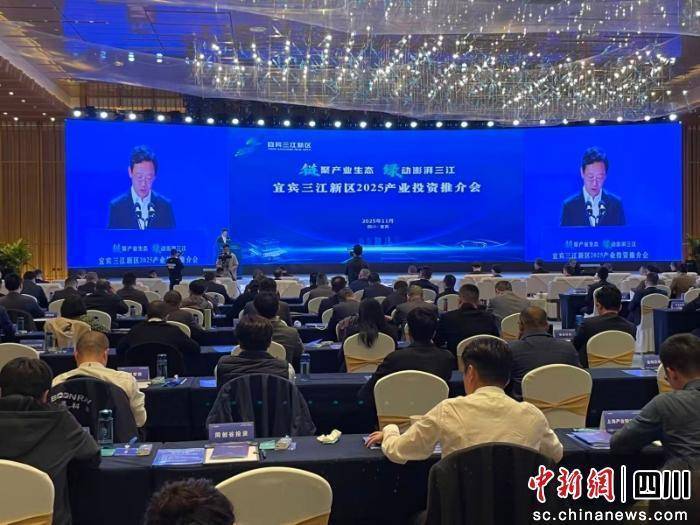
引资247亿元 宜宾三江新区产业投资推介会举行
Sou Hu Cai Jing· 2025-11-13 05:59
Core Insights - The 2025 Yibin Sanjiang New Area Industrial Investment Promotion Conference was held, resulting in the signing of 84 projects with a total investment of 24.738 billion yuan, covering various sectors including new energy and new materials [1][3] Group 1: Investment Opportunities - The event attracted participation from 100 well-known enterprises and 18 fund institutions, including Zhejiang Soft Control Intelligent Technology Co., Ltd. and Contemporary Amperex Technology Co., Ltd. [3] - A fund matrix opportunity list was released, aiming to create an investment development fund matrix with a total scale exceeding 26.55 billion yuan [3] - The conference also unveiled a list of 47 quality cooperation projects from state-owned enterprises, with a total investment exceeding 12 billion yuan, and provided 960,000 square meters of mature industrial space [3] Group 2: Economic Development - Yibin Sanjiang New Area is positioned as a core engine for Yibin's development, seizing major opportunities from the Chengdu-Chongqing economic circle and technological revolutions [5] - The core area of the New Area ranks 26th among 230 national-level economic development zones and has been recognized as the top in Western China for two consecutive years [5] - The GDP of the New Area has consistently increased, crossing five hundred billion yuan milestones over the past five years, with a projected GDP of over 60 billion yuan in 2024 [5][6] Group 3: Industrial Focus - The New Area is focusing on the "one blue and one green" industrial track, establishing a modern industrial system led by advanced manufacturing sectors such as power batteries, smart terminals, and high-end equipment [6] - The power battery industry cluster is becoming globally competitive, with Yibin being recognized as the "Power Battery Capital" [6] - Future plans include promoting the transformation of leading industries towards high-end, intelligent, and green directions, leveraging digital economy and green energy resources [6]

中国股票策略:反内卷行动的潜在市场反应-2015 - 16 年供给侧改革的经验借鉴-China Equity Strategy_ Potential market reaction to anti-involution drive_ Lessons from 2015-16 supply-side reform
2025-07-25 07:15
Summary of Key Points from the Conference Call Industry Overview - The focus is on the **Chinese market**, particularly the **new energy vehicles (NEV)**, **solar**, **coal**, and **cement** sectors, in the context of the **anti-involution initiative** aimed at reducing unhealthy competition and improving corporate profitability [2][3][7]. Core Insights and Arguments 1. **Anti-Involution Initiative**: - The initiative is gaining momentum, with calls for industries to self-regulate to avoid damaging competition. This is expected to improve supply-demand dynamics, drive price recovery, and enhance corporate profitability [2][3]. - China's Producer Price Index (PPI) fell by **2.8% YoY** in the first half of 2025, marking the **33rd consecutive month** of declines, alongside a **9.1% YoY drop** in industrial profit in May [2][12][14]. 2. **Market Reactions**: - Historical parallels are drawn to the **2015-16 supply-side reform**, which led to price increases in materials and a re-rating of relevant sectors. Sectors addressing unhealthy competition, such as solar and power batteries, have recently rebounded [3][4][21]. - Stock prices initially reacted positively to new policies during the supply-side reform, providing excess returns relative to the broader market for **1-2 months** [4]. 3. **Commodity Price Correlation**: - Stock prices initially moved in tandem with commodity prices and production changes, but later decoupled. Significant price increases for relevant commodities occurred during two periods in 2015-16 [5][26]. 4. **Corporate Profitability**: - The coal sector's profitability improved significantly in the second half of 2016, with nearly **90% of capacity** turning profitable by the end of Q3 2016, compared to **8%** in November 2015 [6][31]. 5. **Differences from Previous Reforms**: - The anti-involution push is expected to have a smoother and longer-lasting impact on stock prices compared to the supply-side reform, focusing more on downstream industries where non-state-owned enterprises (non-SOEs) are prevalent [7][9]. Indicators for Investors - Investors should monitor: - Specific capacity controls and recovery in product prices (e.g., polysilicon prices) - Capacity utilization rates in relevant businesses - Rebound in PPI - Indicators such as industrial profit growth and the proportion of profitable businesses, which may lag behind stock price movements [10][36]. Additional Important Insights - The report emphasizes the need for clearer guidelines and stronger support for domestic demand as the anti-involution initiative progresses [10]. - The potential risks facing China's equities include a hard landing in the property market and slow structural reform progress, which could shock the market if not adequately addressed [38]. This summary encapsulates the key points discussed in the conference call, providing a comprehensive overview of the current state and future outlook of the relevant industries in China.