
Property Management Service

Search documents
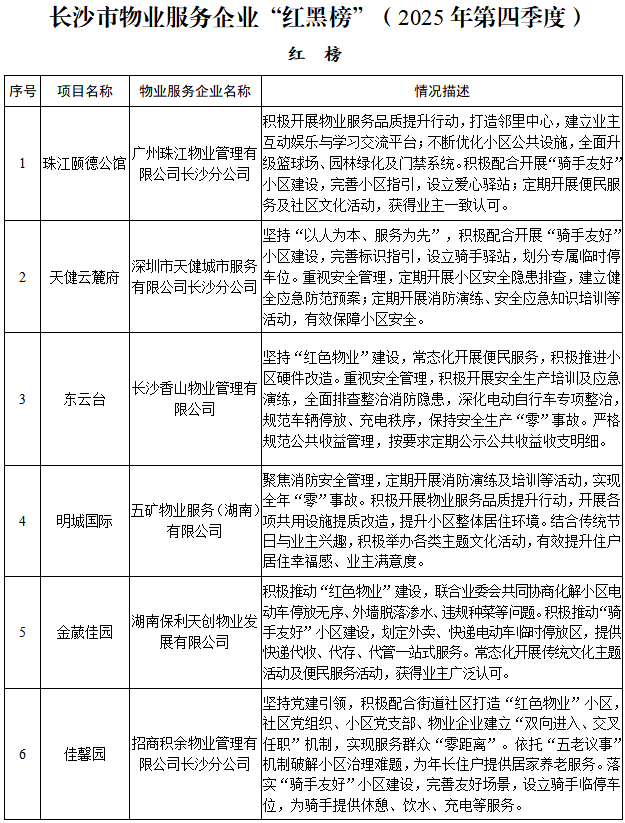
长沙发布2025年第四季度物业“红黑榜” 19家企业登“红榜”6家进“黑榜”
Chang Sha Wan Bao· 2026-02-12 13:32
Core Points - The Changsha Municipal Housing and Urban-Rural Development Bureau and the Changsha Spiritual Civilization Construction Office released the "Red and Black List" of property service companies for the fourth quarter of 2025, highlighting 19 companies on the "Red List" for outstanding service and 6 companies on the "Black List" for significant issues [1][5]. Group 1: Red List Companies - 19 property service companies were recognized for their exemplary service, including projects like Zhujiang Yide Mansion and Tianjian Yunlu Mansion, which implemented quality improvement actions and community engagement initiatives [2][3]. - Guangzhou Zhujiang Property Management Co., Ltd. received praise for enhancing service quality and community facilities, while Changsha Xiangshan Property Management Co., Ltd. focused on "red property" construction and public revenue management [2][3]. - Other notable projects include Jiexin Garden and Longhu Spring River Tianxi, which established collaborative governance mechanisms and improved safety management [8]. Group 2: Key Regulatory Oversight - 14 companies were placed under "key regulatory" supervision due to repeated complaints and unresolved issues, with increased inspection frequency planned [4][10]. - Major concerns included fire safety hazards, with specific issues reported at Sunshine International New City and Tianluo Shangceng, such as malfunctioning fire alarm systems and inadequate emergency measures [4][10]. - Companies like Rongcheng Huayuan faced scrutiny for employee wage issues and poor environmental management, while others like Xinhua Dream City had irregularities in public revenue management [4][10]. Group 3: Black List Companies - 6 companies were listed on the "Black List" due to severe problems and non-compliance with rectification measures, resulting in disqualification from annual industry awards [5][12]. - Notable issues included the absence of fire safety measures at Aiwan Garden and severe operational failures at Shuguang Bohan, including non-functional fire systems and blocked emergency exits [5][12]. - Companies like Green Central Garden faced legal challenges for failing to fulfill contractual obligations after a change in service providers, impacting community operations [5][12].

中国物业管理-2026 年展望:回归基本面以增强增长,自由现金流可见性提升-China Property Management_ 2026 Outlook_ Back to basics to enhance growth_FCF visibility
2025-12-15 01:55
Summary of China Property Management Conference Call Industry Overview - The conference call focused on the **China Property Management (PM)** industry, discussing the outlook for 2026 and beyond, emphasizing the stabilization and potential improvement of PM fundamentals despite challenging macroeconomic conditions and a downturn in the housing market [1][2]. Key Points 1. Market Outlook and Growth Drivers - **Stabilization of PM Fundamentals**: The PM industry is expected to stabilize and improve due to: - Reduced reliance on related developers, with their contribution to new business projected to decrease from 40% in 2024 to 15% during 2026E-2028E [1]. - A focus on upgrading the quality of managed portfolios to enhance profitability and cash collection [1]. - Restructuring of value-added service (VAS) businesses to focus on core community needs, stabilizing their contribution to total revenues at around 10% [1]. - Improved cash collection from better portfolio quality, leading to enhanced free cash flow (FCF) generation [1]. 2. Financial Projections - **Earnings Forecasts**: The average EPS growth is projected at +7% year-over-year for 2028E, indicating an 8% compound annual growth rate (CAGR) from 2026E to 2028E, compared to an average of 0% from 2023 to 2025E [2]. - **Free Cash Flow and Dividends**: An average FCF yield of 13% and a dividend yield of 6% are expected, with aggregate FCF for the sector in 2026E projected to exceed historical peaks [2]. - **Target Prices**: Target prices for PM companies have been adjusted to reflect a range of -15% to +40%, with an average target price implying an 11X P/E ratio for 2026E [2]. 3. Market Share and Project Acquisition - **Focus on High-Tier Cities**: The PM industry is narrowing its focus to approximately 50 cities, primarily Tier-1 and Tier-2 cities, where new home sales are stabilizing at sustainable levels [24]. - **New Project Opportunities**: There are significant opportunities in high-tier cities, with an estimated annual contract value of Rmb25 billion from new home sales and high-quality non-residential projects [12][24]. 4. Value-Added Services (VAS) - **Restructuring of VAS**: The 2C VAS segment is stabilizing, with a focus on asset-light services that cater to residents' core needs, expected to contribute around 10% to overall PM revenue [43][48]. - **Decline in 2B VAS**: The 2B VAS segment has seen a decline, particularly among privately-owned enterprises (POEs), but its impact on overall revenue is diminishing as its contribution shrinks [45][48]. 5. Project Termination Rates - **Stabilization of Termination Rates**: The project termination rate is stabilizing at about 3%-4%, which includes both voluntary and involuntary exits [25][40]. This is a positive sign for portfolio optimization efforts among PM companies. 6. Profitability and Fee Structures - **GPM Stabilization**: The gross profit margin (GPM) is expected to stabilize due to better-structured PM fees and portfolio quality, despite previous downward pressures from macroeconomic factors and government regulations [55][56]. - **Long-Term Fee Growth Potential**: There is potential for PM fees to increase as the housing stock ages, with households expected to allocate more budget towards property management services for enhanced living experiences [58][68]. Conclusion - The China PM industry is poised for stabilization and growth, driven by strategic shifts towards high-quality project acquisitions, improved cash flow management, and a focus on core service offerings. The outlook for earnings and cash flow generation appears positive, with significant opportunities in high-tier cities and a stabilizing market environment.
