Qfitlia (fitusiran)

Search documents
Alnylam to Webcast Presentation at 44th Annual J.P. Morgan Healthcare Conference
Businesswire· 2026-01-05 14:15
Core Insights - Alnylam Pharmaceuticals will present a company overview and participate in a Q&A session at the 44th Annual J.P. Morgan Healthcare Conference on January 12, 2026, at 9:00 am PT [1] - The company plans to unveil its new five-year strategy aimed at guiding its next phase of growth [1] - An update on unaudited fourth quarter and full year 2025 global net product revenues will be shared, along with an outlook for 2026 product sales [1] Company Overview - Alnylam Pharmaceuticals is a leader in RNA interference (RNAi) therapeutics, focusing on innovative medicines for rare and prevalent diseases with unmet needs [2] - The company has developed commercial RNAi therapeutic products including AMVUTTRA, ONPATTRO, GIVLAARI, and OXLUMO, and collaborates with partners like Novartis and Sanofi for additional products [2] - Alnylam has a robust pipeline of investigational medicines, with multiple candidates in late-stage development [2] Strategic Vision - The company is executing its "5Alnylam Px25" strategy to deliver transformative medicines for both rare and common diseases [2] - Alnylam aims to benefit patients globally through sustainable innovation and exceptional financial performance, establishing a leading profile in the biotech industry [2]


首创新药时代:2025年FDA新药全景透视
3 6 Ke· 2026-01-04 04:56
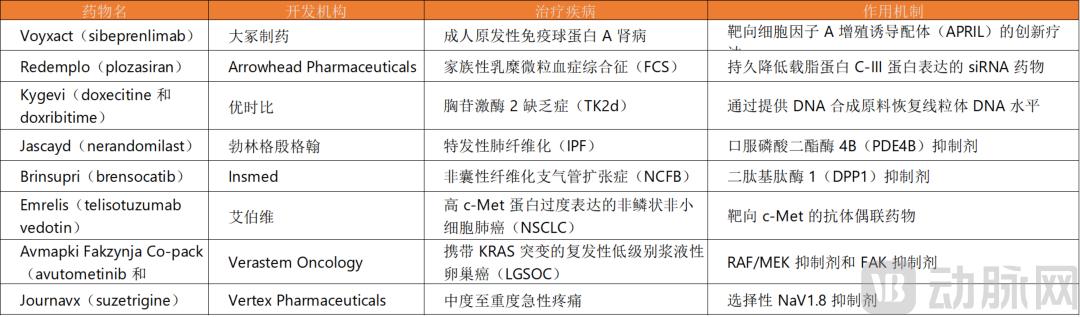
Core Insights - The FDA's CDER approved 44 new drugs by 2025, with over half being "first-in-class" drugs, indicating a shift from "incremental" to "disruptive" treatment paradigms in drug development [1][3][24] - The rise of small molecules continues, but their development is evolving from broad inhibition to precision modulation, enhancing efficacy while reducing side effects [6][7][9][10] First-in-Class Drugs - The approval of "first-in-class" drugs is driven by unmet clinical needs, particularly in rare and complex chronic diseases, where existing treatments are inadequate [3][4] - Brinsupri (brensocatib) is a notable example, targeting Dipeptidyl Peptidase 1 (DPP1) to address non-cystic fibrosis bronchiectasis, providing a new mechanism of action that significantly improves patient outcomes [3][20] - Eight drugs received breakthrough therapy designation, reflecting their innovative mechanisms and potential for substantial clinical improvement [5] Small Molecule Innovations - Small molecules accounted for 66% of new drug approvals, maintaining their central role in drug development while shifting towards precision approaches [6][10] - Aficamten (Myqorzo) exemplifies this trend as a selective allosteric modulator for obstructive hypertrophic cardiomyopathy, demonstrating improved safety and efficacy [7] - Covalent drugs, such as Zegfrovy (sunvozertinib), show promise in overcoming resistance issues by forming stable bonds with targets, enhancing therapeutic effectiveness [8] Peptide and Nucleic Acid Therapies - Peptide and nucleic acid therapies are emerging as significant players, with multiple innovative drugs approved in 2025, marking a shift towards RNA-targeted treatments [10][11] - Qfitlia (fitusiran) offers a revolutionary preventive solution for hemophilia by significantly reducing annual bleeding rates [10][12] - Dawnzera (donidalorsen) provides a long-acting preventive treatment for hereditary angioedema, demonstrating substantial reductions in attack frequency [11] Antibody-Drug Conjugates (ADCs) - ADCs are evolving beyond cancer treatment, with Datroway (datopotamab deruxtecan) showcasing innovative mechanisms and expanding indications [14][15] - Datroway's "bystander effect" allows it to target heterogeneous tumor populations effectively, improving treatment outcomes in breast cancer and non-small cell lung cancer [15][16] Future Directions - The landscape of drug development is shifting towards a broader understanding of drug value, emphasizing patient outcomes and treatment paradigms over traditional sales metrics [19][23] - The integration of advanced technologies like AI and gene editing into drug development processes is expected to yield therapies that fundamentally alter disease progression [24]
Press Release: Sanofi's Qfitlia and Cablivi approved in China, expanding care for rare diseases
Globenewswire· 2025-12-11 06:00
Core Insights - The National Medical Products Administration (NMPA) in China has approved two innovative Sanofi medicines for rare hematologic diseases: Qfitlia for hemophilia and Cablivi for acquired thrombotic thrombocytopenic purpura (aTTP) [1] - These approvals represent Sanofi's fourth and fifth approvals in China for the year, following Tzield and Sarclisa [1] Group 1: Qfitlia - Qfitlia is the first antithrombin-lowering therapy for routine prophylaxis in hemophilia patients aged 12 and older, significantly reducing bleeding episodes [2][3] - The approval is based on ATLAS phase 3 studies showing a 71% reduction in annualized bleeding rates (ABR) for patients without inhibitors and a 73% reduction for patients with inhibitors [9] - Qfitlia requires as few as six subcutaneous injections per year, making it a more accessible treatment option for hemophilia patients [7][10] Group 2: Cablivi - Cablivi is the first targeted therapy for treating aTTP in adults and adolescents, addressing a critical unmet need in this life-threatening condition [4][5] - Approximately 2,700 patients are diagnosed with aTTP annually in China, with a mortality rate of up to 20% despite standard treatments [5] - Cablivi works by inhibiting the interaction between von Willebrand factor and platelets, helping to prevent organ damage during the disease [5][18] Group 3: Sanofi's Commitment - The approvals of Qfitlia and Cablivi expand Sanofi's rare hematology portfolio in China, addressing significant unmet medical needs [6] - Sanofi emphasizes its commitment to delivering meaningful innovations and improving outcomes for patients with rare diseases [7] - The company aims to bring transformative medicines across diverse disease areas, reinforcing its long-term commitment to the Chinese market [1]


Sanofi Trades Below 50 & 200-Day Moving Averages: Time to Buy the Dip?
ZACKS· 2025-06-24 15:01
Core Viewpoint - Sanofi's stock has been underperforming, trading below its 50-day and 200-day moving averages, raising concerns among investors about its future direction [1][2][8]. Group 1: Dupixent and Vaccine Segment - Dupixent, developed in partnership with Regeneron, is a significant revenue driver for Sanofi, approved for multiple inflammatory diseases and expected to generate around €22 billion in sales by 2030 [3][4]. - Sanofi's vaccine segment has shown strong performance, with annual sales exceeding €5 billion and a 13.5% sales growth at constant exchange rates (CER) in 2024, driven by the successful rollout of Beyfortus [5][12]. Group 2: New Products and Pipeline - Sanofi's new products, including Altuviiio and Beyfortus, are contributing to revenue growth, with Beyfortus achieving blockbuster status in its first year [6][7]. - The company has a robust pipeline with 12 potential blockbuster assets in phase III development, including amlitelimab and tolebrutinib [9][10]. Group 3: Financial Performance and Valuation - Sanofi's stock has increased by 3.1% year-to-date, outperforming the industry and S&P 500, with a price/earnings ratio of 10.15, lower than the industry average of 14.81 [14][17]. - Earnings estimates for 2025 and 2026 have risen, reflecting positive momentum from new product launches and pipeline developments [20][24]. Group 4: Challenges and Strategic Moves - The launch of generic versions of Aubagio has negatively impacted its sales, and the influenza vaccine segment is facing competitive pressures [11][12][22]. - Sanofi is actively pursuing mergers and acquisitions to enhance its pipeline, with recent proposed acquisitions of Blueprint Medicines and Vigil Neuroscience [23].

Press Release: Sanofi: strong Q1 performance and 2025 guidance confirmed
Globenewswire· 2025-04-24 05:30
Core Insights - The company reported a Q1 sales growth of 9.7% at constant exchange rates (CER) and a business EPS of €1.79, indicating a strong start to 2025 [1][3][8] Sales Performance - Pharma launches generated sales of €0.8 billion, reflecting a 43.8% increase, primarily driven by ALTUVIIIO [6] - Dupixent sales reached €3.5 billion, up 20.3%, while vaccine sales amounted to €1.3 billion, up 11.4% due to favorable phasing of Beyfortus [6] - Total IFRS net sales were reported at €9,895 million, representing a 10.8% increase [8] Financial Metrics - Business EPS increased by 17.0% reported and 15.7% at CER, reaching €1.79 [6][8] - IFRS net income rose by 65.2% to €1,872 million, with IFRS EPS reported at €1.52, up 67.0% [8] - Free cash flow was reported at €1,029 million [8] Pipeline and Approvals - The company achieved six regulatory approvals across various therapeutic areas, including immunology, rare diseases, and oncology [6][5] - Significant progress was noted in the pipeline, with new data from mid-stage studies unlocking late-stage studies in asthma and skin diseases [6][5] Capital Allocation and Strategy - The company confirmed its capital allocation strategy, including a share buyback program of €5 billion, with 72% already repurchased [7][4] - The anticipated closing of the sale of a controlling stake in Opella is expected in Q2 [7] Future Outlook - Sales are projected to grow by a mid-to-high single-digit percentage at CER in 2025, with business EPS expected to increase at a low double-digit percentage at CER before share buyback [7]
Why Is French Pharma Giant Sanofi Stock Trading Higher On Thursday?
Benzinga· 2025-04-03 16:08
Core Insights - The U.S. FDA granted orphan drug designation to Sanofi SA's rilzabrutinib for two rare diseases: warm autoimmune hemolytic anemia (wAIHA) and IgG4-related disease (IgG4-RD) [1] - Rilzabrutinib is under regulatory review in the US, EU, and China for immune thrombocytopenia (ITP) [2] - The FDA's target action date for the regulatory decision on ITP is August 29, and rilzabrutinib has also received orphan drug designation for ITP in the US, EU, and Japan [3] Clinical Study Results - Phase 2b study results for wAIHA presented at ASH 2024 indicated that rilzabrutinib treatment led to clinically meaningful outcomes in response rate and disease markers [3] - In a phase 2a study for IgG4-RD, rilzabrutinib treatment over 52 weeks resulted in reduced disease flare and other disease markers, along with glucocorticoid sparing [4] - The safety profile of rilzabrutinib in both studies was consistent with previous studies [4] Recent Developments - The FDA recently approved Sanofi's Qfitlia (fitusiran), the first antithrombin-lowering therapy for hemophilia A or B, based on data from the ATLAS phase 3 studies [5] - Sanofi's stock increased by 3.54% to $55.86 during the premarket session following these developments [6]