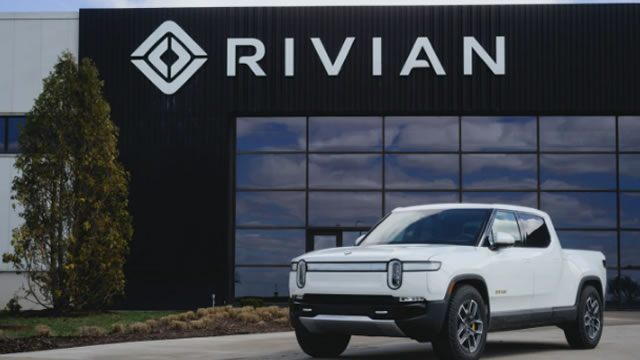
Rivian Autonomy Plus

Search documents
Trade Tracker: Josh Brown buys Exxon Mobil
Youtube· 2025-12-11 17:47
分组1 - Exxon Mobil is experiencing a breakout, with a long-term position being favored by investors [1][7] - The stock has not performed well for a long time, but recent movements suggest a potential upward trend [2][3] - The 120 level has been identified as overhead resistance, which may now be cleared, indicating a possible breakout [3] 分组2 - Rivian is developing its own chip for autonomous driving, moving away from Nvidia chips, and plans to integrate this technology into its R2 models [5][6] - The new autonomous system, named Rivian Autonomy Plus, will be priced at $2,500 or $49.99 per month [5] - Rivian's stock is currently down more than 3%, reflecting market reactions to these developments [6] 分组3 - The Bloomberg commodity index has been rising, indicating a positive outlook for commodities, with gold and silver leading the charge [10][11] - High inflation is expected to drive commodity prices, making exposure to commodity companies a potential hedge for equity investors [13] - Exxon Mobil is highlighted as a diversified player in the energy sector, with exposure to both crude oil and natural gas [15][16]



Rivian Unveils Plans For Autonomous Driving
Youtube· 2025-12-11 17:32
Core Insights - Rivian is advancing its autonomous vehicle technology with a focus on in-house developed hardware and software, aiming for significant improvements in vehicle autonomy capabilities [2][4][36] Group 1: Vehicle Development and Technology - Rivian launched its first vehicles at the end of 2021 and has since been designing an autonomy platform that integrates across business sets [2] - The Gen two fleet represents a tenfold improvement in compute capabilities, enhancing the camera platform and establishing a data flywheel for training [2][3] - The upcoming Gen three architecture will feature an in-house processor, improved camera systems, and LiDAR integration, significantly enhancing compute capabilities [4][10] Group 2: Autonomous Features and Updates - Rivian plans to expand hands-free driving capabilities from 150,000 miles to over 3.5 million miles in North America through an over-the-air update [8] - By 2026, Rivian aims to introduce point-to-point navigation, allowing vehicles to drive autonomously to specified addresses with supervision [9] - Future developments include "Eyes Off" driving capabilities on highways by 2027, leading to personal level four autonomy where vehicles can operate without anyone in the driver's seat [12][13] Group 3: Cost Management and Economic Strategy - The cost of LiDAR sensors has significantly decreased, making them a smaller percentage of vehicle production costs, while in-house custom silicon is expected to provide cost savings and performance improvements [21][22] - Rivian's strategy involves vertically integrating its software and electronics to enhance product differentiation and reduce costs, which is essential for scaling production beyond 50,000 vehicles annually [34][36] - The company has established a strong relationship with TSMC to support its semiconductor needs, which is crucial for its high-volume product strategy [30][22] Group 4: Market Position and Future Outlook - Rivian's self-driving technology is distinct from its joint ventures, focusing on proprietary capabilities that may eventually be licensed to other OEMs [37][39] - The pricing strategy for Rivian's autonomy features is competitive, with options for subscription or upfront payment, reflecting the company's commitment to R&D in self-driving technology [40][43] - Rivian's focus on self-driving technology is central to its business model, with significant investments aimed at building a robust infrastructure for future growth [44][45]