
SEP IRA

Search documents
Retirement Savers Who Max Out Catch-Up Contributions Can Still Fall $120,000 Short
Globenewswire· 2026-03-11 13:05
Core Insights - PensionBee highlights that late starters in retirement savings may require strategies beyond just saving to mitigate retirement shortfalls, with a potential gap of $120,000 compared to peers who started saving earlier [1][2]. Contribution Analysis - A 50-year-old maximizing catch-up contributions could contribute over $505,500 but still fall short of a $1 million retirement nest egg [2]. - The analysis compares two savers: one starting at age 35 and another at age 50, demonstrating the significant impact of starting early [3][4]. Financial Outcomes - Early starters contribute $141,000 and achieve a final balance of $591,000 by age 65, while late starters contribute $243,200 and only reach $439,200 [5][6]. - The late starter would need to work nearly four additional years beyond age 65 to match the early starter's balance [7]. Catch-Up Contribution Limits - Approximately 50% of U.S. households lack a retirement account, and one in five adults over 50 have not started saving [8]. - In 2026, individuals over 50 can contribute up to $32,500 annually, with a temporary super catch-up provision allowing up to $35,750 for ages 60-63 [8]. Additional Analysis - Despite a total contribution of $500,500, the late starter only accumulates $885,600 by age 65, falling short by over $120,000 compared to the early starter who invests $384,300 [14]. - The early starter's contributions grow to $1,007,400, nearly tripling their principal, while the late starter struggles to double theirs [14]. Strategies for Late Starters - PensionBee suggests several strategies for late starters, including choosing retirement-friendly states, maximizing IRA contributions, and delaying Social Security benefits to enhance retirement income [15][16]. - Romi Savova, CEO of PensionBee, emphasizes that while catch-up contributions are beneficial, they are not a comprehensive solution for late savers [17]. Company Overview - PensionBee is a leading retirement savings provider managing nearly $10 billion in assets and serving over 300,000 customers globally, focusing on simplicity and transparency in retirement savings [17].


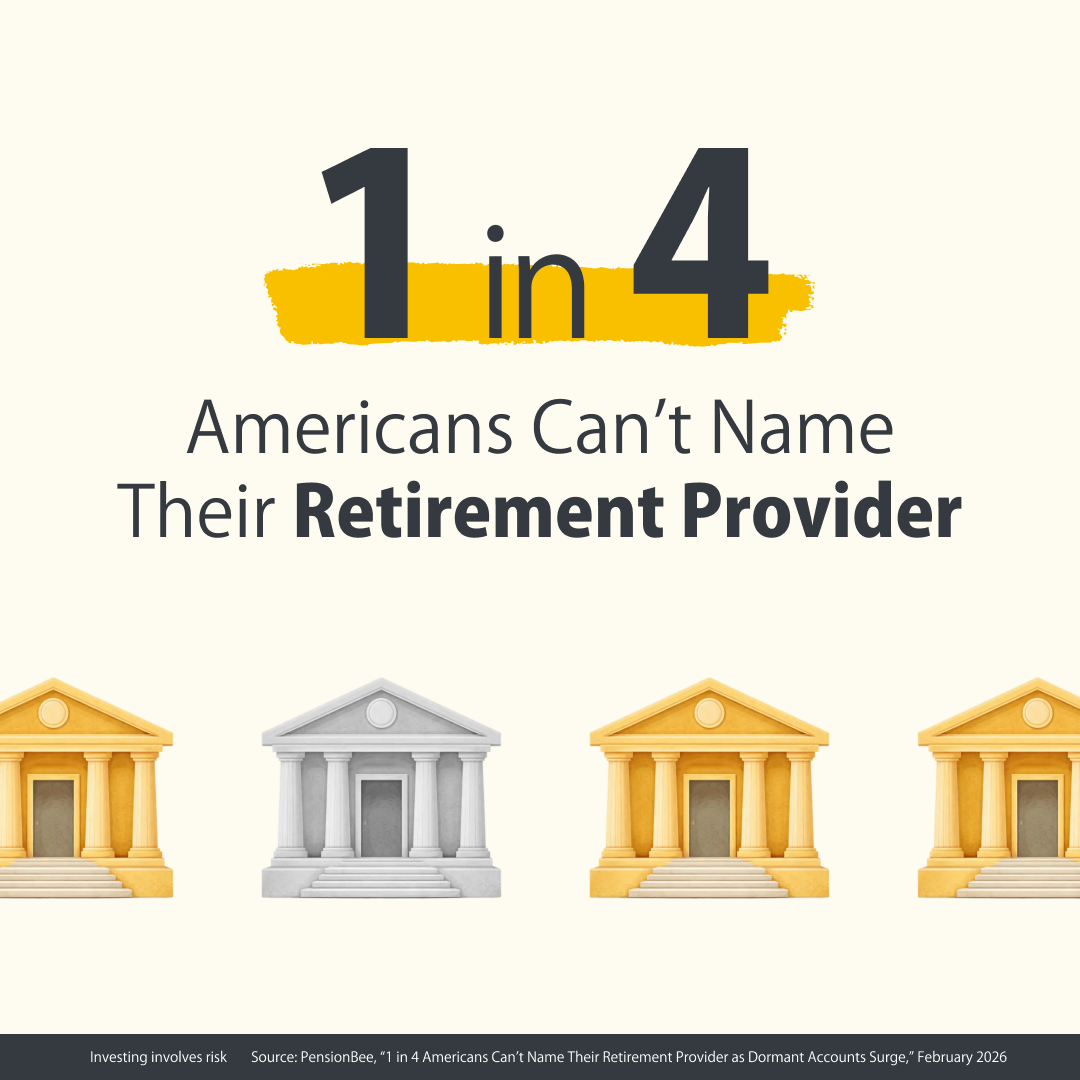
One in Four Americans Can’t Name Their Retirement Provider as Dormant Accounts Surge
Globenewswire· 2026-02-17 14:05
Core Insights - A significant disconnect exists between Americans and their retirement savings, with 25% unable to name their retirement account provider [1][8] - The number of dormant workplace accounts has increased to over 30%, up from 21% in 2012, indicating a growing issue of "forgotten" accounts [1] Survey Findings - The survey conducted by PensionBee involved 1,000 U.S. retirement savers, revealing that 40% consult their account provider for questions, while only 4% use AI for retirement inquiries [8] - A large portion of respondents (31%) check their retirement accounts only once or twice a year, and 9% never review their allocation or do so every three years [8] - 55% of respondents have never consolidated old accounts, leading to fragmented savings across multiple providers [8] Risks of Inactivity - Inactive accounts face two major risks: asset misallocation, where portfolios may become misaligned with a saver’s risk tolerance, and automatic rollover of dormant accounts under $7,000 into Safe Harbor IRAs, which may not grow effectively [3][8] Company Overview - PensionBee is a leading retirement savings provider managing $10 billion in assets and serving over 300,000 customers globally, focusing on simplicity and transparency [5] - The company offers various IRA options, including Traditional, Roth, SEP, and Safe Harbor IRAs, with ETF-backed portfolios [5]
What Is the Required Minimum Distribution (RMD) on a $250,000 Retirement Account?
Yahoo Finance· 2026-01-25 08:50
Core Insights - Tax-deferred accounts such as traditional IRAs and 401(k) plans allow workers to postpone tax payments on contributions, enabling pre-tax savings, with taxes due on withdrawals and gains in the future [2] - Required Minimum Distributions (RMDs) must begin at age 73 for tax-deferred account holders, calculated based on the account balance from the previous year divided by a life expectancy factor [6][9] - Roth accounts are exempt from RMDs while the original account holder is alive, but beneficiaries must adhere to RMD rules [5] Account Types and RMDs - RMDs apply to various retirement accounts including Traditional IRAs, SEP IRAs, SIMPLE IRAs, Traditional 401(k), Traditional 403(b), and 457(b) plans [7] - The first RMD can be delayed until April 1 of the following year, while subsequent RMDs must be completed by December 31 [5][8] RMD Calculation and Penalties - For a 73-year-old with a $250,000 balance in a traditional IRA, the 2026 RMD will be $9,434 [6] - The penalty for failing to withdraw the RMD on time is a 25% excise tax on the amount not withdrawn, which can be reduced to 10% if corrected within two years [10]
Nearly One-Third of All Workplace Retirement Accounts May Be Zombie 401(k)s, Finds PensionBee
Globenewswire· 2026-01-21 14:11
Core Insights - Nearly one in three workplace retirement accounts may be dormant, with over 30% of all 401(k) and 403(b) accounts potentially inactive [1][2][8] - The growth of dormant accounts has significantly outpaced active accounts, with dormant accounts increasing by 130% from 2012 to 2023, while active accounts grew by 44% [8] Key Findings - The number of dormant workplace retirement accounts doubled from 14.8 million in 2012 to 28 million in 2023, and is expected to reach 32.8 million by 2026 [8] - The percentage of funded workplace accounts that are dormant is projected to rise from 21% in 2012 to over 30% by the end of 2026 [8] - The average American worker's job changes more frequently, leading to a higher risk of "compounding loss" from forgotten accounts, with a small monthly fee potentially resulting in nearly $18,000 in lost wealth over a career [4] Regulatory Context - Under current SECURE 2.0 regulations, employers can automatically roll over "left-behind" accounts with balances under $7,000 into Safe Harbor IRAs, which may not keep pace with inflation [5][6] Recommendations - PensionBee suggests four immediate actions to safeguard retirement savings: find old accounts, consolidate them, review investment allocations, and automate contributions [9]
I’m 62, retired and want to keep saving. Is there an age limit for Roth IRAs?
Yahoo Finance· 2026-01-17 15:03
Core Insights - Retirement saving for married couples is a collaborative effort, emphasizing the importance of joint financial planning and contributions to retirement accounts [3][5][6] Group 1: Contribution Rules - A spouse can continue to contribute to a Roth IRA even if they are not working, as long as the other spouse has earned income [3][4] - Contributions must adhere to income phaseout limits, starting at $242,000 for married couples and capping at $252,000 [4] Group 2: Joint Financial Planning - Couples should consider their combined savings and retirement goals rather than focusing solely on individual accounts [5][6] - Retirement spending is a joint responsibility, necessitating a unified approach to budgeting for shared expenses [5][6] Group 3: Consolidation Strategies - Retirees can simplify their financial management by consolidating retirement savings into two main categories: pre-tax accounts (SEP IRA, traditional IRA, 401(k)) and post-tax accounts (Roth IRA) [7]
Best tax deductions to claim this year
Yahoo Finance· 2026-01-15 21:11
Core Insights - The article discusses the impact of tax deductions on taxable income and highlights the importance of choosing between standard deductions and itemizing deductions for maximizing tax benefits [1][2][3] Standard Deduction - Approximately 91% of U.S. taxpayers utilized the standard deduction in 2023, making it the most common tax break [2] - The standard deduction has nearly doubled since 2018 and now adjusts for inflation, providing significant tax relief without the need for itemization [3] - For taxpayers aged 65 and older, a new "senior bonus" deduction of up to $6,000 (or $12,000 for married couples) is available, which phases out at modified AGI levels of $75,000 for individuals and $150,000 for married couples [4] Above-the-Line Deductions - Certain deductions can be claimed even without itemizing, known as "above-the-line" deductions, which reduce gross taxable income [5] - Contributions to traditional IRAs and 401(k)s can significantly lower taxable income, with potential reductions exceeding $20,000 for high earners [6][7] - Health Savings Account (HSA) contributions offer a triple tax advantage and are expected to have expanded eligibility starting in 2026 [9][10] - Taxpayers can deduct up to $2,500 in student loan interest, but this deduction phases out for higher earners [11][12] Itemized Deductions - Itemizing deductions is beneficial primarily for those whose total itemized deductions exceed the standard deduction thresholds of $15,750 for single filers and $31,500 for married couples [13] - The state and local tax (SALT) deduction cap has increased to $40,400 for the 2025 tax year, significantly benefiting homeowners in high-tax states [16][19] - Mortgage interest deductions remain valuable, especially with the recent reinstatement of deductibility for private mortgage insurance (PMI) [20][21] - Charitable donations can be deducted if itemized, with new rules allowing standard deduction filers to deduct up to $1,000 for cash donations starting in 2026 [23][25] Medical Expenses - Medical expenses are deductible only if they exceed 7.5% of adjusted gross income, making it a challenging deduction for many [26][27]
If you’re over 50 and make $500k per year, you should have this much saved for retirement – are you on track?
Yahoo Finance· 2026-01-09 18:40
Core Insights - Individuals with a $500,000 annual income need to replace a significant amount of income in retirement, requiring approximately $3.03 million saved by the mid-50s to maintain their current spending level [2][4]. Investment Strategies - To achieve retirement savings goals, individuals should consider aggressive saving strategies as they approach retirement age, especially if they have not yet reached the target savings amount [5]. - Maximizing contributions to tax-advantaged retirement accounts, such as 401(k)s or IRAs, is crucial for those earning a high income [6]. - In addition to tax-advantaged accounts, individuals may need to invest in taxable brokerage accounts to ensure adequate retirement preparation, particularly if early retirement is a consideration [7]. Financial Assumptions - The retirement planning estimates are based on a 15% pre-tax retirement contribution, a 28% effective tax rate, and an expected annual return of 6% prior to retirement and 5% after retirement [8].
I'm 77 and Still Working. Can I Avoid RMDs?
Yahoo Finance· 2025-12-15 07:00
Core Insights - The IRS mandates required minimum distributions (RMDs) from tax-deferred retirement accounts, which are based on the account holder's age and account balance at the end of the previous year [4][5]. - Recent legislative changes, specifically the SECURE Act 2.0, have increased the RMD age to 73 starting in 2023 and will further increase it to 75 in 2033 [5]. - Roth IRAs are exempt from RMDs, and starting in 2024, designated Roth accounts within employer-sponsored plans will also be exempt from age-based RMDs [6]. RMD Requirements - RMDs are required for most tax-advantaged retirement accounts, with the exception of Roth IRAs [5]. - The previous RMD age was 70 ½, which was raised to 72 by the SECURE Act of 2019 before being adjusted again by the SECURE Act 2.0 [4][5]. Employment Status and RMDs - Individuals who are still employed do not have to take RMDs from their current employer's retirement plan [8]. - However, RMDs must still be taken from retirement accounts associated with former employers, and rolling over those funds into the current plan can help avoid RMDs from old accounts [8].
What is an IRA, and how does it work?
Yahoo Finance· 2025-12-05 15:35
Core Points - An Individual Retirement Account (IRA) is a tax-advantaged investment account for retirement savings, independent of employer ties, making it suitable for self-employed individuals and those looking to supplement workplace retirement accounts [1][2] Types of IRAs - The main types of IRAs are traditional IRAs and Roth IRAs, each with distinct tax implications and contribution rules [3][4][5] - Other types include Rollover IRAs, SEP IRAs, SIMPLE IRAs, Custodial IRAs, Spousal IRAs, and Inherited IRAs, each serving specific needs and circumstances [6][7] IRA Rules - Contributions to IRAs require taxable compensation, defined as income from work, and eligibility varies based on income levels and participation in workplace retirement plans [9][10] - Roth IRAs have specific income limits for contributions, with thresholds set for 2025 and 2026, affecting eligibility based on modified adjusted gross income (MAGI) [11][12] - Annual contribution limits are set by the IRS, with amounts adjusted for inflation; for 2025, the limit is $7,000, increasing to $7,500 in 2026 [13][14] Withdrawal Rules - Traditional IRAs incur taxes on withdrawals, with a 10% penalty for early distributions before age 59 ½, though exceptions exist [15][16] - Roth IRAs allow tax-free withdrawals of contributions at any time, with earnings accessible tax-free after age 59 ½ and a five-year holding period [16][17] - Required Minimum Distributions (RMDs) for traditional IRAs begin at age 73, increasing to 75 in 2033, while Roth IRAs do not require RMDs during the account holder's lifetime [17] IRA vs 401(k) - IRAs and 401(k)s are both tax-advantaged retirement accounts, but IRAs are opened independently, while 401(k)s are employer-sponsored; individuals can contribute to both [18] Choosing an IRA - Factors to consider when choosing an IRA provider include fees, investment options, advisor access, and user experience [24][25] - Steps to open an IRA include deciding on the type, selecting a provider, opening the account, funding it, and choosing investments [26] Rollover IRAs - Rolling over a 401(k) or 403(b) into an IRA can provide lower fees and more investment options, simplifying account management [27] - Specific rules must be followed to avoid penalties during rollovers, including matching the tax structure of the original account and completing the rollover within 60 days [28][29]
Why your love life could be influencing your retirement planning
Globenewswire· 2025-12-03 14:02
Core Insights - A study by PensionBee and The Open University reveals a 'legacy gap' in retirement saving motivations between gay and straight men, despite similar savings amounts [1][2] - The research indicates that sexual orientation influences the reasons for saving, particularly among straight men who are more likely to save for future dependents [3][4] Summary by Sections Research Findings - The study analyzed data from over 28,000 UK retirement accounts and surveys of more than 1,300 PensionBee savers, concluding that sexual orientation does not affect total retirement savings but does influence saving motivations [2] - Straight men without children are more inclined to save for future dependents compared to gay men, although this gap narrows once men become parents or caregivers [3] Behavioral Insights - Social expectations regarding family formation impact men's financial planning and motivations, suggesting that future family considerations shape present saving behaviors [4] - The research adds a behavioral perspective to existing studies on wealth and sexuality, emphasizing the importance of understanding how personal relationships influence financial well-being [4] Financial Inclusion - The findings suggest that financial systems may unintentionally rely on heteronormative assumptions, potentially alienating non-traditional family structures [5] - Financial messaging that focuses on intergenerational wealth transfer may resonate more with straight savers, indicating a need for more inclusive communication strategies [6] Recommendations for Financial Services - The study calls for the financial services industry to modernize retirement education by recognizing diverse family structures and life goals, training professionals to understand varying savings motivations, and ensuring retirement communications engage all savers equally [9] - The research highlights the necessity of inclusive financial education and communication to better serve a diverse clientele [6][9] Company Overview - PensionBee is a leading retirement savings provider managing over $9 billion in assets and serving approximately 300,000 customers globally, focusing on simplicity, transparency, and accessibility [8]