TALO

Search documents
TALO: 支持任意3D基础模型、任意相机配置的室外重建系统
自动驾驶之心· 2026-01-08 09:07
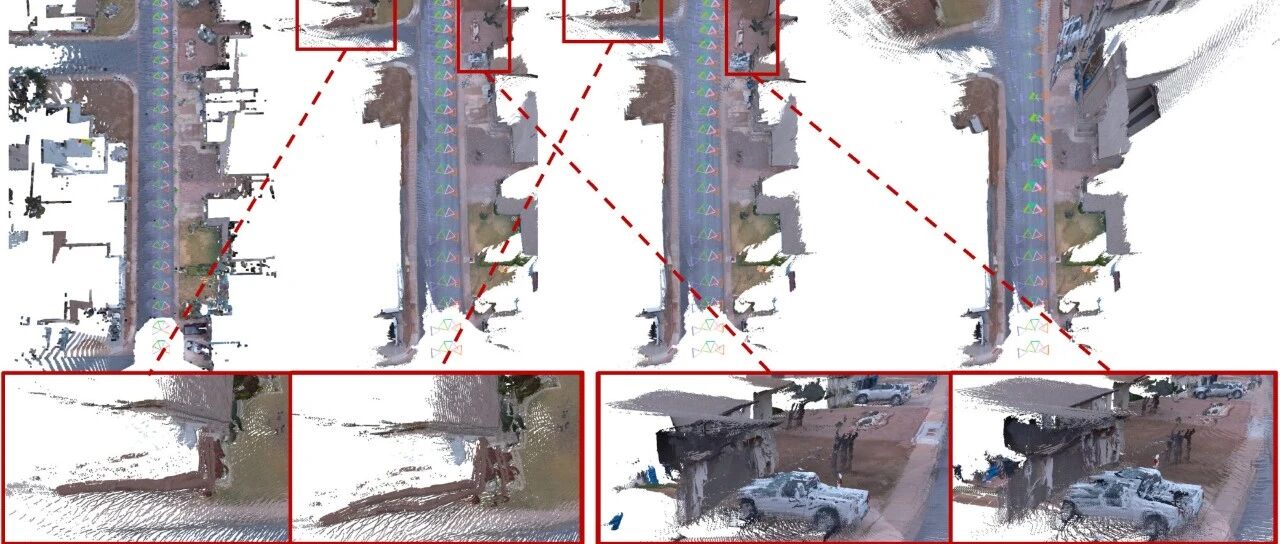
Core Viewpoint - The article discusses the advancements in 3D vision foundational models for online incremental reconstruction, highlighting the limitations of existing methods and introducing a new framework called TALO that enhances global consistency in reconstruction tasks [1][2][7]. Summary by Sections Introduction to 3D Vision Models - Recent foundational models like VGGT, π³, and MapAnything have introduced a data-driven paradigm for 3D reconstruction, allowing for direct predictions of camera parameters and dense geometric structures from input images [1]. Limitations of Existing Models - Most current models are designed for offline scene reconstruction, which is inadequate for real-time applications like autonomous driving that require online incremental reconstruction capabilities [2]. Existing Work on Alignment - The article reviews existing methods for aligning sub-maps, such as VGGT-Long and VGGT-SLAM, which utilize different strategies for maintaining consistency across independently predicted sub-maps [3][4]. Analysis of Alignment Strategies - VGGT-Long employs a Sim(3) alignment strategy, while VGGT-SLAM extends this to SL(4) to address inconsistencies in camera parameters. However, SL(4) has shown instability in outdoor multi-camera settings, leading to significant reconstruction failures [4][5]. Limitations of Global Linear Alignment - The article identifies three fundamental limitations of global linear alignment methods, including the assumption of global geometric consistency, the short-term optimality of pairwise alignments, and the sensitivity of SL(4) to noise in geometric predictions [5][7]. Introduction of TALO Framework - TALO is proposed as a plug-and-play alignment framework that enhances global consistency in online incremental reconstruction by using sparsely distributed control points and a Thin Plate Spline (TPS) transformation model [7][9]. Contributions of TALO - TALO systematically analyzes existing alignment strategies, introduces a robust sub-map registration strategy based on overlapping camera poses, and demonstrates superior performance in maintaining geometric consistency across various datasets and foundational models [9][12]. Experimental Results - TALO was tested on the Waymo and nuScenes datasets, showing optimal results in trajectory accuracy and stability compared to VGGT-Long and VGGT-SLAM, with an average absolute trajectory error (ATE) around 1 meter and significant improvements in rotational accuracy [29][31]. Visual Comparisons - Visual results indicate that TALO effectively restores accurate geometric structures and eliminates common artifacts found in previous methods, demonstrating its robustness and effectiveness in real-world applications [33][34].