
Treasury notes

Search documents
JP Morgan forecasts 10% plunge in S&P 500 over Iran war
New York Post· 2026-03-09 16:54
Core Viewpoint - Wall Street traders are unprepared for a potential 10% drop in the S&P 500 due to escalating tensions in Iran, with oil prices exceeding $100 per barrel and concerns about economic stagnation rising [1][8]. Market Impact - A correction from the S&P 500's peak could bring the index down to approximately 6,270, representing a 7% decline from the previous Friday's close [2]. - Global markets have reacted negatively, with US stocks experiencing modest declines: the S&P 500 fell by 0.8%, the Dow Jones Industrial Average decreased by 1.1%, and the Nasdaq Composite dropped by 0.9% [10]. Oil Market Dynamics - Brent crude oil surged by 5% to $102.50, while West Texas Intermediate reached $98.75, raising inflation concerns that may delay Federal Reserve rate cuts [8]. - Iran's oil exports could be severely impacted if the US and Israel were to seize its Kharg Island port, potentially halving its output [3][10]. Economic Outlook - Economists predict that prolonged conflict could reduce global GDP by 0.5%, with US gasoline prices possibly reaching $4 per gallon [16]. - The situation echoes fears of stagflation, a combination of slow growth and high prices reminiscent of the 1970s oil crisis [16]. Investor Sentiment - Traders currently exhibit a neutral positioning, with a noted lack of extreme de-risking, despite energy stocks facing net selling due to expectations of a quick de-escalation [3][5]. - JPMorgan's Andrew Tyler suggests that a resolution to the conflict could lead to a rebound in risk assets, as underlying macro fundamentals remain supportive [7][17].



Update on the Fed’s Balance Sheet and its Reserve Management Purchases
Wolfstreet· 2026-03-06 03:32
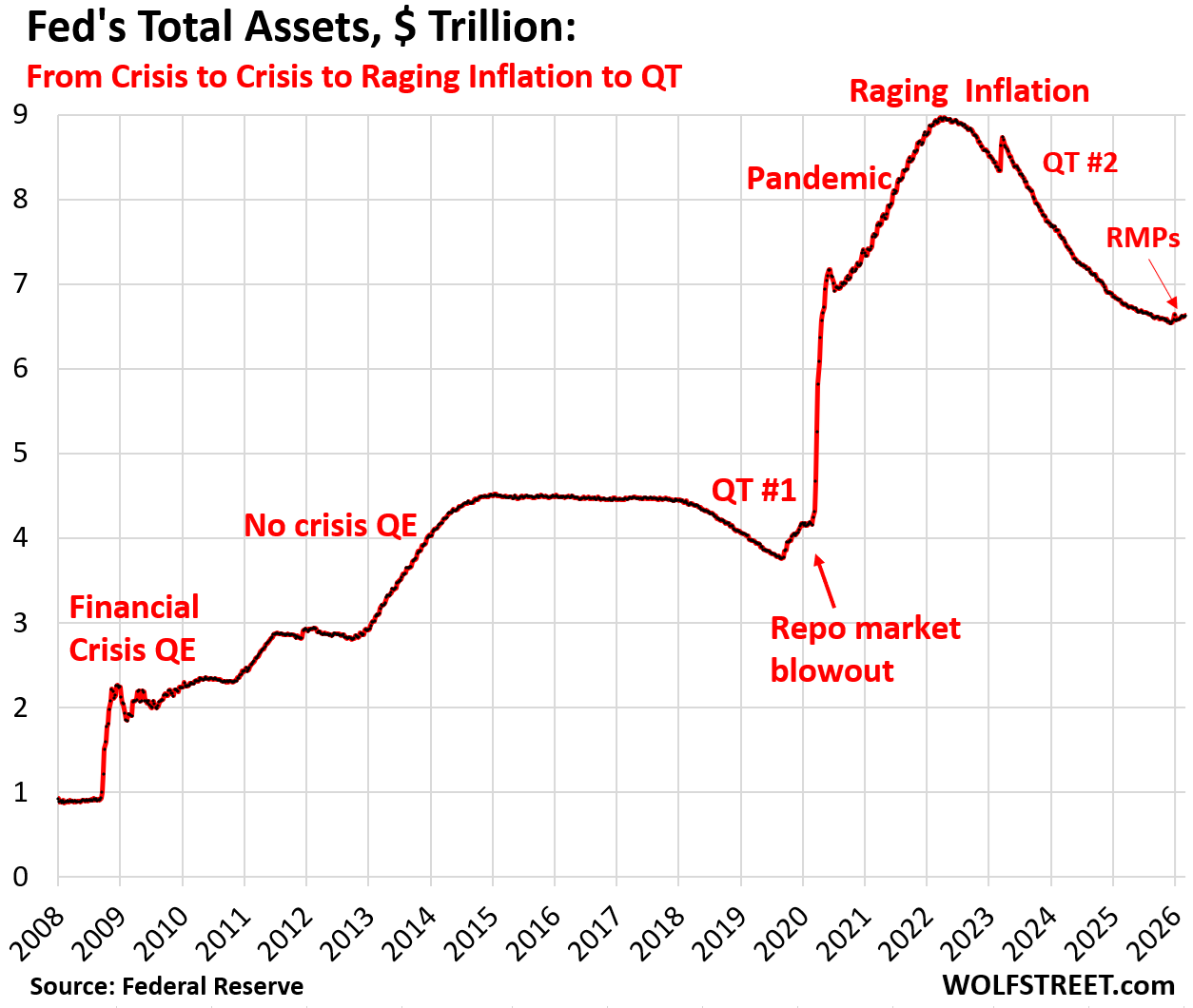
Core Viewpoint - The Federal Reserve's balance sheet has increased significantly due to the ongoing Reserve Management Purchases (RMPs), with a notable shift from Mortgage-Backed Securities (MBS) to Treasury bills (T-bills) as part of its strategy to manage liquidity and reserves in the financial system [1][2]. Group 1: Federal Reserve Balance Sheet Changes - Total assets on the Fed's balance sheet rose by $23 billion in February, reaching $6.63 trillion, with an increase of $93 billion since the initiation of RMPs in early December [1]. - The Fed's balance sheet growth is primarily driven by the purchase of approximately $40 billion in T-bills monthly until mid-April, following the end of a $2.4 trillion Quantitative Tightening (QT) in November [2]. - Mortgage-Backed Securities (MBS) decreased by $13 billion in February to $2.01 trillion, down 27% from their peak, as the Fed continues to replace MBS with T-bills [8][10]. Group 2: Reserve Management and Liquidity Facilities - The Standing Repo Facility (SRF) has remained unused at $0, despite over 40 approved counterparties being able to borrow through overnight repurchase agreements [13][18]. - Reserve balances have increased by $83 billion since the start of RMPs, totaling $3.02 trillion, while Overnight Reverse Repurchase Agreements (ON RRPs) have dropped to $0 billion from over $2 trillion in mid-2022 [22]. - The Fed is currently paying banks 3.65% interest on reserve balances, while the interest on repos is set at 3.75% [21][22]. Group 3: Market Dynamics and Historical Context - The Fed's balance sheet historically grew in line with the economy and inflation, with a 22% increase from 2003 to August 2007, prior to the implementation of Quantitative Easing (QE) [6]. - The transition from a "scarce reserves regime" to an "ample reserves regime" under Powell aims to stabilize overnight interest rates, although the future direction may change under newly nominated Fed chair Kevin Warsh, who opposes the current balance sheet size [4][5].
Where To Put $10K—Or More—Right Now for a Safe, Low-Risk Return
Investopedia· 2026-01-17 01:00
Core Insights - Current cash management options are providing competitive yields, with rates ranging from low-3% to around 5%, allowing savers to earn meaningful returns without market risk [3][9] - A comprehensive chart has been created to compare the best-paying options across various cash categories, including high-yield savings accounts, CDs, brokerage cash options, and U.S. Treasuries [4][12] - The article emphasizes the importance of selecting the right account to maximize earnings on liquid savings, highlighting potential earnings for different deposit amounts [7][9] Savings Accounts and CDs - High-yield savings accounts and CDs are among the top options for earning competitive yields, with the best CDs allowing for locking in high rates for a specified period [4][10] - The article provides a breakdown of potential earnings for different balances over six months, illustrating how much interest can be earned at various annual percentage yields (APYs) [8][9] Brokerage and Treasury Options - Brokerage cash options and U.S. Treasuries are also highlighted as viable alternatives for balancing return, flexibility, and stability [4][11] - Treasury securities, including T-bills, notes, and bonds, offer interest through maturity and can be purchased directly or traded on the secondary market [14][15] Current Rates Overview - The article includes a summary of the top nationally available APYs from banks and credit unions, as well as rates from brokerage and robo-advisor products [13][15] - It notes that the yield on money market funds fluctuates daily, while cash management account rates can be adjusted at any time [14]

Expect tighter balance sheet policy from Fed, says Ironsides Macroeconomics' Knapp
Youtube· 2025-12-10 18:39
分组1 - The discussion centers around differing expectations for the Federal Reserve's monetary policy, with one analyst anticipating a hawkish stance while the other leans towards a dovish outlook [1][4] - The market has been preparing for a potential hawkish cut, with clients expecting uncertainty regarding future cuts, possibly not occurring until June [2][3] - A dovish cut could also be interpreted positively if the Fed indicates a willingness to consider more rate cuts in the future [3][4] 分组2 - The current market conditions show that indices are near all-time highs, which may mitigate the perceived risks associated with a hawkish Fed [6][7] - The market has adjusted to the Fed's slightly hawkish institutional stance, which may be influenced by external pressures [7][8] - The Fed's approach to quantitative easing (QE) is crucial, as it involves buying Treasury notes and mortgage-backed securities, which lowers long-term rates and influences equity prices [11][12]

Bitcoin Bulls Bet on Fed Rate Cuts to Drive Bond Yields Lower, but There's a Catch
Yahoo Finance· 2025-09-14 16:41
Monetary Policy and Interest Rates - The U.S. Federal Reserve is expected to cut interest rates by 25 basis points on Sept. 17, lowering the benchmark range to 4.00%-4.25% [1] - Further easing is anticipated, potentially bringing rates down to around 3% within the next 12 months, with the fed funds futures market indicating a drop to less than 3% by the end of 2026 [1] Treasury Yields and Market Dynamics - Bitcoin bulls are optimistic that the anticipated easing will lead to lower Treasury yields, encouraging risk-taking in the economy and financial markets [2] - However, the expected Fed rate cuts may primarily affect the two-year Treasury yield, while long-term yields could remain elevated due to fiscal concerns and persistent inflation [2] Debt Supply and Fiscal Policy - The U.S. government is expected to increase the issuance of Treasury bills and longer-duration Treasury notes to finance tax cuts and increased defense spending, potentially adding over $2.4 trillion to primary deficits over ten years and increasing debt by nearly $3 trillion [3] - The increased supply of debt is likely to pressure bond prices down and lift yields, particularly for longer-term securities [4] Investor Sentiment and Yield Curve - Investors are demanding higher yields for long-term Treasuries due to concerns about inflation and dollar depreciation linked to high debt levels, which may prevent long-term bond yields from falling significantly [6] - The ongoing steepening of the yield curve indicates rising concerns about fiscal policy, as reflected in the widening spread between different maturities of Treasury yields [5]