Verida

Search documents
Philips remains No. 1 in Medtech at European Patent Office and the largest Dutch patent applicant
Globenewswire· 2026-03-24 08:30
Core Insights - Royal Philips ranked No. 1 among medical technology companies in the European Patent Office's Technology Dashboard 2025, reflecting its leadership in health technology innovation [2][7] - The company filed 676 Medtech patent applications in 2025, contributing to a total of 1,289 European patent applications across various domains [2][4][7] - Philips aims to improve the lives of 2.5 billion people annually by 2030, including 400 million in medically underserved communities [4][7] Innovation and Technology - Philips' innovation strategy focuses on data, AI, and platform-based solutions to enhance healthcare delivery [3] - Recent innovations include the helium-free 3.0T MRI, SmartSpeed Precise with Integrated Dual AI for faster and sharper MR scans, and the world's first real-time AI-enabled 3D navigation solution, LumiGuide [8] - The company invested over 9% of its sales in research and development in 2025, maintaining an industry-leading standard [4] Market Position and Recognition - Philips was recognized as a Clarivate Top 100 Global Innovator for the 13th consecutive year, highlighting its commitment to innovation [4] - The company's intellectual property portfolio includes approximately 53,000 patent rights, 31,500 trademarks, and 159,000 design rights [4] - Philips generated sales of EUR 18 billion in 2025 and employs around 64,800 people globally [10]



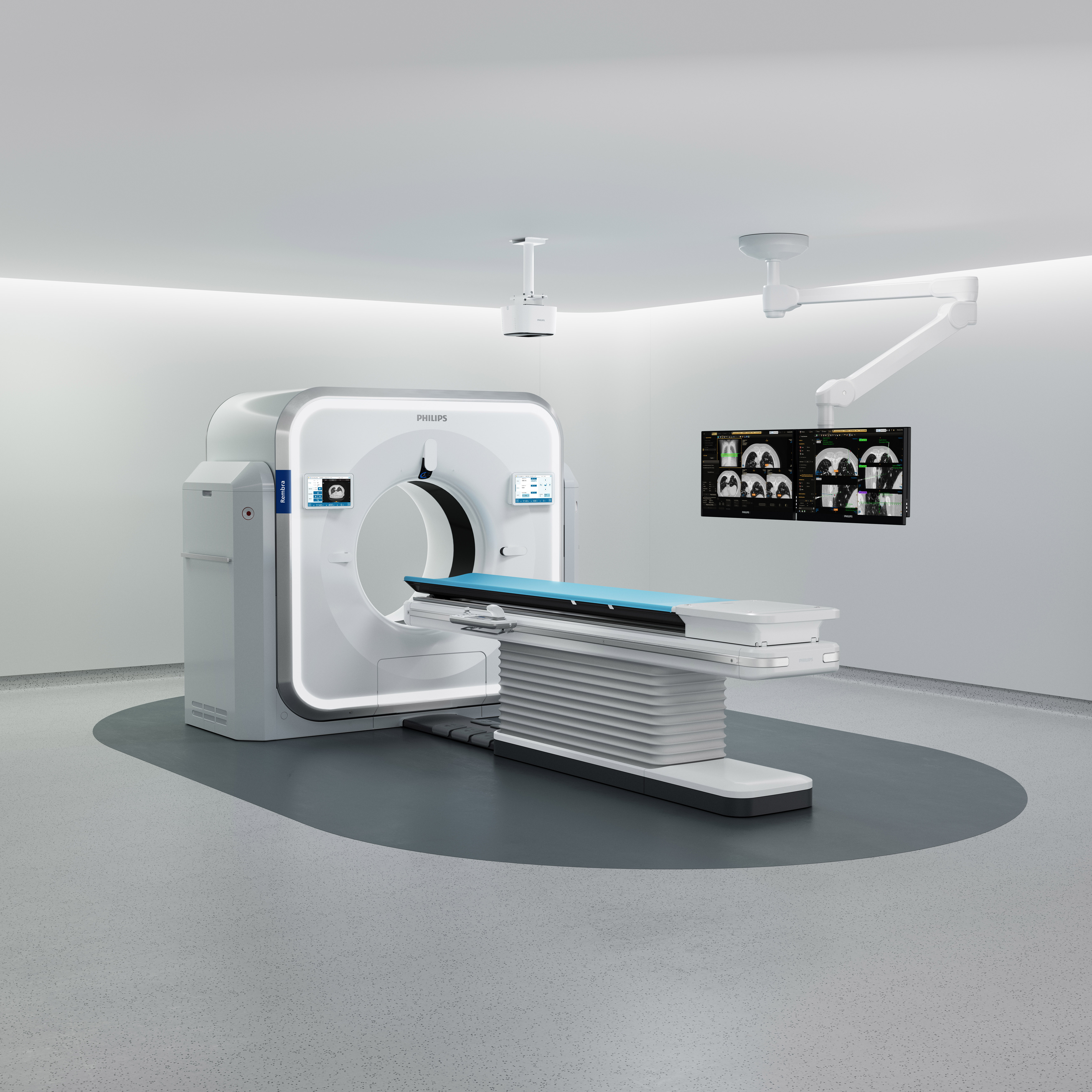
Philips unveils Rembra CT at ECR 2026, setting a new benchmark for speed and patient access designed to support diagnostic confidence for acute and high-demand imaging environments
Globenewswire· 2026-03-04 09:35
Core Insights - Royal Philips has introduced Rembra, a next-generation radiology CT system designed to address the challenges of acute and high-demand imaging, which will be showcased at ECR 2026 in Vienna [1][20][21] Group 1: Product Features - Rembra is engineered to meet the pressures faced by healthcare systems, including rising patient volumes and workforce shortages, by integrating advanced detector technology and AI-powered workflows [2][10] - The system boasts an industry-leading reconstruction speed of up to 106 images per second, facilitating timely clinical decisions in emergency and trauma settings [3][8] - Rembra can support up to 270 exams per day, allowing imaging departments to manage increasing volumes without sacrificing speed or diagnostic confidence [4][8] Group 2: Design and Accessibility - With the largest-in-class 85 cm bore, Rembra enhances patient access and positioning, improving comfort for trauma, bariatric, and interventional cases [5][6] - The system features a 60 cm standard field of view and an 85 cm extended field of view, enabling comprehensive anatomical visualization in a single scan [6][8] Group 3: Clinical Performance - Rembra incorporates Philips' newest NanoPanel Precise XD detector, which is designed for high dose-efficiency and high-resolution imaging, supporting overall image quality and diagnostic confidence [7][9] - The detector provides exceptional in-plane spatial resolution of 23 line pairs per cm, allowing for detailed visualization of fine anatomical structures [8][9] Group 4: Operational Efficiency - Integrated AI-enabled smart workflows are designed to automate routine steps, enhancing workflow efficiency and ensuring consistent results [10] - Rembra is built for high-altitude operations up to 5000 meters and is engineered for reliability and long-term performance, with a system lifetime of up to 20 years [11]
Philips launches Verida, world's first detector-based spectral CT powered by breakthrough AI, to advance diagnostic precision
Globenewswire· 2025-11-30 17:00
Core Insights - Royal Philips has launched Verida, the world's first detector-based spectral CT fully powered by AI, marking a significant advancement in CT technology [1][6] - The integration of AI optimizes the imaging chain, resulting in lower system noise, improved image quality, and enhanced clinical workflow [1][3] Company Overview - Philips is a global leader in health technology, focusing on improving health and well-being through innovation [12] - The company generated sales of EUR 18 billion in 2024 and employs approximately 67,000 people across more than 100 countries [13] Product Features - Verida utilizes AI to enhance spectral image quality and reduce noise, achieving a dose reduction of up to 45% without compromising image quality [3][6] - The system can reconstruct 145 images per second, allowing for exams to be completed in under 30 seconds, effectively doubling the speed of previous systems [4][10] - Verida is designed for high-demand environments, streamlining workflows and reducing the need for repeat scans while delivering consistent imaging quality [6] Clinical Impact - The introduction of Verida is expected to change the approach to cardiac imaging, providing comprehensive insights and potentially reducing the need for invasive procedures [4][5] - Philips' spectral CT technology has been widely adopted in clinical settings, supported by over 800 peer-reviewed publications [2][7] Market Position - Philips' spectral CT has been a reliable clinical tool for over a decade, offering comparable or superior clinical outcomes at a lower total cost of ownership compared to photon-counting CT systems [5][6] - Verida will be available in select markets starting in 2026, further solidifying Philips' position in the health technology sector [6]