WisdomTree Bloomberg U.S. Dollar Bullish Fund

Search documents
US Losing Ability To 'Tax The World' To Fund Deficits, Warns Thomas Massie Amid Diminishing Dollar Dominance - Invesco DB USD Index Bearish ETF (ARCA:UDN), WisdomTree Bloomberg U.S. Dollar Bullish Fun
Benzinga· 2026-01-19 09:19
Core Viewpoint - The United States is losing its ability to export inflation due to the diminishing status of the U.S. dollar as the global reserve currency, which will lead to Americans facing the full inflation tax necessary to service the nation's rising debt [1][2][3]. Economic Mechanism - The ability to print money without immediate hyperinflation is linked to global demand for dollars, which absorbs excess supply. As the dollar's reserve currency status declines, the U.S. will lose its ability to tax the world by creating more money [2]. Government Spending Implications - The loss of reserve currency status will make it difficult to maintain current government spending levels, resulting in a more painful experience for Americans who will bear the full inflation tax [3]. Global Trade Dynamics - The narrative that the U.S. subsidizes global trade is challenged, with the argument that the world actually subsidizes the U.S. by holding dollars, allowing the country to live beyond its means. The dollar's reserve status is crucial for this dynamic [4]. Economic Collapse Warning - A warning is issued that the loss of the dollar's reserve status could lead to economic collapse, as noted by both Massie and Nassim Nicholas Taleb [5]. Structural Financial Shift - Data indicates a structural shift in the global financial order, with the dollar's share of global reserves decreasing from 72% in 1999 to approximately 57% today. Analysts predict a controlled decline of the dollar and a rise in digital assets, which may deflate the fiscal cushion that has allowed the U.S. to run large deficits [6]. Future Outlook - As 2026 approaches, the combination of high deficits and decreasing foreign demand for U.S. Treasuries suggests that the painful reckoning predicted by Massie may occur sooner than expected [7]. Investment Considerations - A list of dollar-tracking ETFs is provided for investors, highlighting their performance over six months, year-to-date, and one year [8].

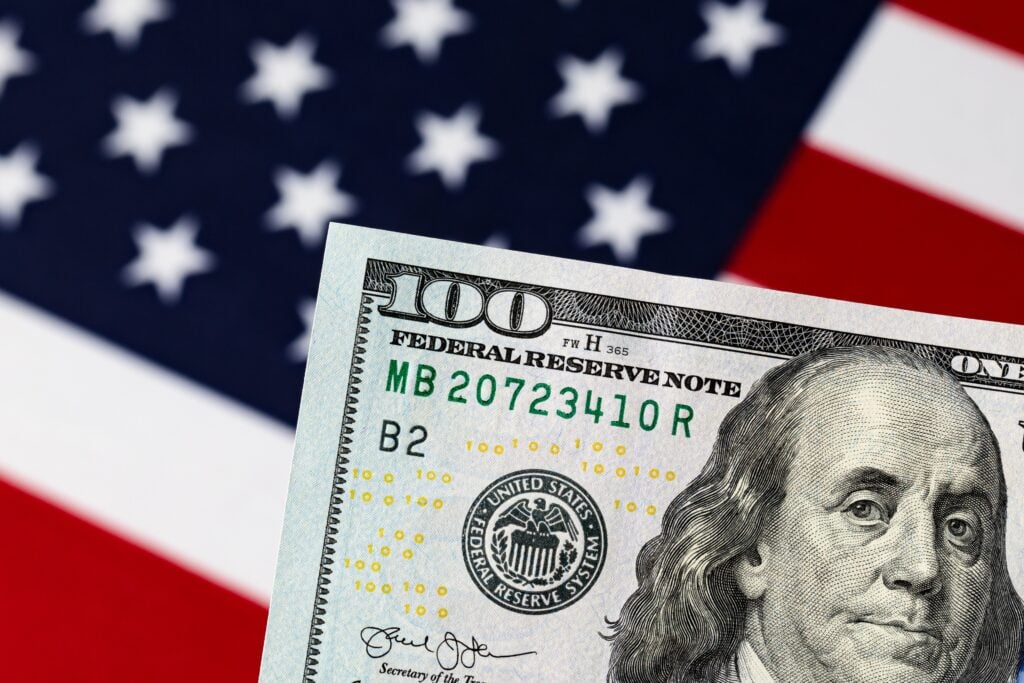
Dollar Dominance To End In 2026? Greenback's 'Controlled Decline' On Cards Amid Policy Uncertainty, Deficits, Rise Of Digital Assets - Invesco DB USD Index Bullish Fund ETF (ARCA:UUP)
Benzinga· 2026-01-01 17:31
Core Viewpoint - The U.S. dollar is facing significant challenges that may lead to a "controlled decline" in its dominance as the primary global reserve currency by 2026, influenced by structural headwinds such as fiscal deficits and the rise of digital assets [1][2]. Group 1: Dollar's Global Position - The dollar's share of global reserves has decreased from 72% in 1999 to approximately 57% today, indicating a potential shift in its status [2]. - Analysts suggest that the dollar's era of effortless strength may be over, with concerns about its safe-haven status due to fiscal imbalances [2]. - Predictions indicate that the dollar may be lower in value by 2026, with estimates of a 20-30% decline over the next five years [2]. Group 2: Market Sentiment and Forecasts - J.P. Morgan holds a "net bearish" outlook for the dollar in 2026, citing a Federal Reserve focused on labor market softness [3]. - Morgan Stanley presents a contrasting view, forecasting a potential drop in the dollar index to 94 in Q2 2026, followed by a recovery to 100 by year-end [3][4]. - J.P. Morgan anticipates the Euro could rise to 1.20 by December 2026, supported by Eurozone growth and fiscal expansion [4]. Group 3: Digital Assets as a Threat - The emergence of digital assets, particularly stablecoins, poses a new structural threat to the dollar's dominance, with the GENIUS Act expected to establish a regulatory framework for stablecoins by 2025 [5]. - Stablecoins are seen as a significant upgrade in how money moves, offering faster and more transparent alternatives to traditional systems [5]. - The shift towards "on-chain" capital formation is projected to reach $100 trillion in five years, indicating a diversification away from traditional banking [6]. Group 4: Current Dollar Index Performance - As of the article's publication, the U.S. Dollar Index was down 0.05% at 97.9840, reflecting a year-to-date decline of 9.70% but a 1.29% increase over the last six months [6]. - Various ETFs tracking the dollar index have shown mixed performance, with some funds experiencing significant declines [7][8].