
BANK OF GUIZHOU(06199)

Search documents
中小银行整合提速,小股东为何频繁投出反对票?三大问题值得关注
Xin Lang Cai Jing· 2026-01-28 00:33
Core Viewpoint - The recent shareholder meetings of various banks reveal a growing trend of dissent among minority shareholders regarding merger proposals, particularly in the context of small and medium-sized banks, indicating a need for better governance and consideration of minority interests in such decisions [1][2][10]. Group 1: Shareholder Voting Trends - Zhangjiagang Rural Commercial Bank's proposal to absorb Jiangsu Donghai Zhangnong Rural Bank received 95.47% approval, contrasting with Suzhou Rural Commercial Bank's similar proposal, which faced 13.08% opposition [1][8]. - Minority shareholders, particularly those holding less than 5%, have shown higher dissent rates, with some proposals receiving over 27% opposition from this group [10][2]. - The trend of dissent among minority shareholders is seen as a legitimate expression of their rights and highlights the need for banks to engage more effectively with these stakeholders [10][2]. Group 2: Regulatory Context and Bank Closures - As of November last year, 368 banks were closed due to regulatory approvals for mergers or dissolutions, with village banks making up the majority of these closures [11]. - The regulatory focus for the year includes effectively addressing risks in small financial institutions, which is a priority in the current financial landscape [10][11]. Group 3: Challenges in Mergers - Shareholder disagreements are a common challenge in the absorption of small banks, with some shareholders preferring liquidation over mergers to minimize losses [13]. - Mergers can impose additional financial pressures on acquiring banks, particularly when the absorbed banks are underperforming, affecting capital adequacy ratios [13][14]. - Cultural integration and personnel management pose significant challenges during mergers, as differences in operational styles between local banks and larger institutions can lead to service disruptions and employee turnover [14][15].
绥阳黔北村镇银行违规被罚 第一大股东为贵州银行
Zhong Guo Jing Ji Wang· 2026-01-27 07:08
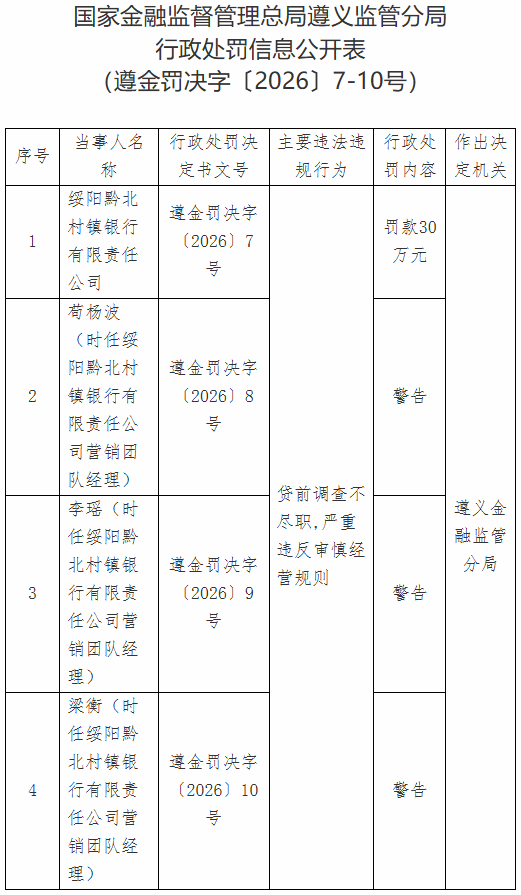
Core Viewpoint - The Zunyi Regulatory Bureau of the National Financial Supervision Administration has imposed a fine on Suiyang Qianbei Village Bank for failing to conduct due diligence in pre-loan investigations, which constitutes a serious violation of prudent operational rules [1]. Group 1: Regulatory Actions - Suiyang Qianbei Village Bank was fined 300,000 yuan for its negligence in pre-loan investigations [1]. - Warnings were issued to three individuals who were marketing team managers at the bank during the time of the violations: Gou Yangbo, Li Yao, and Liang Heng [1][2]. Group 2: Ownership Structure - The largest shareholder of Suiyang Qianbei Village Bank is Guizhou Bank Co., Ltd., which holds a 15% stake in the bank [1].

个人贷款不良率骤增 银行超低折竞抛
经济观察报· 2026-01-25 04:58
Core Viewpoint - The article discusses the increasing trend of personal non-performing loan (NPL) transfers in the banking sector, driven by regulatory changes and the rising pressure of bad debts on financial institutions [1][5]. Group 1: Market Dynamics - The personal NPL transfer market is experiencing a surge, with transaction volumes rising from 186.48 billion in 2021 to 965.30 billion in 2023, and projected to reach 1583.50 billion in 2024 [3][4]. - As of January 22, 2026, there were 20 new announcements for personal NPL transfers within the month, indicating heightened activity in the market [2][8]. - The average discount rate for personal NPL packages has significantly decreased, with rates dropping from 8%-10% before 2023 to around 5% in 2026 [10][11]. Group 2: Regulatory Impact - A regulatory notification extended the trial period for bulk transfers of personal NPLs until December 31, 2026, allowing a wider range of financial institutions to participate in the transfer process [2][4]. - The expansion of trial institutions to include city commercial banks and rural commercial banks has led to a notable increase in the volume of NPL transfers [5][17]. Group 3: Borrower Profile and Economic Context - The borrower demographic for personal NPLs includes failed entrepreneurs, unemployed individuals relying on credit cards for living expenses, and consumers with excessive debt [4][20]. - The economic backdrop, characterized by macroeconomic fluctuations and income instability, has exacerbated the bad debt situation, compelling banks to offload risk assets [5][20]. Group 4: Challenges in Asset Recovery - The recovery rates for NPLs have declined, with some packages facing average recovery rates below 6%, marking the lowest in five years [12][13]. - Financial institutions are facing challenges in asset valuation and recovery due to incomplete documentation and inefficient legal processes [26][28]. Group 5: Strategic Adjustments - Banks are adapting their strategies by improving the quality of NPL packages, such as reducing overdue times and increasing the concentration of borrowers in economically developed areas [24][25]. - There is a push for enhanced transparency and standardization in the NPL transfer process to improve market confidence and asset pricing [28].


一场“不付现金”的承接: 信托受益权置换丰富中小银行改革工具箱
Zhong Guo Zheng Quan Bao - Zhong Zheng Wang· 2026-01-22 23:45
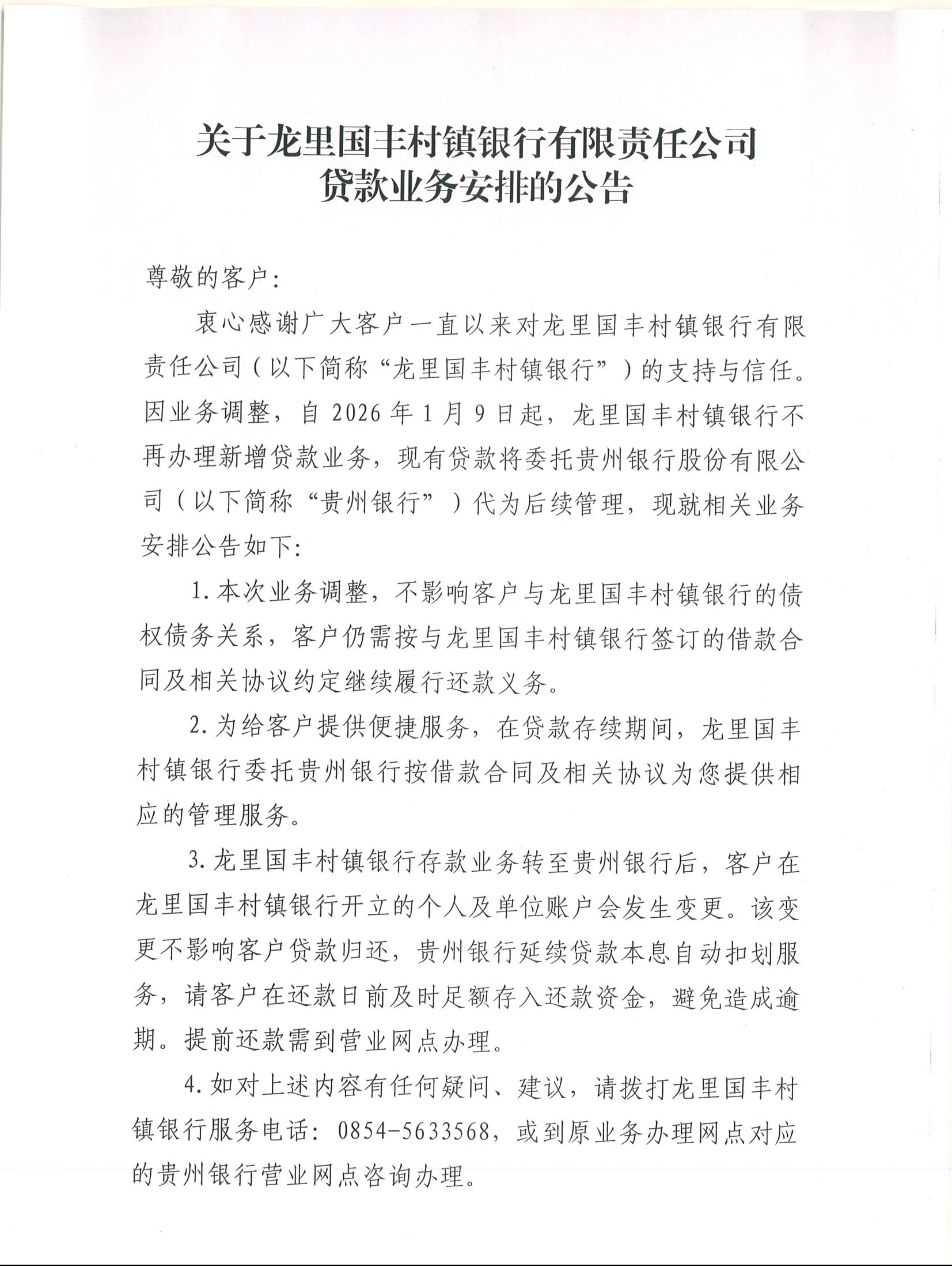
Core Viewpoint - A recent transaction involving 1.913 billion yuan in deposits has attracted market attention due to its "non-cash" payment arrangement, where Guizhou Bank acquires the deposits of Longli Guofeng Village Bank through a trust plan without immediate cash payment [1][2]. Group 1: Transaction Details - Guizhou Bank signed a deposit transfer agreement with Longli Guofeng Village Bank, effective from January 12, 2026, with a total deposit principal and interest amounting to 1.913 billion yuan, leading to a final transfer price of 1.849 billion yuan after deducting related rights [2][3]. - The payment arrangement is unique as Guizhou Bank does not pay cash directly but instead receives a beneficial interest in a trust plan, allowing for a quick transfer of deposit liabilities without complex negotiations [2][5]. Group 2: Regulatory and Operational Context - The Guizhou Financial Regulatory Bureau approved the dissolution of Longli Guofeng Village Bank on January 8, 2026, with Guizhou Bank taking over all deposits and managing existing loans [3]. - Guizhou Bank only assumes deposit liabilities and does not take on loan assets, ensuring that customer obligations remain unchanged and repayments continue as per original agreements [3]. Group 3: Reform and Innovation - The transaction is viewed as an innovative attempt to navigate the ongoing reforms in village banks, which have included various restructuring methods since 2026, such as mergers and acquisitions [4][8]. - The use of trust tools in this context is relatively rare, and it serves to align with policy advancements and regional risk management efforts [4][6]. Group 4: Risk Management and Future Considerations - While the model aims to isolate risks, experts caution that risks have merely transformed rather than disappeared, with underlying credit risks still present [6][7]. - The uncertainty surrounding the recovery of underlying assets, primarily loans from the village bank, poses potential challenges for the trust's beneficial interests and the bank's liquidity [7][8].
一场“不付现金”的承接:信托受益权置换丰富中小银行改革工具箱
Zhong Guo Zheng Quan Bao· 2026-01-22 20:56
Core Viewpoint - A recent transaction involving 1.913 billion yuan in deposits has attracted market attention due to its "non-cash" payment arrangement, where Guizhou Bank acquires the deposits of Longli Guofeng Village Bank through a trust plan without immediate cash payment [1][2] Group 1: Transaction Details - Guizhou Bank signed a deposit transfer agreement with Longli Guofeng Village Bank, effective from January 12, 2026, where Guizhou Bank will assume the liabilities and rights related to the deposits totaling 1.913 billion yuan, with a final transfer price of 1.849 billion yuan after deducting related rights [1][2] - The payment is structured through a trust plan, allowing Guizhou Bank to receive trust benefits instead of direct cash payment, facilitating a quicker transfer of deposit liabilities without complex negotiations [2] Group 2: Regulatory and Structural Context - The transaction is part of ongoing reforms in village banks, with Guizhou Bank being the main initiator of Longli Guofeng Village Bank, which was established in December 2008 [2] - Regulatory approval was granted for the dissolution of Longli Guofeng Village Bank, with all deposits to be managed by Guizhou Bank from January 9, 2026, while new loans will not be issued [2] Group 3: Risk Management and Implications - Guizhou Bank is only assuming deposit liabilities and not the loan assets, maintaining the existing debtor-creditor relationship between customers and the village bank [3] - The use of trust tools in this transaction is seen as a novel approach to manage potential asset risks while alleviating immediate capital and liquidity pressures on the main initiator [3][4] - The model aims to isolate risks but does not eliminate them, as the underlying credit risks of the assets remain, necessitating careful management of uncertainties related to asset recovery and liquidity [5][6]
贵银输活水,“废热”变暖流
Zheng Quan Shi Bao Wang· 2026-01-19 07:48
Core Viewpoint - The article highlights the successful collaboration between Guizhou Bank and local government to finance the Fuling City Urban Central Heating Project, emphasizing the importance of timely financial support for enhancing residents' quality of life and promoting green development [2][4]. Group 1: Project Overview - The Fuling City Urban Central Heating Project has a total investment of approximately 404 million yuan, aiming to utilize industrial waste heat from a nearby power plant to create a clean centralized heating network [2]. - The project is part of Guizhou Province's major engineering projects and is recognized as one of the "Ten Major Livelihood Projects" by the Fuling City government [2][4]. Group 2: Financial Support - Guizhou Bank provided a first tranche loan of 120 million yuan to the project, which was crucial for ensuring heating services before the winter season [1][3]. - The bank's rapid response included the establishment of a special service team to assess the project and expedite the loan approval process, completing it in just over two months [3]. Group 3: Impact and Future Prospects - The project is expected to significantly improve air quality by replacing inefficient coal-fired heating systems, thereby enhancing residents' living conditions [2][4]. - Guizhou Bank aims to continue its collaboration with local governments and quality enterprises to support sustainable development and improve public welfare in the region [4].
村镇银行改革现新解法,贵州银行缘何借信托承接逾19亿元存款?
Mei Ri Jing Ji Xin Wen· 2026-01-16 11:42
Core Viewpoint - Guizhou Bank is set to assume all deposit liabilities of Longli Guofeng Village Bank, totaling 19.13 billion yuan, through a trust plan instead of cash payment, marking an innovative approach in village bank reforms [1][3][5]. Group 1: Transaction Details - The deposit assumption agreement will take effect on January 12, 2026, with a total principal and interest amount of 19.13 billion yuan, and a net consideration of 18.49 billion yuan after deducting related rights [1][2][5]. - The transaction involves Guizhou Bank receiving trust beneficiary shares in exchange for the debt it assumes, which is a rare method in village bank reforms [1][3][4]. Group 2: Strategic Implications - This approach is based on market-oriented and legal principles, aiming to protect the rights of all parties involved and maintain local financial stability [1][5][18]. - The trust structure allows for risk isolation, ensuring the safety of the trust beneficiary rights and optimizing liquidity, which aids in a smooth exit for the institution [6][8][18]. Group 3: Broader Context - Guizhou Bank is also consolidating several other village banks, having completed the acquisition of Tongren Fengyuan Village Bank in 2025 and planning to absorb three more banks pending regulatory approval [2][19][20]. - The bank's actions align with the ongoing nationwide reform of village banks, where over 200 banks have exited the market in the past year, with absorption and restructuring becoming mainstream [4][15].
为"第一片光伏玻璃"提供金融动能!贵州银行黔东南分行助力凯里玻璃产业高质量发展
Zheng Quan Shi Bao Wang· 2026-01-16 04:19
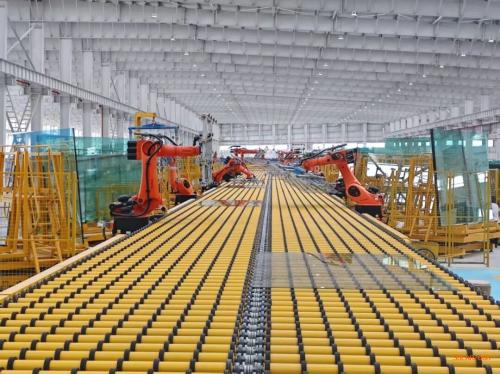
Core Insights - Guizhou Bank's Qiandongnan Branch is focusing on providing specialized financial services to support the development of the glass industry in Kaili City, which is rich in quartz sand resources and has a significant share of the province's glass production capacity [1][3]. Financial Support for Key Enterprises - Qianbo Yongtai, a leading enterprise in the glass industry, is planning to build the province's first 1250 tons/day photovoltaic glass production line, requiring over 1 billion yuan in investment. The bank has provided 372 million yuan in loans to support this project, ensuring its successful construction and operation [2][3]. - Kairong Glass, a well-established local manufacturer, faced financial pressure due to the need for a significant investment in upgrading production lines to meet environmental regulations. The bank responded by providing a 19.5 million yuan working capital loan, enabling the company to complete its production line transformation [5][6]. Technological and Market Expansion - Guizhou Haisheng Glass, funded by Hebei Haisheng Industrial Group, is focusing on the research and production of ultra-thin float glass, with an expected annual output value exceeding 5 billion yuan upon completion of all production lines. The bank has provided 50 million yuan in credit support to meet the company's funding needs for research and equipment upgrades [6][7]. Industry Chain Development - The bank has extended its financial services beyond individual enterprises to the entire glass industry chain, providing 199 million yuan in credit support to over 20 related companies. This initiative aims to address the financial needs of upstream suppliers and downstream sales companies, promoting collaborative development within the glass industry cluster [7]. - The bank is committed to continuing its support for the local glass industry, focusing on high-end, green, and clustered development through a variety of financial products and efficient services [7].
不花钱、不购股!贵州银行借信托承接19亿存款 改革化险出新招
Bei Ke Cai Jing· 2026-01-15 09:29
Core Viewpoint - The reform process of small and medium-sized banks is accelerating, with innovative integration solutions emerging, particularly highlighted by Guizhou Bank's acquisition of all deposits from Longli Guofeng Village Bank through a trust-based debt exchange rather than traditional cash payment methods [1][2][10]. Group 1: Guizhou Bank's Acquisition Strategy - Guizhou Bank plans to assume all deposits from Longli Guofeng Village Bank, holding only 25.36% of its shares, and will not use cash for this transaction, opting instead for a "debt for trust benefit share" approach [2][10]. - The total amount of deposits and interest from Longli Guofeng Village Bank is approximately RMB 19.13 billion, with the acquisition price set at RMB 18.49 billion after accounting for related rights [9][10]. - This method is seen as a financial innovation that allows Guizhou Bank to manage risks without altering its equity structure or incurring cash expenses [24][25]. Group 2: Advantages and Risks of the Trust Model - The trust model significantly reduces liquidity pressure and enhances risk isolation, as it allows for the independent management of debts through a trust plan [5][25]. - The approach is faster and incurs lower transaction costs compared to traditional mergers and acquisitions, while also improving the safety of depositors' funds [25][30]. - However, there are concerns regarding the valuation of trust assets and potential shareholder disputes due to the lack of equity acquisition [25][26]. Group 3: Broader Industry Context - The reform of small and medium-sized banks is part of a larger trend, with over 300 village banks exiting the market by the end of 2025, reducing the total number to 1,282 [27]. - The regulatory framework is focused on accelerating the reform and risk management of small financial institutions, emphasizing the need for governance restructuring and business reorganization [28]. - Guizhou Bank's innovative approach may serve as a model for other banks facing similar challenges, particularly in regions with mature financial ecosystems [29][31].
为“第一片光伏玻璃”提供金融动能!贵州银行黔东南分行助力凯里玻璃产业高质量发展
Zheng Quan Shi Bao Wang· 2026-01-15 08:22
Core Insights - Guizhou Bank's Qiandongnan Branch is focusing on providing specialized financial services to support the development of the glass industry in Kaili City, which is rich in quartz sand resources and has a significant share of the province's glass production capacity [1][2] Group 1: Financial Support for Key Enterprises - Qianbo Yongtai, a leading enterprise in the Kaili glass industry, is planning to build the province's first 1,250 tons/day photovoltaic glass production line, requiring over 1 billion yuan in investment, highlighting its urgent financing needs [2] - The bank has provided 372 million yuan in credit to Qianbo Yongtai, ensuring the smooth construction and operation of the production line, which now produces 1,250 tons of photovoltaic glass daily [2] - Kairong Glass, a long-established local manufacturer, received a tailored loan of 19.5 million yuan to support its transition to cleaner production methods, enabling it to meet environmental standards and improve product quality [3] Group 2: Technological and R&D Support - Guizhou Haisheng Glass, focusing on ultra-thin float glass, is expected to generate over 5 billion yuan in annual output once fully operational, but faces significant funding challenges for R&D and production line expansion [4] - The bank has provided 50 million yuan in credit to Haisheng Glass to support its R&D and equipment upgrades, ensuring the stable operation of its first 700 tons/day production line [5] Group 3: Industry Chain Development - The bank has extended its financial services to the entire glass industry chain, providing 199 million yuan in credit to over 20 related enterprises, addressing the financial needs of both upstream suppliers and downstream sales companies [6] - The "chain finance" service model has been introduced to support core enterprises like Qianbo Yongtai and Haisheng Glass, facilitating financing for their suppliers and sales partners [6] Group 4: Future Directions - The Qiandongnan Branch of Guizhou Bank plans to continue enhancing its financial services to support the high-end, green, and clustered development of the Kaili glass industry, aligning with the provincial strategy of "rich mineral resources and precise development" [7]