
Autoliv(ALV)

Search documents
Autoliv and CATARC in Strategic Partnership
Prnewswire· 2025-10-14 11:52
Core Viewpoint - Autoliv, Inc. and China Automotive Technology and Research Center Co (CATARC) have signed a strategic agreement to enhance automotive safety standards and innovation in China and globally [1][2]. Group 1: Partnership Overview - The partnership combines Autoliv's leadership in automotive safety with CATARC's technical service capabilities to create an integrated service system for improving safety standards for vehicles produced in China [2][5]. - The collaboration will cover research and development, testing, certification, and standards alignment, providing essential technical support for the R&D and global expansion of Chinese automakers [2][5]. Group 2: Focus Areas - The collaboration will focus on four key areas, although specific areas are not detailed in the provided text [3]. - Autoliv aims to define the next generation of safety standards and enhance road safety through this partnership [4]. Group 3: Organizational Background - Autoliv has been present in China for over 30 years and is committed to shaping the future of automotive safety [4]. - CATARC, established in 1985, is a central enterprise with extensive influence in the automotive industry, providing a wide range of services including standards development and testing [9]. Group 4: Impact and Goals - The partnership aims to increase integration between industry, universities, and research institutions, optimizing the use of R&D resources [5]. - The agreement reflects a shared vision to enhance mobility safety and is built on years of successful collaboration between Autoliv and CATARC [6].


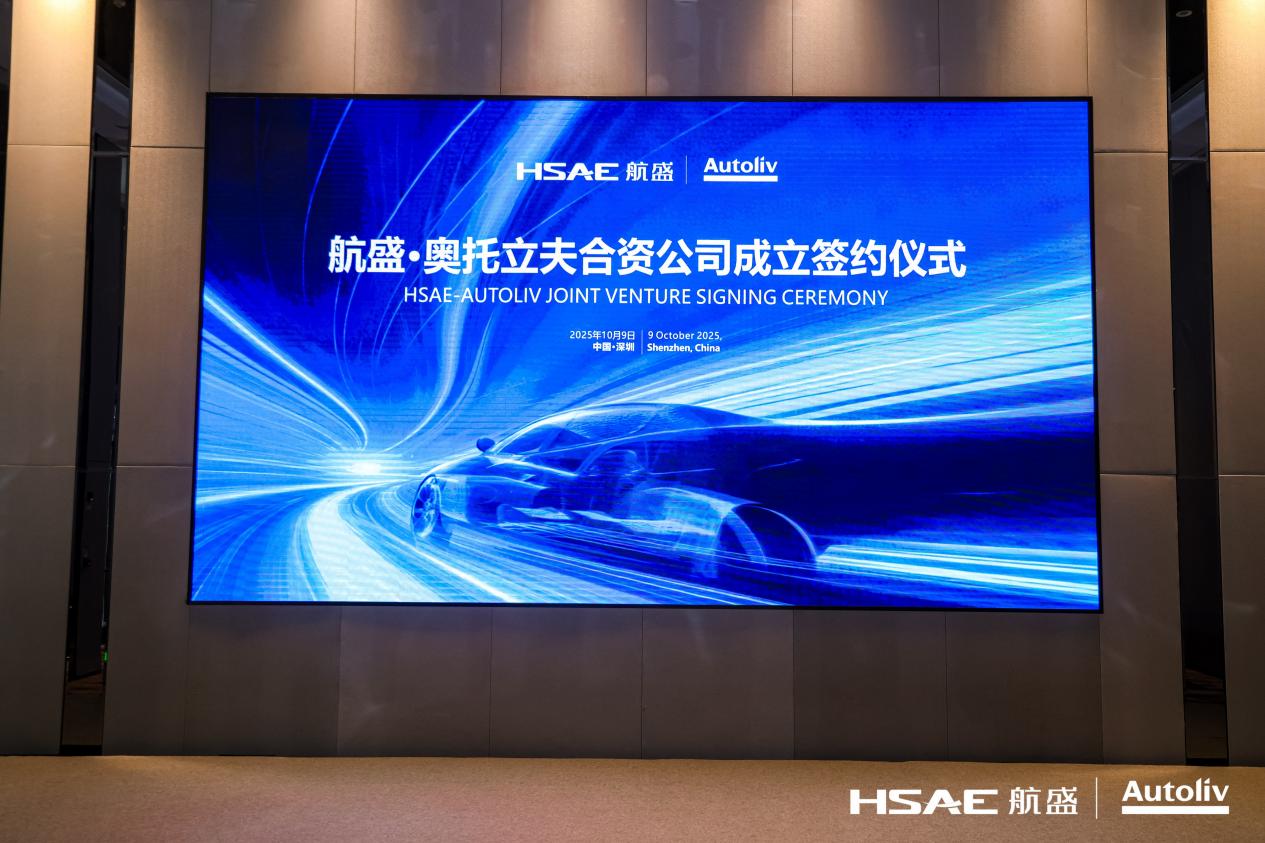
航盛电子与奥托立夫正式签约 共筑汽车电子安全领域新未来
Zhong Guo Qi Che Bao Wang· 2025-10-11 06:02
Core Insights - A strategic partnership focused on automotive electronic safety has been established between Shenzhen Hangseng Electronics and global safety systems leader Autoliv, marking a significant milestone in the integration of China's automotive electronics sector with global safety systems [1][3][4] Group 1: Partnership Details - The joint venture aims to develop and manufacture products in the automotive electronic safety field, with an expected establishment date in Q1 2026, located in the Yangtze River Delta region [3][4] - Initial focus areas for the new company include hands-free detection systems, pre-tensioner safety belt controllers, and electronic applications for safety belt systems [3][4] - This partnership is seen as a critical step in Hangseng's globalization strategy, enhancing Autoliv's ability to provide advanced safety solutions in the global market [3][4] Group 2: Historical Context - The collaboration follows a strategic memorandum signed in 2024, with the recent agreement being the fastest joint venture established by Autoliv in China in nearly 20 years, taking less than 12 months from negotiation to signing [4][5] - The rapid progress reflects a deep mutual trust and efficiency between the two companies [4][5] Group 3: Strategic Values - The partnership is characterized by three strategic values: acting as a bridge connecting global market resources with China's supply chain, fostering dual empowerment through cultural integration, and amplifying resources through technological collaboration [6][7] - The emphasis on quality and long-term sustainable development is a shared principle that underpins the partnership [5][9] Group 4: Innovation and Market Strategy - The joint venture aims to address the challenges of the automotive industry, particularly the need for innovation and quality amidst fierce competition [10][12] - The companies plan to explore global markets, including potential manufacturing and R&D centers in Europe, to leverage high-quality resources [10][12] - A focus on differentiated development is intended to avoid homogenization and low-price competition, enhancing value for customers [12]
Autoliv and Hangsheng Electric plan safety electronics JV for Chinese car market
Reuters· 2025-10-09 10:11
Core Viewpoint - Autoliv, a Swedish auto safety gear maker, plans to establish a joint venture with Hangsheng Electric, a Chinese electric vehicle electronics group, to produce safety electronics for the Chinese market [1] Group 1 - The joint venture aims to enhance the development of safety electronics specifically tailored for electric vehicles in China [1] - This collaboration reflects the growing demand for advanced safety features in the rapidly expanding Chinese electric vehicle market [1] - Autoliv's strategic move is expected to strengthen its position in the global automotive safety industry [1]

Autoliv and HSAE - New Strategic Joint Venture to Advance Automotive Safety Electronics
Prnewswire· 2025-10-09 10:01
Core Insights - Autoliv, Inc. and Hangsheng Electric Co., Ltd. are forming a joint venture to develop advanced safety electronics for the Chinese automotive market [1][2] - The joint venture will be established in Q1 2026, with Autoliv holding a 40% stake and HSAE holding 60% [2] - The partnership aims to leverage Autoliv's global safety leadership and HSAE's expertise in automotive electronics to create integrated solutions for both Chinese and international OEMs [5] Company Overview - Autoliv is a leader in automotive safety systems, developing products such as airbags and seatbelts, and aims to redefine mobility safety standards [5][6] - In 2024, Autoliv's sales reached $10.4 billion, and its products saved approximately 37,000 lives while reducing around 600,000 injuries [6] - Hangsheng Electric Co., Ltd. specializes in automotive electronics, including infotainment systems and intelligent vehicle solutions, serving a wide range of OEMs [7] Strategic Goals - The joint venture will focus on innovation and efficiency in automotive safety technologies, aiming to support both the Chinese market and global customers [3][4] - The partnership is expected to act as a catalyst for the transformation of China's automotive industry, promoting high-quality and sustainable growth [4] - The headquarters and production facilities will be located near Shanghai, enhancing operational synergies with existing Autoliv sites in China [2]

Wells Fargo Lifts Autoliv, Inc. (ALV) Price Target to $132, Keeps ‘Equal Weight’
Yahoo Finance· 2025-10-02 13:38
Core Insights - Autoliv, Inc. (NYSE:ALV) is recognized as a dividend stock benefiting from advancements in AI, with a price target increase from $126.00 to $132.00, indicating a potential rise of approximately 7% [1] - The company exhibits strong pricing power and sustained margins, consistently outperforming the market despite challenges such as tariffs and cost inflation [2] - Autoliv's innovation strategy focuses on enhancing safety systems for various applications, supported by a substantial portfolio of around 12,000 patents, which positions the company favorably for long-term growth [3] Financial Performance - Autoliv has shown stable revenue growth and is committed to shareholder returns through dividends and stock buybacks, reflecting an improving financial position due to automation and digitalization [2] - The company is noted for its commitment to saving lives through its passive safety systems, which have been a core part of its business since its founding in 1953 [4] Market Position - Autoliv's ongoing innovation and market collaborations are expected to bolster its long-term stock performance, particularly in the context of potential tariff relaxations and the trend of onshoring [3][4] - While Autoliv is seen as a viable investment, there are suggestions that certain AI stocks may present greater upside potential with less risk [4]
Invitation to Autoliv's Q3, 2025 Earnings Call
Prnewswire· 2025-09-18 12:27
Core Insights - Autoliv Inc. is set to release its Financial Report for Q3 2025 on October 17, 2025, at 12:00 CET [1] - A teleconference will be held on the same day, featuring Mikael Bratt, President & CEO, as the main speaker [2] Financial Reporting - The Q3 2025 earnings call is scheduled for October 17, 2025, from 14:00 to 15:00 CET [2] - Audio replay of the conference will be available until October 17, 2026 [2] - Transcripts of the earnings call will also be accessible on the company's investor relations page [2] Company Information - For further details about Autoliv, interested parties can visit the company's official website [2]
Autoliv: Strong Pricing Power Signals A Strengthened Competitive Moat
Seeking Alpha· 2025-08-25 12:12
Core Insights - The article expresses a positive outlook on ALV shares, indicating a beneficial long position held by the analyst [1]. Group 1 - The analyst emphasizes the importance of conducting personal research before making investment decisions, highlighting the inherent risks involved in investing [2]. - It is noted that past performance does not guarantee future results, suggesting a cautious approach to investment evaluations [3].

Autoliv Hit Sales and Margin Records in Q2
The Motley Fool· 2025-07-18 23:46
Core Insights - Autoliv reported record net sales of $2.7 billion in Q2, a 4% year-over-year increase, with adjusted operating income rising 14% to $251 million and adjusted operating margin improving by 80 basis points to 9.3% [1] - The company increased its quarterly dividend to $0.85 per share and reaffirmed its annual stock repurchase plans of $300 million to $500 million [1] Financial Performance - The company estimates its tariff exposure will double to around $200 million, with 80% of tariff costs recovered in Q2, limiting the operating margin impact to 35 basis points [2][3] - Adjusted operating margin reached 9.3%, up 80 basis points year over year, with gross margin improving by 30 basis points to 18.5% due to efficiency gains from a reduction of 3,200 direct production staff and investments in automation [4][5] Market Position and Growth - Autoliv achieved 16% growth in sales to domestic OEMs in China and maintained a 60% market share in India, contributing an additional $100 million to sales in 2025 [6][8] - The company expects continued positive sales trends in China as mix effects improve, despite challenges in North America and Western Europe [7][8] Future Outlook - Management projects 2025 organic sales growth of around 3%, an adjusted operating margin of approximately 10% to 10.5%, and operating cash flow of around $1.2 billion, despite anticipated declines in global light vehicle production [9]
Compared to Estimates, Autoliv (ALV) Q2 Earnings: A Look at Key Metrics
ZACKS· 2025-07-18 14:30
Core Insights - Autoliv, Inc. reported revenue of $2.71 billion for the quarter ended June 2025, reflecting a 4.2% increase year-over-year and a surprise of +3.36% over the Zacks Consensus Estimate of $2.63 billion [1] - The company's EPS for the quarter was $2.21, up from $1.87 in the same quarter last year, resulting in an EPS surprise of +6.76% compared to the consensus estimate of $2.07 [1] Financial Performance Metrics - Organic change in Airbags, Steering Wheels, and Other products was 3.1%, exceeding the average estimate of 0.4% from two analysts [4] - Total organic change was reported at 3.4%, significantly higher than the 0.4% estimated by two analysts [4] - Organic change in Seatbelt Products and Other was 4%, compared to the average estimate of 1.9% from two analysts [4] Regional Sales Performance - Net Sales in the Americas reached $891 million, surpassing the average estimate of $855.27 million, but showing a -0.2% change year-over-year [4] - Net Sales in Europe were $828 million, exceeding the average estimate of $751.53 million, with a year-over-year increase of +8.8% [4] - Net Sales in Asia excluding China were $519 million, above the average estimate of $499.63 million, reflecting a +7.5% year-over-year change [4] - Net Sales in China amounted to $477 million, slightly below the average estimate of $488.36 million, with a +1.9% year-over-year change [4] Product Category Sales - Net Sales for Seatbelt Products and Other reached $902 million, exceeding the average estimate of $839.37 million, with a year-over-year change of +5.1% [4] - Net Sales for Airbags, Steering Wheels, and Other products were $1.81 billion, surpassing the average estimate of $1.76 billion, reflecting a +3.7% year-over-year change [4] Stock Performance - Autoliv's shares have returned +5.9% over the past month, outperforming the Zacks S&P 500 composite's +5.4% change [3] - The stock currently holds a Zacks Rank 3 (Hold), indicating expected performance in line with the broader market in the near term [3]

Autoliv(ALV) - 2025 Q2 - Quarterly Report
2025-07-18 13:20
[PART I - FINANCIAL INFORMATION](index=4&type=section&id=PART%20I%20-%20FINANCIAL%20INFORMATION) This section provides the company's financial statements and management's discussion and analysis for the reported period [Financial Statements](index=4&type=section&id=ITEM%201.%20FINANCIAL%20STATEMENTS) This section presents the unaudited condensed consolidated financial statements for the quarterly period ended June 30, 2025, including statements of income, balance sheets, cash flows, and equity, along with notes detailing accounting policies and contingent liabilities [Consolidated Statements of Income](index=4&type=section&id=Consolidated%20Statements%20of%20Income%20(unaudited)) This table presents the unaudited consolidated statements of income, detailing revenues, expenses, and net income for the specified periods Consolidated Statements of Income Highlights (Unaudited) | (In millions, except per share data) | Three Months Ended June 30, 2025 | Three Months Ended June 30, 2024 | Six Months Ended June 30, 2025 | Six Months Ended June 30, 2024 | | :--- | :--- | :--- | :--- | :--- | | **Net sales** | $2,714 | $2,605 | $5,292 | $5,220 | | **Gross profit** | $501 | $475 | $980 | $917 | | **Operating income** | $247 | $206 | $502 | $400 | | **Net income attributable to controlling interest** | $167 | $138 | $334 | $265 | | **Net earnings per share – diluted** | $2.16 | $1.71 | $4.31 | $3.23 | [Condensed Consolidated Balance Sheets](index=6&type=section&id=Condensed%20Consolidated%20Balance%20Sheets%20(unaudited)) This table presents the unaudited condensed consolidated balance sheets, outlining assets, liabilities, and equity at specific dates Condensed Consolidated Balance Sheet Highlights (Unaudited) | (In millions) | As of June 30, 2025 | As of December 31, 2024 | | :--- | :--- | :--- | | **Total current assets** | $3,929 | $3,483 | | **Total assets** | $8,476 | $7,804 | | **Total current liabilities** | $4,235 | $3,633 | | **Total liabilities** | $5,997 | $5,518 | | **Total equity** | $2,480 | $2,285 | [Consolidated Statements of Cash Flows](index=7&type=section&id=Consolidated%20Statements%20of%20Cash%20Flows%20(unaudited)) This table presents the unaudited consolidated statements of cash flows, summarizing cash inflows and outflows from operating, investing, and financing activities Consolidated Statements of Cash Flows Highlights (Unaudited) | (In millions) | Six Months Ended June 30, 2025 | Six Months Ended June 30, 2024 | | :--- | :--- | :--- | | **Net cash provided by operating activities** | $355 | $462 | | **Net cash used in investing activities** | ($208) | ($286) | | **Net cash used in financing activities** | ($170) | ($269) | | **Decrease in cash and cash equivalents** | ($94) | ($90) | [Note 8. Contingent Liabilities](index=14&type=section&id=Note%208.%20Contingent%20Liabilities) This section details the company's contingent liabilities, including ongoing legal proceedings and potential financial exposures - The company faces a civil litigation in Germany from BMW, which filed a complaint claiming damages of **€63 million** plus interest (totaling approx. **€95 million**) related to a past EC investigation, with a possible loss range of **€0** to **€95 million**, but no accrual has been made[75](index=75&type=chunk) - Autoliv is a defendant in a class action lawsuit regarding ARC airbag inflators, and NHTSA issued an initial decision to recall approximately **52 million** ARC and Delphi inflators, some supplied by Autoliv, for which the company has not made an accrual and cannot estimate a range of potential loss[81](index=81&type=chunk)[82](index=82&type=chunk) - In Q2 2025, Stellantis initiated a recall of approximately **250,000** U.S. vehicles equipped with Autoliv's side curtain airbags, with an estimated potential loss range of **$0** to **$385 million**, a substantial portion of which is expected to be covered by insurance, and no accrual has been made[83](index=83&type=chunk) [Note 10. Revenue Disaggregation](index=17&type=section&id=Note%2010.%20Revenue%20Disaggregation) This section provides a detailed breakdown of the company's net sales by product category and geographical region Net Sales by Product and Region (in millions) | | Three Months Ended June 30, 2025 | Three Months Ended June 30, 2024 | | :--- | :--- | :--- | | **By Product** | | | | Airbags, Steering Wheels and Other | $1,812 | $1,747 | | Seatbelt Products and Other | $902 | $858 | | **Total Net Sales** | **$2,714** | **$2,605** | | **By Region** | | | | Americas | $891 | $893 | | Europe | $828 | $761 | | China | $477 | $468 | | Asia excl. China | $519 | $483 | | **Total Net Sales** | **$2,714** | **$2,605** | [Management's Discussion and Analysis of Financial Condition and Results of Operations (MD&A)](index=18&type=section&id=ITEM%202.%20MANAGEMENT'S%20DISCUSSION%20AND%20ANALYSIS%20OF%20FINANCIAL%20CONDITION%20AND%20RESULTS%20OF%20OPERATIONS) Management analyzes the company's financial performance for Q2 and H1 2025, highlighting record sales and profitability driven by organic growth, cost reductions, and tariff compensations, while detailing operational results, liquidity, cash flow, and updated full-year guidance [Executive Overview](index=19&type=section&id=EXECUTIVE%20OVERVIEW) Autoliv achieved record Q2 sales, operating income, margin, and EPS, driven by strong sales and cost reductions, outperforming global LVP, and announced a new **$2.5 billion** share repurchase program and a **21%** dividend increase, while raising full-year organic sales growth guidance to around **3%** Q2 2025 Financial Highlights (vs. Q2 2024) | Metric | Value | Change | | :--- | :--- | :--- | | Net Sales | $2,714 million | +4.2% | | Organic Sales Growth | 3.4% | - | | Operating Margin | 9.1% | - | | Adjusted Operating Margin | 9.3% | - | | Diluted EPS | $2.16 | +27% | | Adjusted Diluted EPS | $2.21 | +18% | - The company successfully passed on most tariff costs to customers, recovering around **80%** in Q2, which limited the negative impact on operating margin to about **35 basis points**[107](index=107&type=chunk)[111](index=111&type=chunk)[114](index=114&type=chunk) - Shareholder returns were enhanced with the announcement of a new share repurchase program of up to **$2.5 billion** through 2029 and a **21%** dividend increase for Q3 to **$0.85** per share[108](index=108&type=chunk) [Results of Operations (Q2 2025 vs Q2 2024)](index=22&type=section&id=RESULTS%20OF%20OPERATIONS%20-%20Q2%202025) Q2 2025 net sales increased **4.2%** to **$2.714 billion**, with **3.4%** organic growth outperforming global LVP, while operating income rose **20.1%** to **$247 million**, and operating margin expanded to **9.1%** due to improved efficiency and lower costs Q2 2025 Organic Sales Growth vs. LVP | Region | Autoliv Organic Growth | LVP Growth | Outperformance/(Underperformance) | | :--- | :--- | :--- | :--- | | Americas | 4.1% | (0.9)% | 5.0 pp | | Europe | 3.3% | (1.6)% | 4.9 pp | | China | 1.7% | 8.8% | (7.0) pp | | Asia excl. China | 3.8% | 2.5% | 1.3 pp | | **Global** | **3.4%** | **2.7%** | **0.7 pp** | - Gross profit improved by **$27 million**, driven by operational efficiencies in labor, freight, and logistics, which offset negative effects from un-recovered tariff costs[133](index=133&type=chunk) - Diluted EPS increased by **27%** to **$2.16**, primarily driven by higher operating income (**$0.39**) and a lower share count (**$0.10**)[131](index=131&type=chunk)[138](index=138&type=chunk) [Results of Operations (Six Months 2025 vs 2024)](index=25&type=section&id=RESULTS%20OF%20OPERATIONS%20-%20Six%20Months%202025) For the first six months of 2025, net sales increased **1.4%** to **$5.292 billion** with **2.8%** organic growth, while operating income grew **25%** to **$502 million**, and operating margin improved to **9.5%** due to higher gross profit and reduced RD&E costs Six Months 2025 Organic Sales Growth vs. LVP | Region | Autoliv Organic Growth | LVP Growth | Outperformance/(Underperformance) | | :--- | :--- | :--- | :--- | | Americas | 2.7% | (2.0)% | 4.7 pp | | Europe | 2.6% | (3.1)% | 5.7 pp | | China | 0.1% | 11.4% | (11.3) pp | | Asia excl. China | 5.8% | 3.2% | 2.6 pp | | **Global** | **2.8%** | **3.1%** | **(0.3) pp** | - In China, LVP for global OEMs declined **4%** while it increased **21%** for domestic OEMs, with Autoliv's sales to domestic OEMs growing **17%**, and performance is expected to improve in the second half of 2025 due to a record number of new launches[144](index=144&type=chunk) - Diluted EPS for the six-month period increased by **34%** to **$4.31**, with higher operating income contributing **$0.92** and a lower share count adding **$0.24**[146](index=146&type=chunk)[154](index=154&type=chunk) [Liquidity and Capital Resources](index=27&type=section&id=LIQUIDITY%20AND%20CAPITAL%20RESOURCES) Operating cash flow for the first six months of 2025 was **$355 million**, down from **$462 million** due to increased working capital, while net debt rose to **$1.752 billion** with a leverage ratio of **1.3x**, remaining within the target range Cash Flow Summary (Six Months Ended June 30) | (In millions) | 2025 | 2024 | | :--- | :--- | :--- | | Operating cash flow | $355 | $462 | | Capital expenditure, net | ($208) | ($286) | | **Free operating cash flow (Non-GAAP)** | **$147** | **$176** | - Net debt was **$1,752 million** as of June 30, 2025, an increase of **$172 million** from the prior year, mainly because shareholder returns (dividends and repurchases) exceeded free operating cash flow[161](index=161&type=chunk) - The leverage ratio (Net debt + Pension liabilities / Adjusted EBITDA) was **1.3x**, compared to **1.2x** a year ago, remaining within the company's target range of **0.5x** to **1.5x**[163](index=163&type=chunk)[179](index=179&type=chunk)[181](index=181&type=chunk) [Full Year 2025 Guidance](index=32&type=section&id=Full%20year%202025%20guidance) Autoliv updated its full-year 2025 guidance, raising organic sales growth forecast to around **3%** and reiterating adjusted operating margin of **10-10.5%** and operating cash flow of about **$1.2 billion**, based on an assumed **0.5%** decline in global LVP Full Year 2025 Guidance and Assumptions | Metric | Guidance/Assumption | | :--- | :--- | | **Guidance** | | | Organic sales growth | Around 3% | | Adjusted operating margin | Around 10-10.5% | | Operating cash flow | Around $1.2 billion | | **Assumptions** | | | LVP growth | Around -0.5% | | Tax rate (excl. unusual items) | Around 28% | [Quantitative and Qualitative Disclosures About Market Risk](index=34&type=section&id=ITEM%203.%20QUANTITATIVE%20AND%20QUALITATIVE%20DISCLOSURES%20ABOUT%20MARKET%20RISK) As of June 30, 2025, there have been no material changes to the company's quantitative and qualitative disclosures about market risk since its 2024 Annual Report on Form 10-K - There have been no material changes to the information related to market risk since the company's 2024 Annual Report on Form 10-K[194](index=194&type=chunk) [Controls and Procedures](index=34&type=section&id=ITEM%204.%20CONTROLS%20AND%20PROCEDURES) Management, including the CEO and CFO, concluded that the company's disclosure controls and procedures were effective as of June 30, 2025, with no material changes to internal control over financial reporting during the quarter - The CEO and CFO concluded that the company's disclosure controls and procedures are effective as of the end of the reporting period[195](index=195&type=chunk) - No material changes were identified in the company's internal control over financial reporting during the fiscal quarter[195](index=195&type=chunk) [PART II - OTHER INFORMATION](index=35&type=section&id=PART%20II%20-%20OTHER%20INFORMATION) This section contains additional information including legal proceedings, risk factors, equity sales, and other disclosures [Legal Proceedings](index=35&type=section&id=ITEM%201.%20LEGAL%20PROCEEDINGS) This section incorporates by reference detailed disclosures on the company's ongoing legal proceedings and contingent liabilities from Note 8 in Part I of this report - Information regarding ongoing legal proceedings is incorporated by reference from Part I, Item 1, "Financial Statements, Note 8 Contingent Liabilities"[196](index=196&type=chunk) [Risk Factors](index=35&type=section&id=ITEM%201A.%20RISK%20FACTORS) The company reports no material changes to its risk factors from the 2024 Form 10-K, except for an updated risk concerning international operations, highlighting increased exposure to geopolitical instability, trade policies, and tariffs - The risk factors are largely unchanged from the 2024 Form 10-K, except for an update to the risks related to international operations[197](index=197&type=chunk) - The updated risk factor emphasizes exposure to unexpected changes in laws, trade policies, tariffs, and geopolitical turmoil, noting recent U.S. tariffs on imports from China and retaliatory actions[198](index=198&type=chunk)[200](index=200&type=chunk) [Unregistered Sales of Equity Securities and Use of Proceeds](index=37&type=section&id=ITEM%202.%20UNREGISTERED%20SALES%20OF%20EQUITY%20SECURITIES%20AND%20USE%20OF%20PROCEEDS) During Q2 2025, the company repurchased **510,361** shares, and a new stock repurchase program authorizing up to **$2.5 billion** in common shares was approved, effective July 1, 2025, through December 31, 2029 Common Stock Repurchases (Q2 2025) | Period | Total Number of Shares Purchased | Average Price Paid per Share (USD) | | :--- | :--- | :--- | | April 1-30, 2025 | 112,339 | $90.79 | | May 1-31, 2025 | 270,911 | $100.26 | | June 1-30, 2025 | 127,111 | $106.82 | - A new stock repurchase program was approved, authorizing up to **$2.5 billion** in share repurchases between July 1, 2025, and December 31, 2029[206](index=206&type=chunk) [Other Information](index=37&type=section&id=ITEM%205.%20OTHER%20INFORMATION) An executive adopted a Rule 10b5-1(c) trading plan to sell shares acquired upon vesting in February 2026, primarily to cover associated taxes - An executive, Staffan Olsson, adopted a Rule 10b5-1(c) trading plan for the future sale of company stock to cover vesting taxes[209](index=209&type=chunk) [Exhibits](index=38&type=section&id=ITEM%206.%20EXHIBITS) This section lists all exhibits filed with the Quarterly Report on Form 10-Q, including corporate governance documents, debt agreements, officer certifications, and interactive data files - The report includes various exhibits, such as the company's Restated Certificate of Incorporation, By-Laws, debt agreements, and certifications by the CEO and CFO[211](index=211&type=chunk)