
Corvus Pharmaceuticals(CRVS)

Search documents
What made Corvus stock double on Tuesday and is it sustainable?
Invezz· 2026-01-20 19:10
Core Insights - Corvus Pharmaceuticals' shares more than doubled on January 20 following the announcement of positive Phase 1 trial data for its oral investigational drug, soquelitinib, aimed at treating atopic dermatitis [1] Company Summary - The significant increase in share price indicates strong investor confidence in the potential of soquelitinib as a treatment option for atopic dermatitis [1] - The positive trial results may position Corvus Pharmaceuticals favorably in the competitive dermatology market, particularly for conditions like atopic dermatitis [1]



Corvus Stock Spikes On Heels Of Strong Eczema Study Results
Benzinga· 2026-01-20 19:00
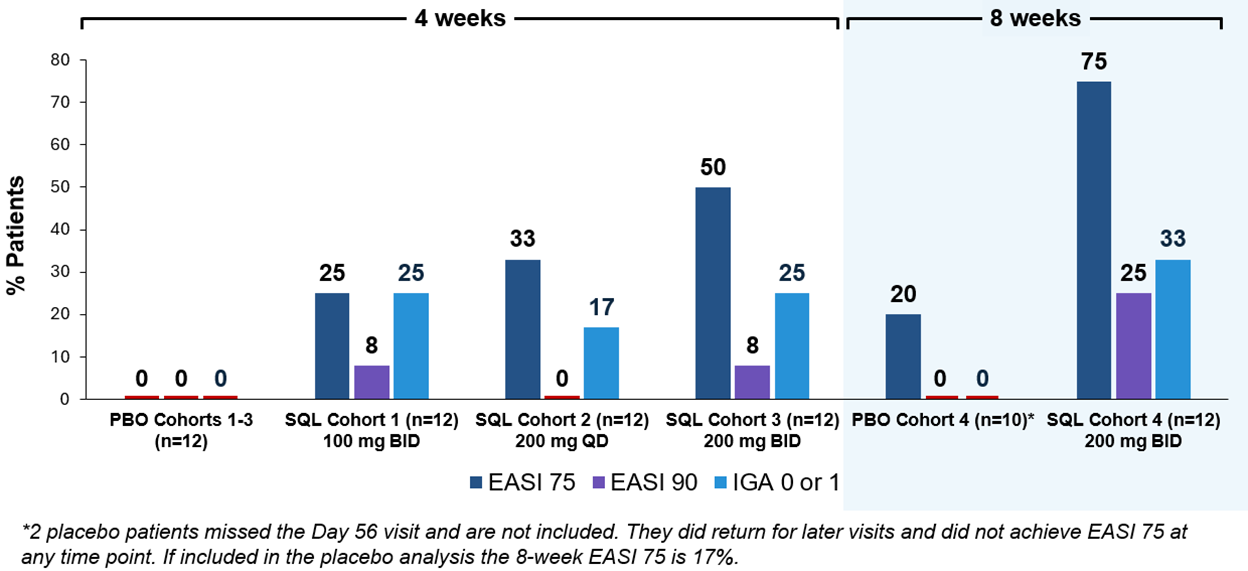
Core Insights - Corvus Pharmaceuticals reported positive data from cohort 4 of the Phase 1 trial for soquelitinib in patients with moderate-to-severe atopic dermatitis, leading to a significant increase in stock price and trading volume [1][9] Efficacy and Safety Results - Cohort 4 demonstrated favorable safety and efficacy results, with a deeper response over an 8-week treatment period compared to a 4-week period, and clinical activity observed in patients with prior systemic therapies [2] - The mean baseline EASI score was 25.7 for soquelitinib patients and 21.9 for placebo patients, indicating a higher severity of eczema in the treatment group [2] - Across all four cohorts (n=72), 35% of patients had prior systemic therapies, with 50% in cohort 4, and significant responses were noted in EASI 75 and IGA 0 or 1 endpoints [3] Treatment Outcomes - At day 56, the mean percent reduction in EASI for cohort 4 patients receiving soquelitinib was 72%, compared to 40% for placebo [3] - Continuous improvement in response was observed from day 28 to day 56, with no disease flares in the soquelitinib group compared to two in the placebo group [4] Biomarker Data - A reduction in serum IL-4 cytokine was noted in cohorts 3 and 4, with cohort 4 showing the largest reductions, indicating a dose-dependent response [5] - Serum IL-5 reduction occurred as early as day 8, with lower levels of IL-17 and TARC also observed [6] Safety Profile - As of January 15, no new safety signals were reported, with adverse events occurring in 41.7% of soquelitinib patients and 50% of placebo patients, all classified as Grade 1-2 [6] Future Trials - Corvus plans to initiate a Phase 2 clinical trial for soquelitinib in the first quarter of 2026, targeting approximately 200 patients who have failed prior therapies [7] - The trial will consist of four cohorts of 50 patients each, testing various dosages of soquelitinib alongside a placebo group [8]

Crude Oil Gains 2%; D.R. Horton Earnings Top Views - Bakkt Hldgs (NYSE:BKKT), Corvus Pharma (NASDAQ:CRVS)
Benzinga· 2026-01-20 17:29
Market Overview - U.S. stocks experienced a decline, with the Nasdaq Composite falling 1.5% amid President Trump's tariff threats related to the Greenland dispute [1] - The Dow decreased by 1.17% to 48,780.92, while the S&P 500 dropped 1.32% to 6,848.33 [1] - European shares also fell, with the eurozone's STOXX 600 down 0.92% and major indices in Spain, London, Germany, and France experiencing declines [8] Company Earnings - D.R. Horton, Inc. reported net income of $594.8 million, or $2.03 per diluted share, for Q1 of fiscal 2026, down from $844.9 million, or $2.61 per diluted share, in the same quarter last year [3] - Revenue for D.R. Horton was $6.887 billion, a decrease from $7.613 billion year-over-year, but exceeded the consensus estimate of $6.603 billion [4] Stock Movements - Rapt Therapeutics Inc shares surged 64% to $57.52 following GSK's announcement of an acquisition [9] - Corvus Pharmaceuticals Inc shares increased by 107% to $16.66 after positive clinical trial results [9] - Immunitybio Inc shares rose 23% to $6.78 after a meeting with the FDA regarding its application for a cancer treatment [9] - Bakkt Holdings Inc shares fell 19% to $17.42 after announcing a $300 million ATM equity program [9] - NovaBay Pharmaceuticals Inc shares dropped 45% to $8.07 following a stock offering announcement [9] - Synlogic Inc shares decreased by 38% to $0.70 after receiving a Nasdaq delisting notification [9] Commodities - Oil prices increased by 2% to $60.62, while gold rose by 3.6% to $4,759.30 [7] - Silver saw a significant increase of 7.1% to $94.845, whereas copper fell by 0.8% to $5.7845 [7]






Dow Jones crashes 700 points today: Why US stock market is down today? 5 Key reasons behind Dow crash
The Economic Times· 2026-01-20 15:22
Market Overview - U.S. stock markets experienced a sharp decline, with the Dow Jones Industrial Average dropping approximately 700 points (about 1.5%), the S&P 500 losing around 1.4%, and the Nasdaq Composite sliding nearly 1.7%, indicating a broad sell-off across Wall Street [1][17] - The Cboe Volatility Index rose above 20, its highest level since late November, reflecting increased market fear and risk aversion [1] Tariff Announcement Impact - President Trump's announcement of escalating tariffs on imports from eight NATO countries, including Denmark, Norway, Sweden, France, Germany, the U.K., the Netherlands, and Finland, triggered the market sell-off, with tariffs starting at 10% on February 1 and potentially rising to 25% by June 1 if no agreement is reached [4][19] - The announcement included a warning of 200% tariffs on French wines and champagne due to diplomatic tensions with France, further escalating investor concerns [5] Geopolitical Concerns - Geopolitical tensions, particularly in the Middle East regarding Iran's internal unrest and strained relations with Israel, contributed to global risk concerns, affecting investor sentiment [2][14] - Iran's protests and potential military responses to U.S. or Israeli actions have raised fears of regional conflict, which could impact global energy markets and crude oil prices [15][22] Corporate Earnings and Market Sentiment - The earnings season is unfolding, with S&P 500 earnings growth expected to be between 12-15%, which could provide support if broader economic signals remain stable [3] - Technology stocks, particularly Nvidia, AMD, and Alphabet, faced significant declines of over 2% due to rising bond yields, which can increase borrowing costs and reduce future profit valuations [10][19] Safe-Haven Assets - As a result of the market turmoil, precious metals like gold and silver surged due to increased safe-haven demand, with gold trading near record highs [2][11]

Corvus Pharmaceuticals (NasdaqGM:CRVS) Update / briefing Transcript
2026-01-20 14:02
Corvus Pharmaceuticals Conference Call Summary Company Overview - **Company**: Corvus Pharmaceuticals (NasdaqGM:CRVS) - **Date**: January 20, 2026 - **Key Executives Present**: Dr. Richard Miller (CEO), Leif Lea (CFO), Jeff Arcara (CBO), Dr. Ben Jones (SVP, Pharmaceutical Development), Dr. Suresh Mahabhashyam (VP, Clinical Development) [2][3] Core Industry and Product Focus - **Industry**: Pharmaceuticals, specifically focusing on immune diseases and atopic dermatitis - **Product**: Socalitinib, a first-in-class oral drug targeting interleukin-2 inducible T-cell kinase (ITK) [4][39] Key Findings and Data from Clinical Trials - **Phase I Clinical Trial Results**: - Socalitinib shows potential as a leading therapy for atopic dermatitis, achieving significant clinical results [5][6] - Efficacy metrics: - EASI 75: 75% of patients - EASI 90: 25% of patients - IGA 0/1: 33% of patients - Mean percent reduction in EASI score: 72% at eight weeks [6][24] - Responses are durable, with continued reduction in EASI scores post-treatment [6][21] - **Cohort 4 Specifics**: - 24 patients enrolled with a one-to-one randomization of active versus placebo - Treatment duration extended to eight weeks, confirming positive results from earlier cohorts [18][24] - EASI score reduction: 72% for Socalitinib vs. 40% for placebo, p-value of 0.035 [24][26] - **Prior Systemic Therapy**: - 35% of all patients had prior therapies, with 50% in cohort 4 - Socalitinib demonstrated efficacy in patients with prior systemic therapy, indicating no resistance [27][30] Mechanism of Action - Socalitinib selectively inhibits ITK, leading to a rebalancing of the immune system without causing immunosuppression [9][10] - Induction of T regulatory cells (Tregs) contributes to durable suppression of inflammation [21][30] Market Opportunity - Over 3 million patients with moderate to severe atopic dermatitis, with a significant unmet need for safe and effective oral therapies [15][38] - The market for atopic dermatitis is projected to grow to $170 billion by 2030, with oral agents expected to gain a larger share [38] Future Plans - Initiation of a phase 2 randomized placebo-controlled trial in atopic dermatitis, planned to enroll 200 patients [37][39] - Exploration of Socalitinib's efficacy in other immune diseases, including hidradenitis suppurativa and asthma [39] Safety Profile - No new safety signals observed in cohort 4; adverse events (AEs) were similar between active and placebo groups [31][55] - Historical data from lymphoma studies indicate a strong safety profile, with no patients discontinuing due to safety concerns [54][55] Conclusion - Socalitinib is positioned as a promising treatment for atopic dermatitis and potentially other immune diseases, with a strong clinical efficacy and safety profile [39][40]
Corvus Pharmaceuticals Announces Positive Data from Cohort 4 Confirming Results for Placebo-Controlled Phase 1 Clinical Trial of Soquelitinib for Atopic Dermatitis
Globenewswire· 2026-01-20 12:00
Core Insights - Corvus Pharmaceuticals announced positive results from cohort 4 of the Phase 1 clinical trial for soquelitinib, showing favorable safety and efficacy in patients with moderate to severe atopic dermatitis [1][2][3] - The company plans to initiate a Phase 2 trial in Q1 2026, targeting patients who have failed prior therapies [1][22] Efficacy Results - In cohort 4, 75% of soquelitinib patients achieved EASI 75, 25% achieved EASI 90, and 33% achieved IGA 0/1, compared to placebo results of 20%, 0%, and 0% respectively [1][7] - The mean percent reduction in EASI for soquelitinib patients was 72% at day 56, compared to 40% for placebo [5] - Continuous improvement in response was observed from day 28 to day 56, with a statistically significant difference (p=0.035) [9] Safety Profile - No new safety signals were reported; adverse events occurred in 41.7% of soquelitinib patients and 50% of placebo patients, all classified as Grade 1-2 [21] - No severe or serious adverse events were reported during the trial [21] Patient Demographics - Cohort 4 included 12 patients treated with soquelitinib and 12 placebo patients, with 10 evaluable at day 56 [3][4] - 50% of cohort 4 patients had received prior systemic therapies, consistent with the overall cohort data where 35% had prior treatments [3][13] Mechanism of Action - Soquelitinib is believed to act through ITK inhibition, which regulates multiple T cell functional pathways, showing potential for a wide range of inflammatory and immune diseases [1][2][25] - Biomarker data indicated reductions in serum IL-4 and IL-5 cytokines, supporting the drug's mechanism of action [18][19] Future Plans - The upcoming Phase 2 trial will enroll approximately 200 patients and will evaluate different dosing regimens of soquelitinib [22] - The trial aims to further assess the efficacy and safety of soquelitinib in a larger patient population [2][22]
Corvus Pharmaceuticals to Announce Results from Cohort 4 of Placebo-Controlled Phase 1 Clinical Trial of Soquelitinib for Atopic Dermatitis
Globenewswire· 2026-01-16 21:01
Core Insights - Corvus Pharmaceuticals, Inc. will host a conference call and webcast on January 20, 2026, to report results from cohort 4 of a Phase 1 clinical trial evaluating soquelitinib for moderate to severe atopic dermatitis [1] - Soquelitinib is an investigational oral small molecule drug that selectively inhibits ITK and is currently in a registration Phase 3 clinical trial for relapsed/refractory PTCL [3] Company Overview - Corvus Pharmaceuticals is a clinical-stage biopharmaceutical company focused on ITK inhibition as a novel immunotherapy approach for various immune diseases and cancers [3] - The company is developing multiple clinical-stage candidates targeting a range of cancer indications [3] Conference Call Details - The conference call can be accessed via a toll-free domestic number or an international number, and a live webcast will be available on the investor relations section of the Corvus website [2] - A replay of the webcast will be accessible on the Corvus website for 60 days following the event [2]

Corvus Pharmaceuticals Confirms Plans to Announce Results from Cohort 4 of Placebo-Controlled Phase 1 Clinical Trial of Soquelitinib for Atopic Dermatitis in January 2026 Following Annual Healthcare Conference
Globenewswire· 2026-01-05 13:30
Group 1 - Corvus Pharmaceuticals is set to announce results from cohort 4 of its Phase 1 clinical trial for soquelitinib in patients with moderate to severe atopic dermatitis in the second half of January 2026 [1] - The company has canceled all previously planned conference attendances, including a presentation at the J.P. Morgan 2026 Healthcare Conference scheduled for January 12th [1] - Soquelitinib is an investigational oral small molecule drug that selectively inhibits ITK and is currently in a registration Phase 3 clinical trial for relapsed/refractory PTCL [2] Group 2 - Corvus Pharmaceuticals is pioneering ITK inhibition as a new approach to immunotherapy for various immune diseases and cancer [2] - The company is focused on developing innovative treatments and has a lead product candidate, soquelitinib, which is also in a Phase 1 clinical trial for atopic dermatitis [2]
After-Hours Gainers: GH Research, Phathom, Forte, OKYO, Zai Lab, LifeMD, Werewolf & Corvus Rally
RTTNews· 2026-01-05 03:16
Core Insights - Biotech companies experienced significant gains in after-hours trading, driven by investor interest despite limited news catalysts [1] Company Updates - GH Research PLC (GHRS) saw the largest increase, rising 22.36% to $16.20 ahead of a key update on its Investigational New Drug Application (IND) for GH001 with the FDA, scheduled for January 5, 2026 [2] - Phathom Pharmaceuticals, Inc. (PHAT) increased by 5.03% to $16.50, with the rise attributed to investor positioning rather than new announcements [3] - Forte Biosciences, Inc. (FBRX) gained 3.56%, closing at $24.45, continuing its upward trend in the biotech sector without any new updates [3] - OKYO Pharma Limited (OKYO) advanced 5.38% to $2.35, influenced by prior disclosures regarding share acquisitions by its Executive Chairman [4] - Zai Lab Limited (ZLAB) rose 5.60% to $18.30, reflecting ongoing investor interest in international biotech firms [5] - LifeMD, Inc. (LFMD) added 3.15% to $3.60, with no corporate updates released [5] - Werewolf Therapeutics, Inc. (HOWL) climbed 3.58% to $0.67, indicating speculative interest in smaller-cap biotech stocks [6] - Corvus Pharmaceuticals, Inc. (CRVS) increased by 7.24% to $7.85, extending its upward momentum without any new announcements [6]





Corvus Pharmaceuticals Presents Final Data from Soquelitinib Phase 1/1b T Cell Lymphoma Trial
Globenewswire· 2025-12-08 15:30
Core Insights - Corvus Pharmaceuticals presented final data from its Phase 1/1b trial of soquelitinib for T cell lymphoma, showing promising median progression-free survival (PFS) of 6.2 months and median overall survival (OS) of 28.1 months, indicating potential as a new treatment option [1][2][5] Group 1: Clinical Trial Results - The Phase 1 trial enrolled 75 patients with various T cell lymphomas, with a median of 3 prior therapies, and only 31% achieving an objective response to their last therapy [2][4] - In the 200 mg twice-daily cohort, 6 patients achieved complete responses, with an objective response rate of 37.5% among those with 1 to 3 prior therapies [4] - The trial demonstrated no dose-limiting toxicities or significant adverse events, indicating a favorable safety profile for soquelitinib [4] Group 2: Mechanism of Action - Soquelitinib operates through ITK inhibition, affecting T cell receptor signaling and promoting Th1 differentiation while blocking Th2 and Th17 pathways [3][8] - Biomarker studies showed an increase in Th1 cells and a reduction in IL-5, supporting the drug's immunological effects [9] Group 3: Future Development Plans - The company is advancing soquelitinib into a registration Phase 3 trial for relapsed/refractory peripheral T cell lymphoma (PTCL), with plans to enroll 150 patients [5][11] - Corvus is also exploring soquelitinib's potential in atopic dermatitis and other immune and inflammatory diseases, with additional data expected in early 2026 [5][7]