
Hitek(HKIT)

Search documents
海天网络近期关注点:财报披露、重大事项与市场表现
Jing Ji Guan Cha Wang· 2026-02-12 20:46
Group 1 - The core viewpoint of the articles highlights the recent financial performance and market characteristics of Hai Tian Network (HKIT.US), emphasizing the importance of upcoming financial reports and official announcements for investors [1][2]. Group 2 - The latest financial report indicates that the company's revenue is relatively small and it is currently operating at a loss, with the most recent revenue reported at $741,500 and a net loss of $916,100 [2]. Group 3 - There are currently no brokerage firms providing investment rating recommendations for the stock, indicating a lack of analyst coverage [3].
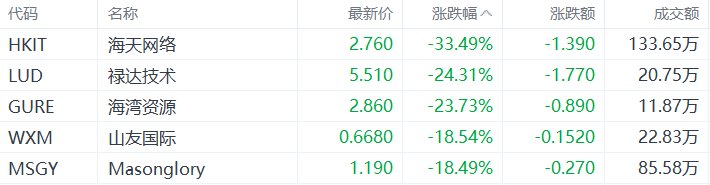
美股异动丨海天网络跌33.49%,为跌幅最大的中概股


Ge Long Hui· 2025-11-12 01:00
Core Viewpoint - Chinese concept stocks experienced significant declines, with notable drops in several companies' stock prices, indicating potential volatility in the market [1] Group 1: Stock Performance - Haitan Network (HKIT) saw a decline of 33.49%, closing at 2.760, with a drop of 1.390 and a trading volume of 1.3365 million [1] - Luda Technology (LUD) fell by 24.31%, ending at 5.510, down by 1.770, with a trading volume of 207.5 thousand [1] - Gulf Resources (GURE) decreased by 23.73%, closing at 2.860, down by 0.890, with a trading volume of 118.7 thousand [1] - Shanyou International (WXM) dropped 18.54%, closing at 0.6680, down by 0.1520, with a trading volume of 228.3 thousand [1] - Masonglory (MSGY) experienced an 18.49% decline, closing at 1.190, down by 0.270, with a trading volume of 855.8 thousand [1]

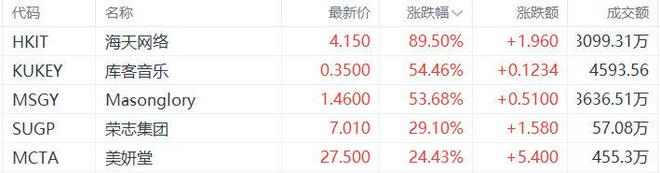
美股异动丨海天网络涨89.5%,为涨幅最大的中概股
Ge Long Hui· 2025-11-11 00:27
Core Insights - Chinese concept stocks experienced significant gains, with notable increases in share prices for several companies [1] Group 1: Stock Performance - Haitan Network (HKIT) saw a remarkable increase of 89.5%, closing at 4.150, with a trading volume of 30.9931 million [1] - Kuke Music (KUKEY) rose by 54.46%, reaching a price of 0.3500, with a trading volume of 4.59356 million [1] - Masonglory (MSGY) increased by 53.68%, closing at 1.4600, with a trading volume of 36.3651 million [1] - Rongzhi Group (SUGP) experienced a gain of 29.1%, closing at 7.010, with a trading volume of 570,800 [1] - Meiyantang (MCTA) rose by 24.43%, closing at 27.500, with a trading volume of 4.553 million [1]
Hitek(HKIT) - 2025 Q2 - Quarterly Report
2025-10-22 14:22
Financial Performance - Total revenues for the six months ended June 30, 2025, were $741,541, a decrease of 59.6% compared to $1,833,590 for the same period in 2024[4] - Gross profit for the first half of 2025 was $173,866, down 81.8% from $953,410 in 2024[4] - Operating loss increased to $1,347,587 in 2025 from $371,854 in 2024, reflecting a significant rise in operating expenses[4] - Net loss for the six months ended June 30, 2025, was $916,109, compared to a net income of $121,662 in 2024[4] - The company reported a basic and diluted loss per ordinary share of $0.03 for the six months ended June 30, 2025, compared to earnings of $0.01 in 2024[4] - For the six months ended June 30, 2025, HiTek Global reported a net loss of $916,109 compared to a net income of $121,662 for the same period in 2024[9] - The company reported a total loss before income taxes of $1,016,991 for the six months ended June 30, 2025, compared to an income of $292,239 for the same period in 2024[110] - The company reported an operating loss of $548,003 for the six months ended June 30, 2025, compared to an operating loss of $770,127 in 2024, showing an improvement of about 29%[129] Assets and Liabilities - Total current assets as of June 30, 2025, were $34,348,326, slightly up from $34,186,178 as of December 31, 2024[3] - Total assets decreased to $41,111,545 as of June 30, 2025, from $41,542,190 at the end of 2024[3] - Total liabilities increased to $6,516,315 as of June 30, 2025, compared to $6,267,270 as of December 31, 2024[3] - Shareholders' equity decreased to $34,595,230 as of June 30, 2025, from $35,274,920 at the end of 2024[3] - The company's total liabilities as of June 30, 2025, were $6,668,610, compared to $6,701,376 as of December 31, 2024[26] - Total accounts receivable as of June 30, 2025, was $2,470,950, a decrease from $3,409,258 as of December 31, 2024, representing a reduction of approximately 27%[118] - Total short-term investments as of June 30, 2025, amounted to $21,600,727, a decrease from $22,932,540 on December 31, 2024[75] Cash Flow and Investments - The company generated net cash provided by operating activities of $1,153,600 for the six months ended June 30, 2025, an increase from $754,123 in the prior year[9] - Cash at the end of the period on June 30, 2025, was $8,198,325, an increase from $7,216,058 at the end of the same period in 2024[9] - The company reported a net cash used in investing activities of $225,763 for the six months ended June 30, 2025, significantly lower than $11,028,114 in the prior year[9] - Net cash used in operating activities for the six months ended June 30, 2025, was $695,615, slightly higher than $678,667 in 2024[131] Revenue Breakdown - Revenues for the six months ended June 30, 2025, were $737,904, down from $1,823,568 in the same period of 2024, indicating a decline of approximately 59.6%[26] - Hardware sales generated $616,929, down from $747,378 in the previous year, while tax devices and services revenue was $124,612, compared to $263,768 in 2024[53] - The Company recognized $55,720 in revenue from deferred revenue for the six months ended June 30, 2025, down from $164,104 in 2024[55] Tax and Regulatory Matters - The company did not pay any cash for income taxes during the six months ended June 30, 2025, compared to $79,149 in the same period of 2024[9] - The effective tax rate for the six months ended June 30, 2025, was 9.9%, significantly lower than 58.4% for the same period in 2024[114] - The company had no significant unrecognized uncertain tax positions or liabilities as of June 30, 2025, indicating a stable tax position[115] Shareholder Information - The weighted average number of ordinary shares outstanding increased to 29,299,364 in 2025 from 14,392,364 in 2024[4] - The company issued 3,404,685 ordinary shares in April 2023, raising approximately $15.1 million from the IPO at $5 per share[101] - As of June 30, 2025, the company had outstanding warrants for 14,907,000 Class A ordinary shares with an exercise price of $0.55, expiring in 1.5 years[104] Risk Factors - The Company’s operations are concentrated in the PRC, exposing it to specific political, economic, and legal risks[34] - Cash balances held in PRC banks as of June 30, 2025, were uninsured, but the Company has not experienced any losses in bank accounts during the reporting periods[33] Accounting and Compliance - The company is currently evaluating the impact of new accounting standards on its disclosures, with updates effective for annual periods beginning after December 15, 2024, and December 15, 2026[71][72] - The Company follows ASC 606 for revenue recognition, ensuring that revenue reflects the consideration expected in exchange for goods and services[45]
Hitek(HKIT) - 2024 Q4 - Annual Report
2025-04-25 20:29
VIE Structure and Regulatory Risks - The company operates through a VIE entity in China, with consolidated financial statements presented in USD[23]. - The VIE structure allows the company to consolidate financial results, despite not holding equity interests in the VIE entity[32]. - The Exclusive Technical Consulting and Service Agreement entitles the company to 100% of HiTek's quarterly profit as a service fee[37]. - The company faces regulatory risks from the PRC government, which may impact operations and the value of Class A Ordinary Shares[45]. - Recent regulatory actions in China include enhanced supervision over overseas listings and cybersecurity reviews[47]. - The company is subject to uncertainties regarding the interpretation and enforcement of PRC laws, which may affect its operations[44]. - The VIE Agreements may not be effective in providing control over HiTek, posing risks to investors[44]. - The company must comply with evolving regulations, which could lead to significant operational changes[48]. - The VIE structure does not replicate a foreign investment in China-based companies, exposing the company to unique risks[42]. - The approval of the China Securities Regulatory Commission (CSRC) is required for overseas special purpose vehicles controlled by PRC companies seeking public listings, with uncertainties regarding the application of M&A Rules[99]. - The PRC Data Security Law and related cybersecurity measures impose requirements for companies holding personal information of over one million users to undergo cybersecurity reviews before foreign listings[100]. - The CSRC's Trial Administrative Measures require domestic companies to complete filing procedures within three working days of submitting initial public offerings or listing applications[108]. - The company has not received any regulatory objections or inquiries regarding its initial public offering from the CSRC or other PRC authorities as of the report date[110]. - The legal environment in the PRC presents uncertainties that could limit the company's ability to enforce VIE Agreements and affect business operations[104]. - The company faces potential sanctions from PRC regulatory authorities if it fails to obtain necessary approvals for future offerings in the U.S.[105]. - Recent opinions from the Chinese government emphasize the need for stricter oversight of overseas listings, which may lead to additional compliance requirements[107]. - The evolving PRC legal system presents uncertainties that may impact the company's operations and legal protections[191]. Financial Operations and Dividend Policies - The company intends to reinvest future earnings into business expansion and does not anticipate paying cash dividends in the foreseeable future[55]. - Current PRC regulations allow indirect subsidiaries to pay dividends only from accumulated profits, and a portion of profits must be set aside for statutory reserves[58]. - The company may face difficulties in obtaining foreign currency for dividend payments due to PRC regulations on currency conversion and remittance[59]. - Cash dividends, if any, will be paid in U.S. dollars and may be subject to a withholding tax rate of up to 10%[60]. - The withholding tax rate may be reduced to 5% under certain conditions, but obtaining the necessary tax resident certificate is not guaranteed[61]. - The company does not intend to pay dividends for the foreseeable future, affecting shareholder returns[68]. - The company may be subject to PRC income tax on dividends and gains from the transfer of its Ordinary Shares, which could adversely affect shareholder value[189]. Revenue Concentration and Operational Risks - A significant portion of revenue is concentrated on a few large customers, increasing vulnerability to customer loss[71]. - For the year ended December 31, 2024, two customers collectively accounted for 29% of total revenues, while one customer accounted for 18% of total revenues for the year ended December 31, 2023[82]. - The company relies on a limited number of suppliers for retail hardware, which poses operational risks if suppliers are lost[71]. - Two suppliers accounted for 40% of total purchases for the year ended December 31, 2024, compared to one supplier accounting for 12% of total purchases for the year ended December 31, 2023[84]. - The company generally offers a two-year credit period to large customers, which may lead to deferred payments or bad debts, negatively impacting business operations[83]. - The company faces risks from health epidemics like COVID-19, which could disrupt operations and financial results[67]. - Increased competition in the VAT reporting service industry may negatively impact revenues and profit margins[77]. - Future revenues depend on the growth of new business entities in the Xiamen metropolitan area, which is beyond the company's control[72]. Currency and Taxation Risks - The company's financial statements are maintained in RMB, while shares are quoted in USD, making it susceptible to currency conversion rate fluctuations[149]. - The PRC government imposes regulations on RMB conversion and remittance, which may restrict the company's ability to pay dividends to shareholders[150]. - If classified as a "resident enterprise" under PRC tax laws, the company could face a 25% tax rate on worldwide income, affecting net income and dividends[151][152]. - The PRC subsidiary's profits distributed to offshore subsidiaries are subject to a withholding tax rate of 10%, which may be reduced to 5% if certain conditions are met[153]. - HiTek HK intends to file required forms with PRC tax authorities to prove eligibility for the 5% withholding tax rate, but approval is not guaranteed[154]. - The company faces uncertainty regarding its PFIC status for the current and future taxable years[216]. Compliance and Legal Risks - Compliance with cybersecurity and data protection laws is critical, as non-compliance could materially affect the company's business and financial condition[158]. - The PRC Cybersecurity Law mandates that personal information and important data must be stored in China, impacting operational practices[159]. - The company is not currently subject to cybersecurity review but cannot guarantee future compliance due to evolving regulations[160]. - Noncompliance with anti-corruption and anti-bribery laws could lead to severe penalties and harm the company's reputation[166]. - Regulatory compliance in China imposes added costs and potential sanctions, which could affect business operations[168]. - The company faces significant risks from potential governmental sanctions and litigation, which could adversely affect its business and financial condition[169]. - Increased regulatory scrutiny in the technology industry may lead to substantial fines and changes in business practices, negatively impacting operations[170]. Market and Economic Conditions - Economic conditions in China, including potential reductions in disposable income due to government fiscal measures, could adversely affect the company's operations and financial condition[140]. - Changes in PRC government regulations regarding VAT collection and ACTCS business may impact the company's compliance and operational capabilities[141]. - The company operates in an emerging market with uncertainties regarding the growth of the IT service market and the adoption of its solutions and products[156]. - Labor costs in China have been increasing, and the company expects staff costs to continue rising, which may adversely affect profitability if not passed on to customers[177]. - Stricter regulatory requirements regarding labor contracts and employee benefits may increase labor-related costs and affect operational flexibility[178]. Shareholder and Corporate Governance - The dual-class share structure concentrates voting control with the Chairman and CEO, potentially misaligning interests with other shareholders[68]. - As of April 21, 2025, the Chairman and CEO collectively own 85.34% of the voting rights, allowing them significant control over corporate decisions[199]. - The dual-class structure of shares may lead to a concentration of voting power, potentially discouraging favorable change of control transactions[199]. - The company is classified as a "controlled company," allowing it to rely on exemptions from certain corporate governance requirements, which may affect shareholder protections[208]. - The company anticipates incurring significant legal and compliance costs as a result of being a public entity, particularly after ceasing to qualify as an "emerging growth company"[206]. - The lack of effective internal controls over financial reporting may adversely affect the accuracy of financial results and investor confidence[202]. - The company may face increased costs and regulatory burdens if it ceases to qualify as a foreign private issuer, impacting its financial reporting obligations[209]. Stock Market and Trading Risks - The Class A Ordinary Shares currently trade under $5.00 per share, categorizing them as a "penny stock," which is subject to additional regulations[217]. - Trading in penny stocks may negatively affect the price and liquidity of the company's shares due to restrictions on broker/dealers[217]. - The SEC defines a "penny stock" as any equity security with a market price of less than $5.00 per share, impacting trading volume and volatility[217]. - Broker/dealers must make a special suitability determination for the purchase of penny stocks, which may restrict sales[217]. - The company must provide written disclosures to purchasers of penny stocks, acknowledging the risks involved[217].
Hitek(HKIT) - 2024 Q2 - Quarterly Report
2024-10-29 01:54
Financial Performance - Revenues for the six months ended June 30, 2024, were $1.83 million, a decrease of 37.9% compared to $2.95 million for the same period in 2023[5] - Gross profit decreased to $953,410 for the first half of 2024, down 36.5% from $1.50 million in the prior year[5] - Operating loss for the six months ended June 30, 2024, was $371,854, compared to an operating income of $507,701 in 2023[5] - Net income for the first half of 2024 was $121,662, a decline of 80.5% from $621,974 in the same period last year[5] - The company reported a comprehensive loss of $193,047 for the first half of 2024, compared to a comprehensive income of $124,629 in 2023[5] - Basic and diluted earnings per share for the first half of 2024 were $0.01, down from $0.05 in the same period last year[5] - The total income before income taxes for the six months ended June 30, 2024, was $292,239, a decrease from $947,915 in 2023, reflecting a decline of approximately 69.1%[120] - Net income for the six months ended June 30, 2024, was $461,348, down from $780,309 in 2023, indicating a decrease of about 40.9%[139] Assets and Liabilities - Total assets increased to $43.50 million as of June 30, 2024, up from $35.43 million at the end of 2023, representing a growth of 22.5%[3] - Total current assets rose to $37.29 million as of June 30, 2024, compared to $24.79 million at the end of 2023, marking a 50.3% increase[3] - Total liabilities increased to $15.36 million as of June 30, 2024, up from $7.09 million at the end of 2023, reflecting a 116.0% rise[3] - Shareholders' equity decreased to $28.14 million as of June 30, 2024, down from $28.34 million at the end of 2023, a decline of 0.7%[3] - Total liabilities increased to $10,256,639 as of June 30, 2024, compared to $7,073,660 at the end of 2023, marking an increase of about 45.8%[139] - Total assets increased to $37.71 million as of June 30, 2024, compared to $29.70 million in the same period of 2023, reflecting a growth of approximately 26.8%[145] Cash Flow and Investments - Net cash provided by operating activities increased significantly to $754,123 compared to $200,869 for the same period in 2023, marking an increase of approximately 274.5%[10] - Total cash at the end of the period was $7,216,058, up from $5,495,270 as of June 30, 2023, indicating an increase of approximately 31.3%[10] - Cash flows from investing activities showed a net outflow of $11,028,114, compared to an outflow of $10,997,089 in the same period of 2023, reflecting a slight increase of 0.3%[10] - Net cash provided by operating activities increased significantly to $4,585,904 in 2024, compared to $804,161 in 2023, reflecting a growth of over 471%[139] - Net cash used in operating activities was $678,667 for the first half of 2024, compared to $595,236 in the same period of 2023, reflecting increased cash outflows[149] Revenue Breakdown - Hardware sales generated $747,378 in revenue for the six months ended June 30, 2024, compared to $1,313,059 in 2023, indicating a decrease of about 43%[60] - Revenue from tax devices and services was $263,768 for the six months ended June 30, 2024, down from $859,855 in 2023, reflecting a decline of approximately 69%[60] - The Company recognized $164,104 in revenue from deferred revenue for the six months ended June 30, 2024, compared to $649,333 in 2023, marking a decrease of about 75%[63] - Total revenues for the six months ended June 30, 2024, were $1,823,568, a decrease from $2,797,326 in the same period of 2023, representing a decline of approximately 34.8%[139] Customer Concentration - Major customers accounted for 45% of total revenues in the first half of 2024, up from 41% in the same period of 2023, indicating increased reliance on key clients[128] - Customer A contributed $397,838 (22% of total revenues) in 2024, while Customer B contributed $424,606 (23%), showing a shift in revenue distribution among major customers[128] Tax and Expenses - The effective tax rate for the six months ended June 30, 2024, was 58.4%, significantly higher than 34.4% in the same period of 2023, indicating a substantial increase in tax burden[125] - Operating expenses for the six months ended June 30, 2024, were $770,127, nearly double the $394,676 reported in the same period of 2023[147] - Interest expense for the six months ended June 30, 2024, was $154,015, slightly down from $160,319 in 2023[111] Development and Future Plans - The company made an advance payment for software development totaling $333,005 during the six months ended June 30, 2024[10] - The company has a refundable deposit of $1,010,000 related to a potential acquisition of Viva Champion Limited, which is currently in the due diligence phase[94] - The company raised $8.20 million through advances from private placements during the first half of 2024, contributing positively to financing activities[149] Currency and Exchange Rates - The company reported a foreign currency exchange rate of RMB 7.2674 to USD 1 as of June 30, 2024, compared to RMB 7.0971 as of December 31, 2023, indicating a depreciation of the RMB[73]
Hitek(HKIT) - 2023 Q4 - Annual Report
2024-04-05 20:06
Corporate Structure and Ownership - The company operates as an offshore holding entity in the Cayman Islands, with significant operations conducted in China through its indirect subsidiary HiTek and the VIE structure[15]. - HiTek's equity is primarily owned by key executives, with 44.74% held by CEO Xiaoyang Huang and 29.83% by Chairman Shenping Yin[16]. - The company does not have direct ownership of its operating entities in China but relies on VIE Agreements, which may not be effective under PRC laws[79]. - HiTek, a variable interest entity, was established on January 18, 1996, in Xiamen, Fujian Province, PRC, and is controlled by PRC residents and corporate entities[214]. Regulatory Environment and Compliance - The company is subject to regulatory risks from the PRC government regarding the VIE structure, which could materially affect operations and share value[24]. - The VIE structure poses unique risks, including potential changes in PRC laws that could impact foreign investment and operational control[23]. - The company has not received any formal inquiries or sanctions from the CSRC regarding its listing on the Nasdaq Capital Market[27]. - The evolving regulatory landscape regarding cybersecurity and data privacy in China poses risks to the company's operations and reputation[85]. - The PRC government has initiated regulatory actions to enhance supervision over overseas listings by Chinese companies, which may affect HiTek's operations[38]. - The company must comply with various cybersecurity and data protection laws, and any failure to do so could materially affect its business and financial condition[151]. - The PRC Cybersecurity Law mandates that personal information collected must be stored in China, and any violation could lead to administrative penalties[153]. - The company is not currently subject to cybersecurity review by the CAC, but future changes in user data thresholds could impose significant operational disruptions[153]. - The PRC Data Security Law requires data processing activities to comply with a classification and hierarchical protection system, with potential penalties for non-compliance, including business license revocation[155]. - The Personal Information Protection Law mandates obtaining individual consent for using sensitive personal information, with potential fines for non-compliance[157]. - The company faces potential sanctions from the CSRC if it fails to comply with new regulatory requirements related to overseas capital-raising activities[95]. - The SEC issued amendments to the HFCA Act, requiring the prohibition of trading for issuers whose auditors are not PCAOB inspected for two consecutive years, reducing the previous period from three years[113]. - The PCAOB secured complete access to inspect and investigate registered public accounting firms in mainland China and Hong Kong as of December 15, 2022[112]. - The company is subject to potential penalties if it fails to comply with PRC laws, which could significantly impact its operations[81]. - The company must implement effective management systems to handle anticipated growth, or it risks adversely affecting its business[69]. Financial Performance and Dividends - HiTek intends to reinvest future earnings to finance business expansion and does not anticipate paying cash dividends in the foreseeable future[31]. - As of the date of the annual report, there has been no distribution of dividends or assets among the holding company, its subsidiary, or the consolidated VIE[32]. - Current PRC regulations allow indirect subsidiaries to pay dividends only out of accumulated profits, and at least 10% of after-tax profits must be set aside for statutory reserves[33]. - Cash dividends, if any, will be paid in U.S. dollars and may be subject to a withholding tax rate of up to 10%[35]. - The company does not intend to pay dividends in the foreseeable future, focusing on retaining earnings for business expansion[186]. Market and Competition - The company may face increased competition in the VAT reporting service industry, which could negatively impact revenues and profit margins[55]. - Future revenues depend on the growth of new business entities in the Xiamen metropolitan area, which is beyond the company's control[50]. - The company experienced a decrease in new customers in February 2020 due to COVID-19, which may affect future revenue growth[46]. - Approximately 1.5% of SME clients are in the FMCG sector, which is increasingly adopting electronic invoicing, potentially reducing ACTCS service usage[51]. - One customer accounted for 18% of total revenues for the year ended December 31, 2023, while two customers accounted for 49% in 2022[61]. Risks and Challenges - The company relies on a limited number of suppliers, with one supplier accounting for 12% of total purchases in 2023, posing a risk to operations[63]. - The company may need additional capital for future operations, which could lead to dilution of existing shareholders' equity if raised through equity securities[68]. - The impact of global conflicts, such as the war in Ukraine, could adversely affect the company's business and financial condition[53]. - Key personnel retention is critical for the company's success, particularly the Chairman and CEO, whose loss could significantly impact operations[73]. - The company faces challenges in enforcing VIE Agreements in China due to uncertainties in the legal environment[88]. - The company is subject to risks associated with potential delisting under the HFCA Act if PCAOB access is obstructed in the future[120]. - The inability of U.S. regulators to conduct investigations directly in China may hinder the enforcement of shareholder rights and regulatory compliance[124]. - The company operates under Cayman Islands law, which may limit the ability of shareholders to pursue legal actions compared to U.S. companies[126]. - The evolving regulatory landscape in China may lead to new laws that could restrict the services offered by the company in the ACTCS industry[132]. - The company's operations and revenue are entirely generated in the PRC, making it highly susceptible to changes in PRC government policies, which could adversely affect profitability[133]. - The PRC government continues to exert significant control over economic growth, and any changes in laws or regulations could materially impact the company's business operations[135]. - The company is dependent on government policies that promote a market-based economy, and any political or economic climate changes in the PRC may impair its ability to operate profitably[137]. Shareholder Rights and Corporate Governance - The dual-class share structure allows the Chairman and CEO to control approximately 95.20% of voting rights, potentially misaligning interests with other shareholders[192]. - The board of directors has the authority to issue shares with special rights without further shareholder approval, which may discourage changes in control[205]. - Shareholders holding at least 10% of the issued shares can requisition an extraordinary general meeting, but there are limitations on proposing matters at meetings not called by shareholders[208]. - The company treats HiTek as a wholly-owned subsidiary for U.S. federal income tax purposes, impacting the PFIC analysis[211]. - The registration of transfers of Class A Ordinary Shares may be declined under certain circumstances, including if the shares are not fully paid up[206]. - The company must provide at least 15 calendar days' notice for convening annual general meetings, with a quorum requiring at least one shareholder present representing one-third of the total issued voting shares[208]. Economic and Currency Risks - The company conducts its business in RMB, and fluctuations in currency conversion rates between RMB and USD could affect the value of investments[139]. - If classified as a "resident enterprise" under the PRC Enterprise Income Tax Law, the company could face a uniform tax rate of 25% on worldwide income, impacting net income and dividends[142]. - The withholding tax rate on profits distributed to offshore holding companies is generally 10%, but may be reduced to 5% under certain conditions, which the company is currently assessing[145]. - Fluctuations in foreign currency exchange rates, particularly between Renminbi and USD, could adversely affect financial results and operations[166]. - Substantial increases in labor costs in China may negatively impact profitability unless passed on to customers[171]. - Stricter labor contract regulations may increase labor-related costs and limit operational flexibility[172]. Internal Controls and Financial Reporting - The lack of effective internal controls over financial reporting may adversely affect the company's financial results and investor confidence[195]. - The company may incur substantial costs if involved in securities litigation, which could divert resources and management attention[190]. - Market opportunity estimates and growth forecasts are subject to significant uncertainty, which could impact the company's business performance[188]. - The company is classified as a "controlled company," allowing it to rely on exemptions from certain corporate governance requirements[202]. - The market price of Class A Ordinary Shares may be volatile and influenced by various external factors beyond the company's control[188].
5 Investors Betting Big on Hitek Global (HKIT) Stock
InvestorPlace· 2024-02-08 17:19
Core Insights - Hitek Global's shares have surged nearly 300%, with unclear reasons behind the jump [1] - The company operates as a holding entity for several Chinese subsidiaries focused on information technology and technical consulting [1] - A short squeeze is unlikely, as short interest is only 0.21% of the float [1] Company Overview - Hitek has a float of 5.76 million shares, with today's trading volume exceeding 60 million shares, indicating a significant turnover [1] - Total shares outstanding are reported at 14.39 million [1] SEC Filing and Proposals - The latest SEC filing includes proposals for the 2024 general annual meeting, scheduled for February 5, 2024 [1] - The most significant proposal involves re-designating and re-classifying the 14.39 million currently issued shares into 6.2 million Class A ordinary shares [2] - Other proposals include the reappointment of three directors, the appointment of two new directors, and the appointment of Wei, Wei & Co. as the independent registered public accounting firm [2] Institutional Ownership - Institutional ownership of HKIT is low, with only 1.09% of shares and 2.73% of the float held by institutions [3] - During Q3, 11 13F filers disclosed stakes in Hitek, an increase of seven from the previous quarter [3] - The largest institutional shareholders include Citadel, HRT Financial, and Geode Capital Management, each holding a minimal stake [3] Major Shareholders - The largest shareholders of Hitek include: 1. Fortune Enterprise Holdings: 8.19 million shares 2. Cede & Co.: 3.4 million shares 3. Luotec Information: 548,237 shares 4. Star Discover Global: 431,000 shares 5. Centurion Tech Holdings: 414,000 shares [3]

Hitek(HKIT) - 2023 Q2 - Quarterly Report
2023-11-05 16:00
Revenue Performance - Total revenues for the six months ended June 30, 2023, were $2,948,115, representing an increase from $2,859,150 in the same period of 2022, a growth of approximately 3.1%[8] - Hardware sales generated $1,313,059 in revenue for the six months ended June 30, 2023, up from $799,247 in the same period of 2022, indicating a growth of approximately 64.4%[59] - Revenue from tax devices and services was $859,855 for the six months ended June 30, 2023, compared to $961,054 in 2022, reflecting a decrease of about 10.5%[59] - Software sales revenue decreased to $775,201 for the six months ended June 30, 2023, down from $1,098,849 in the same period of 2022, a decline of approximately 29.4%[59] - The Company recognized revenue of $649,333 from deferred revenue for the six months ended June 30, 2023, compared to $136,657 in the same period of 2022, an increase of approximately 376.5%[57] - Revenues for the six months ended June 30, 2023, were $2,797,326, a slight increase from $2,752,332 in the same period of 2022[144] Profitability Metrics - Gross profit for the first half of 2023 was $1,499,280, down from $1,840,122 in 2022, indicating a decrease of about 18.6%[8] - Operating income decreased to $507,701 for the six months ended June 30, 2023, compared to $761,737 in 2022, reflecting a decline of approximately 33.2%[8] - Net income for the first half of 2023 was $621,974, slightly down from $638,427 in the same period of 2022, a decrease of about 2.6%[8] - The company reported a basic and diluted earnings per share of $0.05 for the first half of 2023, down from $0.06 in the same period of 2022[8] - The company's income before income taxes for the six months ended June 30, 2023 was $947,915, compared to $885,777 for the same period in 2022, reflecting a growth of 7.0%[124] Asset and Liability Management - Total current assets increased to $22,374,777 as of June 30, 2023, compared to $12,102,158 as of December 31, 2022, a growth of approximately 84.8%[4] - Total assets reached $33,182,147 as of June 30, 2023, up from $21,205,091 at the end of 2022, an increase of about 56.5%[6] - Total liabilities decreased to $7,224,843 as of June 30, 2023, from $7,678,565 as of December 31, 2022, a reduction of approximately 5.9%[6] - Shareholders' equity increased to $25,957,304 as of June 30, 2023, compared to $13,526,526 at the end of 2022, reflecting a growth of about 92.5%[5] - Total current assets of consolidated VIEs increased to $12,241,892 as of June 30, 2023, from $11,276,852 as of December 31, 2022[144] - Total liabilities of consolidated VIEs increased to $7,172,377 as of June 30, 2023, from $5,329,843 as of December 31, 2022[144] Cash Flow Analysis - Net cash provided by operating activities was $200,869, significantly lower than $4,222,313 in the prior year[13] - Net cash provided by operating activities decreased significantly to $804,159 for the six months ended June 30, 2023, compared to $4,431,188 for the same period in 2022[144] - The company reported a net cash used in operating activities of $(595,236) for the six months ended June 30, 2023, compared to $(214,958) in 2022[151] - Total cash at the end of the period increased to $5,495,270 from $1,690,819 at the end of June 2022[13] Investment and Development - Net cash used in investing activities was $10,997,089, compared to $7,636,014 in the previous year, indicating increased investment outflows[13] - The company made an advance payment for software development totaling $(346,635), which is a significant increase from $(122,207) in the previous year[13] - The company has capitalized product development costs of $401,647 as of June 30, 2023, related to a software development project[98] Taxation and Compliance - Total income tax expense for the six months ended June 30, 2023, was $325,941, compared to $0 for the same period in 2022[125] - The effective tax rate increased to 34.4% for the six months ended June 30, 2023, compared to 27.9% for the same period in 2022[130] - Cash paid for income taxes was $21,104, down from $34,202 in the previous year, reflecting a decrease in tax obligations[13] Shareholder Activity - The company issued 3,404,685 ordinary shares in April 2023, raising approximately $15.1 million in net proceeds[118] - The company raised $15,142,902 from the issuance of ordinary shares during the six months ended June 30, 2023, enhancing its capital base[151] - The company issued 10,987,679 shares as of June 30, 2023, compared to 10,987,679 shares in the previous year, maintaining the same number of outstanding shares[149] Credit and Receivables - The allowance for credit losses increased to $1,884,744 as of June 30, 2023, compared to $164,122 at the end of 2022, indicating a substantial rise in provisions for potential credit losses[84] - As of June 30, 2023, the company's accounts receivable, net, was $1,263,451, a decrease from $3,271,218 as of December 31, 2022, reflecting a significant reduction of approximately 61.4%[84] - Accounts receivable increased to $(1,081,209), up from $(1,015,176) in the prior year, indicating a rise in outstanding receivables[13] Other Financial Metrics - Interest income for the six months ended June 30, 2023 was $363,224, an increase of 56.8% compared to $231,632 for the same period in 2022[96] - Interest expense for the six months ended June 30, 2023 was $160,319, an increase from $122,765 in the same period of 2022[117] - The company reported a net investment income of $88,846 for the six months ended June 30, 2023, compared to a net loss of $(6,124) for the same period in 2022, marking a significant turnaround[81]
Hitek(HKIT) - 2022 Q4 - Annual Report
2023-04-26 16:00
VIE Structure and Regulatory Risks - The company operates as an offshore holding entity incorporated in the Cayman Islands, with significant operations conducted in China through its indirect subsidiary Haitian Weilai and the VIE structure[15]. - The VIE Agreements allow the company to consolidate the financial results of HiTek, with WFOE entitled to collect a service fee equal to 100% of HiTek's quarterly profit[18]. - The Exclusive Technical Consulting and Service Agreement has a term of ten years, effective from March 31, 2018, unless terminated by WFOE with a 30-day notice[18]. - The Equity Interest Pledge Agreement ensures that HiTek shareholders pledge their equity interests to WFOE, which is entitled to receive dividends during the pledge term[19]. - The Exclusive Equity Interests Purchase Agreement grants WFOE an exclusive option to purchase equity interests in HiTek, effective for ten years with a potential extension[20]. - The company faces risks related to the VIE structure, including regulatory uncertainties and potential changes in PRC laws that could impact operations and share value[23]. - The company is not required to obtain permission from PRC authorities for the VIE's operation, but future regulatory changes could impact operations[42]. - The VIE Agreements may be subject to interpretation under PRC law, which could limit the company's ability to enforce its rights and control over HiTek[88]. - The company's corporate structure and VIE Agreements may be challenged under PRC laws, potentially leading to significant financial and operational consequences[87]. - As of the report date, all revenue and net income are derived from HiTek, the VIE in China, highlighting the dependency on this structure[79]. Financial Performance and Dividend Policy - The company intends to retain future earnings for reinvestment and does not anticipate paying cash dividends or transferring assets in the foreseeable future[31]. - As of the date of the annual report, there has been no distribution of dividends or assets among the holding company, its subsidiary, or the consolidated VIE[32]. - Current PRC regulations allow indirect PRC subsidiaries to pay dividends only from accumulated profits, which must be determined according to Chinese accounting standards[33]. - The company may face difficulties in obtaining and remitting foreign currency for dividend payments due to PRC government controls[34]. - Cash dividends, if any, will be paid in U.S. dollars and may be subject to a PRC withholding tax rate of up to 10%[35]. - The company relies on payments from HiTek to WFOE for dividend distribution, which are subject to PRC taxes[35]. - The company does not intend to pay dividends in the foreseeable future, meaning returns on investment will depend on the market price of its ordinary shares[188]. Regulatory Compliance and Legal Risks - Recent regulatory changes by the CSRC require domestic companies to complete filing procedures for overseas listings, which could affect future capital market activities[27]. - The approval of the China Securities Regulatory Commission (CSRC) may be required for future public offerings in the U.S., creating uncertainty regarding compliance and operational performance[89]. - The company must comply with the Trial Administrative Measures for Overseas Securities Offering and Listing, which require filing procedures with the CSRC within three working days of submission[92]. - The company may face potential sanctions from the CSRC or other PRC regulatory authorities if it fails to comply with new regulatory requirements related to overseas capital-raising activities[95]. - The company may be subject to fines or sanctions imposed by the PRC government for non-compliance with SAFE registration requirements[100]. - There are uncertainties regarding the interpretation and implementation of PRC laws that may impact the company's ability to operate profitably[96]. - The company faces substantial uncertainties regarding its corporate structure and governance due to the interpretation of the Foreign Investment Law and its impact on VIE Agreements[102]. Market and Operational Risks - Health epidemics, such as COVID-19, could disrupt operations and adversely affect business performance[46]. - Company’s future revenues and growth prospects are dependent on the establishment of new business entities in the Xiamen metropolitan area, which is beyond its control[50]. - Approximately 1.5% of the company's SME clients are FMCG business entities, and the increased use of electronic invoices may reduce annual service fee revenue, negatively affecting total revenue[51]. - For the year ended December 31, 2022, two customers accounted for 49% of total revenues, with the largest customer representing 36%[60]. - The company provided a two-year credit period to large customers, which may lead to deferred payments or bad debts, negatively impacting business operations[61]. - Four suppliers accounted for 16%, 15%, 13%, and 11% of total purchases for the year ended December 31, 2022, indicating a risk of operational disruption if any supplier is lost[62]. - The company has loan agreements totaling RMB 40 million (approximately US$5.98 million) with a borrower, which poses a risk if the borrower defaults on payments[64]. - The company may need additional capital to fund future operations, and failure to secure this capital could reduce planned expansion and marketing efforts[67]. - The company relies on third-party payment processing, and any failure in these services could impair its ability to operate effectively[70]. - The loss of key personnel, particularly senior executives, could disrupt business operations and adversely affect financial condition[73]. Intellectual Property and Related Party Transactions - The company relies on intellectual property rights, including copyright and trade secret laws, to protect its products and services, but faces challenges in enforcement, particularly in China[74]. - Related party transactions have occurred, including dealings with Beijing Zhongzhe Yuantong Technology Co., Ltd., which may present conflicts of interest and affect business operations[75]. Currency and Economic Risks - The company's business is conducted in RMB, while its shares are quoted in USD, exposing it to currency conversion risks[141]. - The company maintains its financial records in RMB, and fluctuations in the RMB to USD exchange rate can materially affect cash flows and revenue reported in USD[142]. - If classified as a PRC "resident enterprise," the company would be subject to a 25% enterprise income tax on worldwide income, potentially impacting net income and dividends[144]. - Dividends from the PRC subsidiary to offshore subsidiaries may incur a withholding tax rate of 10%, which could be reduced to 5% under certain conditions[147]. - The company faces increased regulatory scrutiny in the technology industry, which may lead to substantial fines and changes in business practices[166]. - Economic conditions in China, such as a potential reduction in net disposable income, could adversely affect the company's business and financial condition[130]. - The PRC government exercises significant control over economic growth, which could adversely affect the company's business operations[136]. Compliance with Cybersecurity and Data Protection Laws - The company is subject to various cybersecurity and data protection laws, and non-compliance could lead to significant legal liabilities and operational disruptions[153]. - The PRC Cybersecurity Law mandates that personal information and important data must be stored in China, which could affect operational practices[155]. - The company must comply with the Personal Information Protection Law (PIPL), which could result in fines or penalties if not adhered to[159]. - Compliance with data privacy laws may incur additional costs and operational restrictions, potentially affecting business performance[160]. Corporate Governance and Public Company Status - The company completed its initial public offering and listing prior to September 30, 2023, and is not required to complete additional filing procedures under the Trial Measures[95]. - The company is classified as a "controlled company" under NASDAQ rules, allowing it to rely on exemptions from certain corporate governance requirements[200]. - The company may incur significant legal, accounting, and other expenses as a result of being a public company, particularly after it ceases to qualify as an "emerging growth company"[196]. - The market price of the company's ordinary shares may be volatile and could decline regardless of its operating performance, influenced by various external factors[192]. - The company lacks effective internal controls over financial reporting, which may affect its ability to accurately report financial results and prevent fraud[194]. - The company does not expect to be classified as a Passive Foreign Investment Company (PFIC) under current rules, but must make this determination annually[211]. - The company may face increased U.S. federal income tax liability and additional reporting requirements if classified as a PFIC[209]. - The company's ordinary shares may trade under $5.00 per share, classifying them as penny stocks, which could negatively affect their price and liquidity[212]. - The estimates of market opportunity and growth forecasts in the annual report are subject to significant uncertainty and may not prove accurate[190].