KKR(KKR)

Search documents
RBC Capital Initiates Coverage on KKR & Co. Inc. (KKR) with an Outperform Call
Yahoo Finance· 2026-03-02 14:47
Core Viewpoint - KKR & Co. Inc. is identified as one of the most undervalued stocks on the NYSE, with RBC Capital initiating coverage and assigning an Outperform rating and a target price of $137, highlighting the company's progress towards its mid-term and long-term targets set during the investor day presentation in April 2024 [1][5]. Group 1: Financial Targets and Performance - KKR has set a target for strategic holdings' operating earnings of $300 million per annum by 2026, with management now projecting to exceed this target, aiming for $350 million by year-end [1]. - The fee-related earnings per adjusted share (FREPS) target is set at $4.50 by 2026, with 2025 results showing FRE of $4.13, reflecting a 14% year-over-year growth, indicating that only a 9% growth is needed in 2026 to meet the target [2]. Group 2: Company Overview - KKR & Co. Inc. is an investment firm specializing in alternative asset management, capital markets, and insurance solutions, founded in May 1976 and based in New York [3].

I spent the day at an iconic Wall Street steakhouse in search of the power lunch — but I was looking in the wrong place
Business Insider· 2026-03-02 10:48
Core Insights - The dining culture on Wall Street is evolving, with a shift towards in-office dining experiences as companies invest in upscale cafeterias and restaurants to keep employees in the office [7][8][10] Company Overview - Delmonico's, a historic steakhouse near the NYSE, serves approximately 150 lunches and 300 dinners daily, hosting around 25 corporate events each week [3][4] - The restaurant's signature dish is the 18-ounce Delmonico ribeye priced at $89, with a notable mushroom risotto at $46 [3] Industry Trends - The pandemic has altered business lunch dynamics, leading to a decline in traditional dining out as companies create their own dining spaces [7][8] - Major firms like JPMorgan, KKR, and Meta are transforming their offices into dining hotspots, offering amenities such as pubs and food halls [8][10] - Despite the changes, Delmonico's continues to cater to high-finance clientele, maintaining a presence in the dining scene [11] Consumer Behavior - Younger employees value boutique benefits, including quality food options, which influences their dining preferences [8] - There is a noted difference in dining experiences between corporate cafeterias and traditional restaurants, with the latter still being favored for client entertainment [9] Market Dynamics - The restaurant industry is experiencing fluctuations in patronage, influenced by external factors such as holidays and public school breaks [12] - Delmonico's serves around 400 pounds of steak daily, indicating a steady demand for high-quality dining despite changing trends [14]


Bank stocks just got hit by two things at once
Yahoo Finance· 2026-03-01 20:06
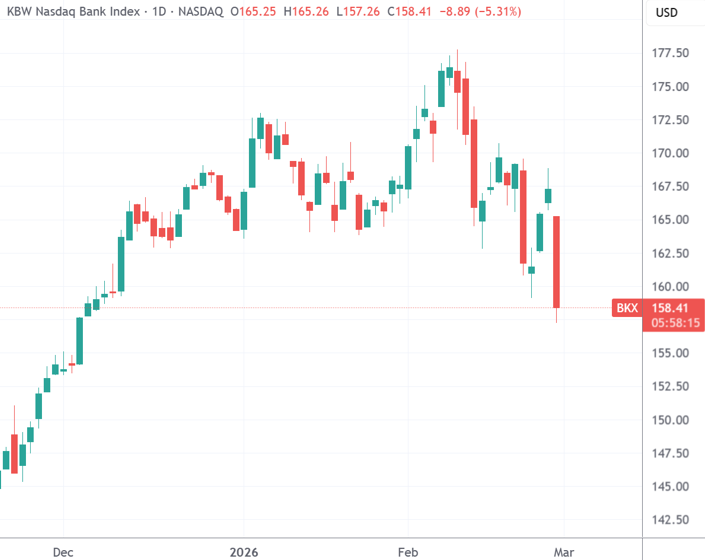
Core Viewpoint - Bank stocks experienced a significant decline on February 27, marking the worst single-day performance for the sector since April of the previous year, driven by fears of AI impacting white-collar jobs and the collapse of a UK mortgage lender [1][2][3] Group 1: Impact of AI on Employment - Concerns are rising that artificial intelligence will drastically reduce white-collar financial jobs, a risk that the market has not fully accounted for [2] - Jack Dorsey, CEO of Block, announced layoffs of over 4,000 employees, nearly half of the workforce, citing AI as the primary reason for this decision [4][5] - Dorsey indicated that many companies would likely follow suit within a year, leading to structural changes across various sectors, including banking [6] Group 2: Market Reaction and Stock Performance - The KBW Bank Index fell nearly 6% intraday, reaching its lowest level since March 2025, with all 23 member stocks closing in the red [3] - Major banks experienced significant stock declines, with Goldman Sachs down 7.5%, Morgan Stanley down 6.9%, and Citigroup down 5.8% among others [8]


88亿,水之密语、芬浓又被卖了
投中网· 2026-02-28 11:27
Core Viewpoint - The article discusses the acquisition of FineToday, a daily care company, by Bain Capital from CVC Capital, highlighting the financial implications and strategic decisions involved in the deal [3][4]. Group 1: Acquisition Details - Bain Capital acquired FineToday for approximately 200 billion yen (about 8.8 billion RMB), which includes popular brands like "Water of Secrets" and "Fennong" [3]. - CVC Capital had previously purchased FineToday from Shiseido for 160 billion yen, but the sale to Bain Capital resulted in a nominal profit in yen but a loss in USD due to the depreciation of the yen [4]. - The acquisition reflects Bain Capital's ongoing interest in the Japanese market, having previously acquired other brands like Mash and Snow Peak [5]. Group 2: Financial Performance - FineToday has shown stable financial performance, maintaining sales above 100 billion yen from 2022 to 2024, with a gross margin of over 55% [13]. - The adjusted EBITDA margin improved from 15.5% to 21% during CVC's ownership, indicating effective cost control and pricing strategies [13]. Group 3: Market Context and Strategy - The article notes that the Japanese market is characterized by low consumer spending and a depreciating yen, prompting international PE firms to seek opportunities in Japan [17]. - FineToday benefits from a strong brand heritage established by Shiseido, allowing it to operate effectively across East Asia and Southeast Asia [18]. - The company has a significant presence in the Chinese market, which accounts for 40% of its revenue, but faces intense competition [19].


Barclays Cuts KKR & Co. (KKR) Price Target Amid Mixed Q4 Results, Maintains Overweight Rating
Yahoo Finance· 2026-02-28 03:57
Group 1 - KKR & Co. Inc. ranks among the best stocks for long-term growth, with Barclays reducing its price target to $136 from $159 while maintaining an Overweight rating [1] - The company reported an adjusted net income per share of $1.12, below analyst forecasts of $1.14, but revenue reached $5.74 billion, significantly exceeding expectations of $2.11 billion [1] - KKR raised $28 billion in funds during the quarter, slightly below average projections, and is nearing completion of its Americas XIII fundraising while continuing to market Asia Private Equity and Global Infrastructure flagship funds [2] Group 2 - KKR management reiterated its forecast of over $7 earnings per share for fiscal year 2026, contingent on a sharp increase in realizations [3] - KKR is a leading global investment firm managing various alternative asset classes, including private equity, credit, infrastructure, and real estate, with a notable presence in insurance solutions [3]
美国金融板块周五再度爆发抛售潮,发生了什么?
Feng Huang Wang· 2026-02-27 22:42
Group 1 - The U.S. banking, asset management, and financial services sectors faced heavy selling pressure, with the KBW Bank Index dropping over 5%, nearing its largest single-day decline since April of the previous year [1] - Major Wall Street firms such as Goldman Sachs and Morgan Stanley saw declines exceeding 7%, while Wells Fargo, Citigroup, and Bank of America dropped over 5% [1] - Concerns about financial system risks stemming from artificial intelligence and the collapse of the UK mortgage company MFS have shaken confidence in the private credit industry [1][3] Group 2 - Financial technology company Block announced layoffs of over 10,000 employees, reducing its workforce to below 6,000, citing increased productivity from AI as the reason [3] - The collapse of MFS has raised new concerns regarding the quality of private credit, with Apollo Global Management, Jefferies, and TPG identified as creditors of MFS [3][4] - MFS is reported to have a "double pledging" issue, potentially leading to a £930 million shortfall in its £1.2 billion debt, which has parallels to previous bankruptcy cases that caused significant losses for misled institutions [4] Group 3 - Jefferies shares fell over 10%, while Apollo Global Management dropped more than 8%, with KKR and TPG also experiencing declines [4] - The credit card and payment service provider American Express saw a decline of over 6%, as the market sold off assets sensitive to credit [5] - Truist Securities highlighted that the market is focused on American Express due to its direct reflection of potential white-collar unemployment risks [5]




KKR(KKR) - 2025 Q4 - Annual Report
2026-02-27 21:39
Strategic Initiatives and Business Growth - In Q1 2024, the company implemented strategic initiatives, including the creation of the Strategic Holdings business segment, aiming for more stable recurring revenues from dividend payments and earnings [210]. - The company aims to grow its business by increasing AUM in existing sectors and pursuing new investment strategies, including expanding into new geographic markets and investor bases [209]. - The company announced changes to its insurance business management in 2025, focusing on longer-duration liabilities and assets, including investments in private equity and real assets, which may impact short- to medium-term financial results [211]. Regulatory and Compliance Risks - The company faces risks related to regulatory compliance, operational errors, and market conditions, which could adversely affect its financial performance and reputation [29]. - The company is subject to various legal and regulatory risks, including potential litigation and negative publicity that could impact its ability to raise capital and conduct business [206]. - The company emphasizes the importance of managing conflicts of interest arising from its investment activities to maintain its reputation and operational integrity [213]. - Compliance with evolving laws and regulations is critical, with potential non-compliance leading to significant operational and financial risks [273]. - Regulatory actions could result in sanctions, operational restrictions, and reputational harm, adversely affecting the company's business [274]. - The company operates under multiple regulatory frameworks globally, including the SEC in the U.S. and various authorities in Europe and Asia, which adds complexity to compliance efforts [282]. - The insurance business is subject to strict regulatory requirements, and any adverse regulatory actions could limit operational capabilities and financial performance [283]. - The company faces substantial regulatory risks due to its global investment activities, which are subject to complex laws across multiple jurisdictions [302]. Market Competition and Performance - The competitive landscape for the company's asset management business is intense, with competition based on investment performance, liquidity, and investor perception [215]. - The company faces extensive competition from local and regional investment firms, financial institutions, and other competitors in various countries, which may have more established relationships with target companies [217]. - Competitors may have greater financial, technical, and marketing resources, potentially leading to competitive advantages in capital raising and investment opportunities [218]. - The capital markets business competes primarily with investment banks and broker-dealers across North America, Europe, Asia-Pacific, and the Middle East, focusing on servicing both funds and third parties [219]. Financial Performance and Volatility - Earnings and cash flow are highly variable due to investment valuation volatility, affecting reported results significantly during market fluctuations [221]. - The timing and receipt of carried interest from investment vehicles are unpredictable, contributing to cash flow volatility and dependent on performance conditions [223]. - Fee income can vary significantly based on fluctuations in assets under management (AUM) and the number of investment transactions, impacting overall revenue [226]. - The inability to raise capital from third-party investors could materially affect AUM, revenues, liquidity, and overall financial results [231]. - Poor investment performance can adversely affect the company's ability to fundraise, especially in comparison to competitors [232]. Investment Strategies and Risks - The company has expanded its offerings of financial products to individual investors, which increases operational complexity and regulatory risks [243]. - Certain investment vehicles managed by the company are publicly traded, leading to heightened litigation risks and additional governance obligations [244]. - The company has launched U.S. holding company conglomerates, referred to as K-Series, which rely on regulatory exclusions; failure to maintain these exclusions could adversely affect financial results [245]. - The portion of assets under management (AUM) referred to as perpetual capital is subject to fluctuations and potential reductions due to withdrawals and redemptions [248]. - The company's insurance subsidiaries face risks related to contractual obligations, which could reduce permanent capital if outflows exceed inflows [249]. Cybersecurity and Data Privacy - Cybersecurity failures and data breaches pose significant risks, potentially jeopardizing confidential information and leading to regulatory liabilities and reputational damage [266]. - The company is subject to various security threats, with an increase in the number and sophistication of cyberattacks, which could materially impact operations and stakeholder trust [267]. - The company is subject to evolving data privacy and cybersecurity regulations, which may increase compliance costs and expose it to enforcement risks and reputational harm [326]. - Non-compliance with data privacy and cybersecurity laws could result in regulatory investigations, fines, and reputational damage, adversely affecting the company's financial condition [330]. Sustainability and Stakeholder Relations - Increased focus on sustainability matters by stakeholders may constrain capital deployment opportunities and impact the company's reputation [270]. - The company must navigate divergent views on sustainability from various stakeholders, which could lead to increased compliance costs and reputational risks [271]. - Sustainability-related laws and disclosure requirements could impose significant compliance burdens, increasing operational costs and affecting investment activities [322]. Economic and Market Conditions - Valuations of equity investments are significantly impacted by global equity market volatility, affecting both publicly listed and privately held assets [334]. - Rising interest rates can negatively impact the valuations of equity and infrastructure investments, particularly those valued using discounted cash flow analysis [335]. - Foreign exchange rate fluctuations can materially affect the valuations of investments denominated in currencies other than the U.S. dollar, impacting overall financial results [337]. - Commodity market conditions can influence investment valuations, particularly in energy-related sectors, where price volatility can affect revenues and profitability [338]. Investment Management and Operational Challenges - The company utilizes a significant amount of leverage in its investment activities, regularly borrowing substantial capital for operations and investments [357]. - Portfolio companies often incur debt, and their performance may be negatively impacted by difficult credit market conditions, which could impair the value of investments [358]. - The due diligence process may not reveal all relevant facts, particularly in emerging markets where fraud and accounting irregularities can be difficult to detect [361][362]. - The company faces complexities and risks in large private equity and real assets investments, including regulatory scrutiny and potential undisclosed liabilities [353].
一篇有关AI的“假想”报告吓崩华尔街,私募巨头股价大跌,市场信心为何如此脆弱?
3 6 Ke· 2026-02-26 01:53
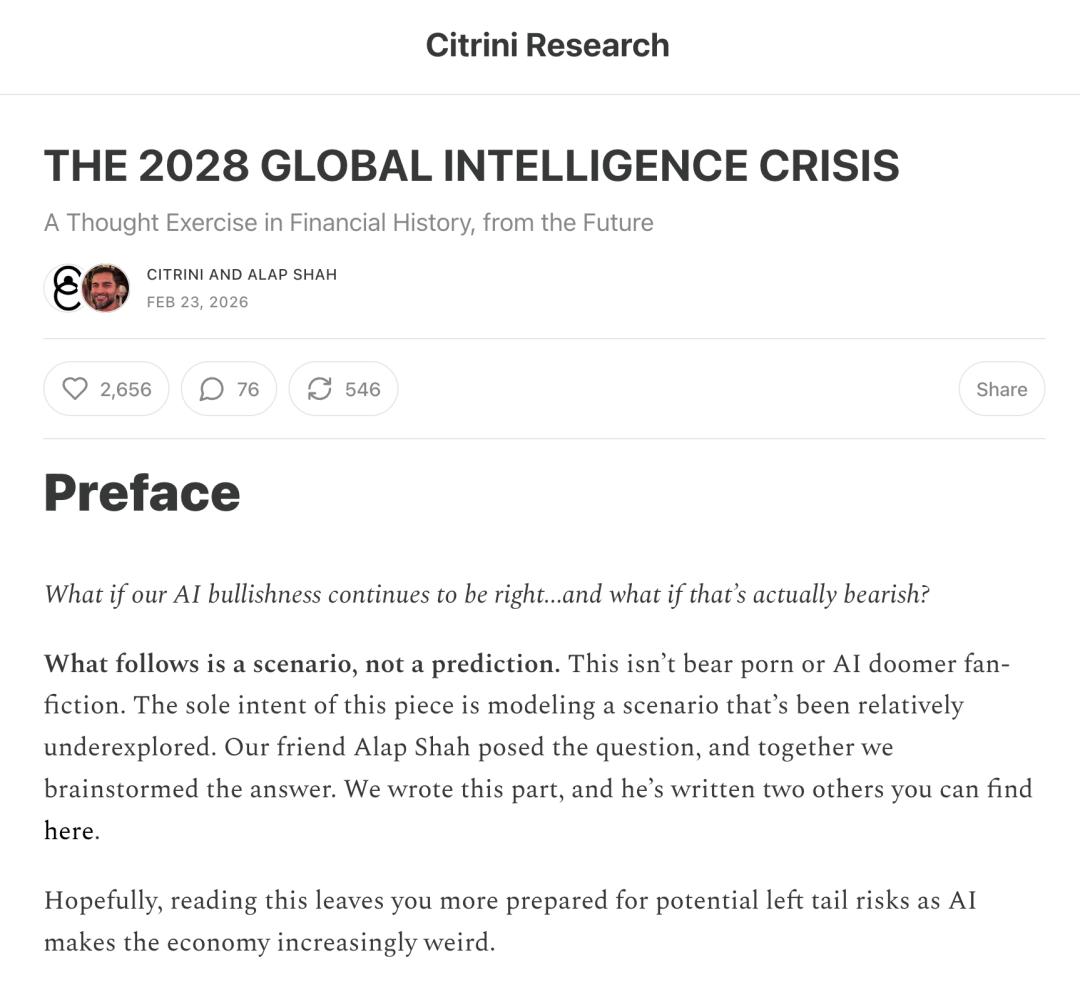
Core Viewpoint - The report by Citrini Research highlights potential risks of artificial intelligence (AI) to the global economy, triggering significant discussions and panic selling in the U.S. stock market, particularly affecting delivery, payment, and software stocks, as well as major private equity (PE) firms like Blackstone and KKR [1][3]. Group 1: AI Impact on the Economy - The report titled "2028 Global Intelligence Crisis" suggests that uncontrolled deflationary forces from AI could lead to an economic plague targeting "intermediaries" and "white-collar wages," with a collapse in the private credit market being a core trigger for a financial crisis [3][7]. - AI's evolution is expected to erode the competitive advantages of the Software as a Service (SaaS) industry, leading to a collapse in pricing and the failure of business models reliant on Annual Recurring Revenue (ARR) [7][9]. - A hypothetical scenario in the report predicts a $5 billion private credit default by Zendesk in 2027, which could trigger a chain reaction affecting the entire SaaS pricing structure and leading to widespread defaults in private credit [7][9]. Group 2: Market Reactions and PE Firms - The liquidity crisis at Blue Owl Capital, which announced asset sales to meet investor redemption demands, has exacerbated market tensions and contributed to stock price declines for major PE firms [9][10]. - Following the announcement from Blue Owl, stocks of firms like Blackstone and Apollo Global Management dropped significantly, with Blackstone's stock falling over 15% from February 19 to 23 [10][13]. - The private credit market, which has rapidly expanded to $1.8 trillion, is now facing structural risks, with an expected increase in default rates due to AI disruptions, particularly in the technology and business services sectors [13][14]. Group 3: Future Considerations - The U.S. market is reassessing the long-term impacts of AI on finance and the real economy, leading to heightened scrutiny on risk pricing and liquidity management within the private credit industry [14]. - Citadel Securities argues that the rapid expansion of AI is unlikely to cause massive job losses, countering the fears raised by the Citrini Research report [14].

《2028全球智能危机》:一篇雄文引发股市恐慌背后的十个逻辑
3 6 Ke· 2026-02-25 05:52
Core Viewpoint - The article discusses the potential risks associated with the rapid advancement of AI technology, suggesting that the optimism surrounding AI may signal a bear market rather than economic growth. It highlights the disconnect between GDP growth driven by AI and the actual economic benefits experienced by the general population [5][45]. Group 1: Market Reaction - On February 23, 2026, the U.S. stock market experienced a significant drop, with the Dow Jones falling over 800 points and only 27% of stocks rising [5]. - Major companies like DoorDash, MongoDB, ServiceNow, and Salesforce saw declines of 7%, 6%, and 4% respectively, while financial firms like American Express and KKR dropped over 8% [5]. Group 2: Economic Implications of AI - The article introduces the concept of "Ghost GDP," where economic output increases without benefiting the average person, as AI-driven productivity bypasses human consumption [7][25]. - A negative feedback loop is described, where AI advancements lead to layoffs, which in turn drive further investment in AI, perpetuating job losses without a self-correcting mechanism [9][10]. Group 3: Corporate Behavior - Companies threatened by AI, such as ServiceNow, are becoming aggressive adopters of AI technologies, often resulting in significant layoffs to fund these investments [12][19]. - The article notes that traditional companies are rapidly embracing AI due to the immediate threats they face, contrasting with past scenarios where new entrants disrupted established firms [19][20]. Group 4: Consumer Spending Dynamics - The article emphasizes that machines do not spend money, which poses a risk to the consumer-driven economy, as 70% of U.S. GDP is derived from human consumption [25]. - The impact of white-collar job losses on consumer spending is highlighted, noting that the affluent contribute significantly to overall consumption, and their job losses could lead to a substantial decline in spending [29][30]. Group 5: Financial Sector Risks - The growth of private credit in the U.S. has led to increased funding for software companies, which may face revenue declines as AI replaces traditional roles [30][31]. - The article warns that even high-quality mortgage loans may become problematic as borrowers lose jobs or face salary reductions due to AI advancements [33][34]. Group 6: Policy Limitations - Traditional monetary policy tools, such as interest rate cuts, may not effectively address the structural unemployment caused by AI advancements [36][38]. - The article argues that existing economic frameworks are based on the assumption of human labor scarcity, which is being challenged by AI's capabilities [40][41].


13 亿美元加码东南亚教育,KKR 敲定 XCL 教育多数股权收购,深化区域投资布局
3 6 Ke· 2026-02-25 00:19
Core Viewpoint - KKR has agreed to acquire a majority stake in XCL Education Holdings, a Southeast Asian K-12 education operator, with the deal valuing the company at approximately $1.3 billion [1][3]. Group 1: KKR Overview - KKR, founded in 1976 and headquartered in New York, is a leading private equity firm known for pioneering the leveraged buyout (LBO) model, alongside Blackstone, Carlyle, and TPG [3]. - As of September 2024, KKR manages assets totaling $624.4 billion across various sectors, including private equity, credit, infrastructure, and real estate, with a current market capitalization of approximately $82.174 billion [3]. Group 2: XCL Education Holdings - XCL Education, established on July 16, 2019, and based in Singapore, focuses on K-12 education services in Southeast Asia and is backed by Temasek Holdings, a significant sovereign investment entity [4]. - The company operates several international school campuses in Southeast Asia, including XCL World Academy in Singapore, Bangkok American School, and Australian International School in Vietnam, catering to a diverse student body from over 40 countries [4]. Group 3: KKR's Investment Strategy - KKR has a broad investment strategy in the education sector, with a focus on Asia, including investments in Lighthouse Learning in India, Taylor's Education Group in Southeast Asia, and EQuest Education Group in Vietnam [5]. - The firm has invested approximately $15 billion in the Southeast Asian market, with notable transactions including a $6.6 billion acquisition of STT GDC and a $750 million financing to Chandra Asri Group for acquiring ExxonMobil's Esso retail business in Singapore [5]. Group 4: Southeast Asia M&A Market - The Southeast Asian M&A market has shown significant improvement in 2026, with total transaction value nearing $12 billion, more than tripling compared to the same period last year [6]. - Other notable transactions include Sunway Bhd's proposed acquisition of IJM Corp Bhd for approximately 11 billion Malaysian Ringgit (around $3.2 billion Singapore dollars), highlighting the region's growing appeal to international capital [6].