
PepsiCo(PEP)

Search documents
Coca-Cola Vs Pepsi Stock: Which is the Better Investment for 2026?
ZACKS· 2026-01-08 02:20
Core Viewpoint - As the stock market approaches all-time highs, investors are looking for defensive options, with Coca-Cola and Pepsi being prime candidates due to their consistent performance during market corrections [1] Company Performance - Coca-Cola's return on invested capital (ROIC) is 18%, showing a positive trend towards 20% or higher, while Pepsi's ROIC is at 14%, indicating a decline in recent quarters [3][4] - Coca-Cola's fiscal 2025 earnings per share (EPS) rose 3% to $2.98, with a projected 8% increase to $3.22 for FY26, alongside a sales increase of 3% for FY25 and a projected 5% increase to $51.01 billion for FY26 [6] - Pepsi's FY25 EPS is expected to slightly dip to $8.12 but is projected to rebound by 5% to $8.55 in FY26, with sales expected to rise 2% for FY25 and 4% to $97.07 billion in FY26 [9] Valuation and Dividend Analysis - Pepsi trades at 16 times forward earnings and near 2 times forward sales, aligning with industry averages, while Coca-Cola trades at a premium of 6 times forward sales [10] - Coca-Cola offers a 3% annual dividend yield, matching the industry average, while Pepsi has a higher yield of 4%, with both companies classified as "Dividend Kings" for increasing dividends for over 50 consecutive years [12] Investment Outlook - As 2026 begins, Pepsi appears to meet more investor criteria despite Coca-Cola's stronger ROIC, with Coca-Cola potentially facing short-term weakness due to its higher valuation compared to Pepsi and its beverage peers [13]



百事公司宣布与西门子和英伟达展开合作
Bei Jing Shang Bao· 2026-01-07 14:04
Group 1 - The core point of the article is that PepsiCo has announced a collaboration with Siemens and NVIDIA to advance the application of artificial intelligence and digital twin technology in the manufacturing sector [1] - This collaboration represents the first industry project that combines AI with digital twin technology, aiming to enhance production efficiency, optimize supply chain management, and reduce carbon emissions [1] - PepsiCo will utilize Siemens' industrial software platform and NVIDIA's AI computing technology to deploy intelligent digital systems across its global factories, marking a significant step in the smart transformation of the food and beverage industry [1]


百事(PEP.US)打造行业首个智能生态系统,联手英伟达定义“未来工厂”
Zhi Tong Cai Jing· 2026-01-07 06:49
Core Viewpoint - PepsiCo has announced a groundbreaking multi-year partnership with Siemens and NVIDIA at CES, aimed at deploying advanced AI and digital twin technologies to transform its manufacturing and supply chain operations [1] Group 1: Partnership and Technology - The collaboration will start with a pilot factory in the U.S. and will gradually expand globally [1] - The partnership utilizes Siemens' new digital twin builder developed on NVIDIA's Omniverse platform to create high-fidelity 3D simulations for every machine, conveyor belt, pallet path, and operator path [1] - The platform is expected to help PepsiCo design, test, and optimize facility layouts virtually before making physical changes [1] Group 2: Benefits and Outcomes - The industrial metaverse environment combines 2D and 3D digital twin data with real-time operational information, allowing AI agents to identify up to 90% of potential issues in advance [1] - Early deployments have achieved a 20% increase in throughput, nearly 100% design validation, and reduced capital expenditures by 10% to 15% by validating investments in a virtual environment rather than through traditional physical expansion [1] Group 3: Strategic Vision - PepsiCo's CEO for Latin America and Global Strategy and Transformation Officer, Asina Kaniula, stated that the company is deploying its first digital blueprint to reimagine the design, construction, and expansion of its supply chain, marking an industry first [1] - Kaniula emphasized that with a unified, AI-driven digital foundation, PepsiCo is building a future where every factory and warehouse operates as part of a single intelligent ecosystem, capable of responding to and predicting demand [1]
Stock Of The Day: Is This The Bottom For Pepsi?
Benzinga· 2026-01-06 17:42
Core Viewpoint - PepsiCo, Inc. (NYSE: PEP) shares have experienced a downward trend as investors shift their focus from consumer staples to the financial sector, but the stock is currently at a support level and considered oversold, indicating a potential for reversal and upward movement [1][2][6]. Group 1 - The stock has trended lower due to a market imbalance where supply exceeds demand, leading to a decrease in price [2][3]. - Pepsi's shares are at a support level around $140, where previous sell-offs have ended, suggesting a potential stabilization [6]. - The stock is currently considered oversold, which may attract buyers anticipating a price rebound [7][8]. Group 2 - The Relative Strength Index (RSI) indicates that Pepsi is oversold, as the blue line has crossed below the horizontal red line, reinforcing the potential for a price increase [8]. - The combination of being at a support level and oversold conditions suggests that the downtrend for Pepsi may have ended, with a possibility of reversal [8].
PepsiCo Announces Industry-First AI and Digital Twin Collaboration with Siemens and NVIDIA
Prnewswire· 2026-01-06 16:30
Core Insights - PepsiCo has announced a multi-year collaboration with Siemens and NVIDIA to implement advanced digital twin technology and AI in its plant and supply chain operations, marking a first for a global consumer packaged goods (CPG) company [1][10] - The initiative aims to enhance production and distribution capacity, optimize existing facilities, and drive innovation through digital approaches [2][3] Group 1: Collaboration and Technology - The partnership leverages Siemens' Digital Twin Composer and NVIDIA's Omniverse libraries to create high-fidelity 3D digital twins of manufacturing and warehouse facilities [3][4] - This collaboration is expected to set a new standard for the industry by combining industrial AI expertise with advanced digital twin technology [10] Group 2: Operational Improvements - PepsiCo's use of digital twins allows for the simulation, validation, and optimization of facility layouts before physical modifications, enhancing operational agility [3][6] - Initial deployments have resulted in a 20% increase in throughput and reductions in capital expenditure (Capex) by 10 to 15% through the identification of hidden capacity [7][8] Group 3: Future Vision - The company envisions a future where its facilities operate as part of a unified, intelligent ecosystem that anticipates and adapts to consumer demand [9] - This digital-first strategy is part of PepsiCo's broader commitment to sustainability and resilience in its business operations [12]

Don’t Push for Growth in 2026, Push for Yield: The Case for 3 Top Dividend Stocks
Yahoo Finance· 2026-01-05 18:22
分组1 - PepsiCo has a strong dividend yield of 4% and a remarkable 53-year history of increasing dividends, indicating a solid defensive investment option [1] - The company has demonstrated significant pricing power, particularly in its snack business, leading to impressive gross margins of 53.6% and operating margins around 15% [2] - PepsiCo is a major player in the carbonated beverage and snack industry, benefiting from past acquisitions and a strong brand portfolio, making it a top choice for defensive investors [3] 分组2 - The macroeconomic environment for 2026 is expected to differ significantly from the previous year, with concerns about inflation and a slowing job market impacting growth stock performance [4] - Restaurant Brands, another defensive stock, has shown stable cash flows and growth potential, with a core dividend yield of 3.7% and expectations for continued growth despite market conditions [9][10] - Constellation Energy focuses on nuclear energy, which is increasingly in demand, and is expected to provide robust dividend distributions and growth potential in the medium to long term [12][13]


Are Functional Waters and Energy Drinks Reviving PepsiCo's PBNA Unit?
ZACKS· 2026-01-05 16:01
Core Insights - PepsiCo's Beverages North America (PBNA) segment is a key component of its long-term growth strategy, achieving 2% organic revenue growth in Q3 2025 due to improved volume trends and strong brand performance [2][10] Performance Highlights - Trademark Pepsi experienced both volume and net revenue growth, with Pepsi Zero Sugar showing double-digit gains, supported by effective marketing initiatives [3][10] - The Mountain Dew brand also saw renewed momentum, with Baja Blast projected to exceed $1 billion in retail sales [3][10] Strategic Initiatives - The modern soda brand poppi is expanding rapidly, enhancing PepsiCo's position in functional and better-for-you beverages [4] - Management identified protein as a strategic growth platform, with brands like Muscle Milk and Propel contributing to innovation in performance and wellness [4] - The relaunch of Muscle Milk and new protein-enhanced Starbucks beverages aim to meet rising consumer demand for protein, particularly during morning consumption [4] Margin and Revenue Outlook - Although Q3 results faced tariff-related pressures, margins are rebounding in Q4, with expectations for continued margin expansion as cost pressures ease [5] - PBNA's revenue is projected to grow by 1% year-over-year in Q4 and 0.8% in 2025, driven by balanced contributions from volume growth and price realization [5][6] Competitive Landscape - PepsiCo competes with Coca-Cola and Monster Beverage, both of which are also focusing on innovation and growth in their respective beverage segments [7][8][9] - Coca-Cola is emphasizing brand-led growth and premiumization, while Monster Beverage is benefiting from strong demand in the energy drink market [8][9] Valuation and Earnings Estimates - PepsiCo shares have increased by 5.8% over the past six months, contrasting with a 1.4% decline in the industry [12] - The forward price-to-earnings ratio for PepsiCo is 16.62X, lower than the industry average of 17.84X [13] - The Zacks Consensus Estimate for PepsiCo's 2025 earnings per share (EPS) indicates a slight decline of 0.5%, while 2026 EPS is expected to grow by 5.4% [14]

What You Need To Know Ahead of PepsiCo's Earnings Release
Yahoo Finance· 2026-01-05 14:11
Company Overview - PepsiCo, Inc. has a market capitalization of $194.5 billion and operates globally in the food and beverage sector, offering products under well-known brands such as Pepsi, Lay's, and Quaker [1] Financial Performance - Analysts forecast an adjusted EPS of $2.24 for fiscal Q4 2025, representing a 14.3% increase from $1.96 in the same quarter last year [2] - For fiscal 2025, the expected adjusted EPS is $8.12, slightly down from $8.16 in fiscal 2024, but projected to rebound to $8.55 in fiscal 2026, reflecting a 5.3% year-over-year growth [3] Recent Stock Performance - Over the past 52 weeks, PepsiCo shares have decreased by 5.3%, underperforming the S&P 500 Index, which increased by 16.9% during the same period [4] - On October 9, shares rose by 4.2% following the announcement of stronger-than-expected Q3 2025 results, with an adjusted EPS of $2.29 and revenue of $23.94 billion, driven by a 9% revenue growth in Europe, the Middle East, and Africa [5] Analyst Sentiment - The consensus rating for PepsiCo stock is "Moderate Buy," with 20 analysts covering the stock: seven recommend "Strong Buy," 12 suggest "Hold," and one has a "Strong Sell" rating [6] - The average analyst price target for PepsiCo is $158.53, indicating a potential upside of 11.5% from current levels [6]
为什么现在的零食热量都按“份”算?
3 6 Ke· 2026-01-05 11:53
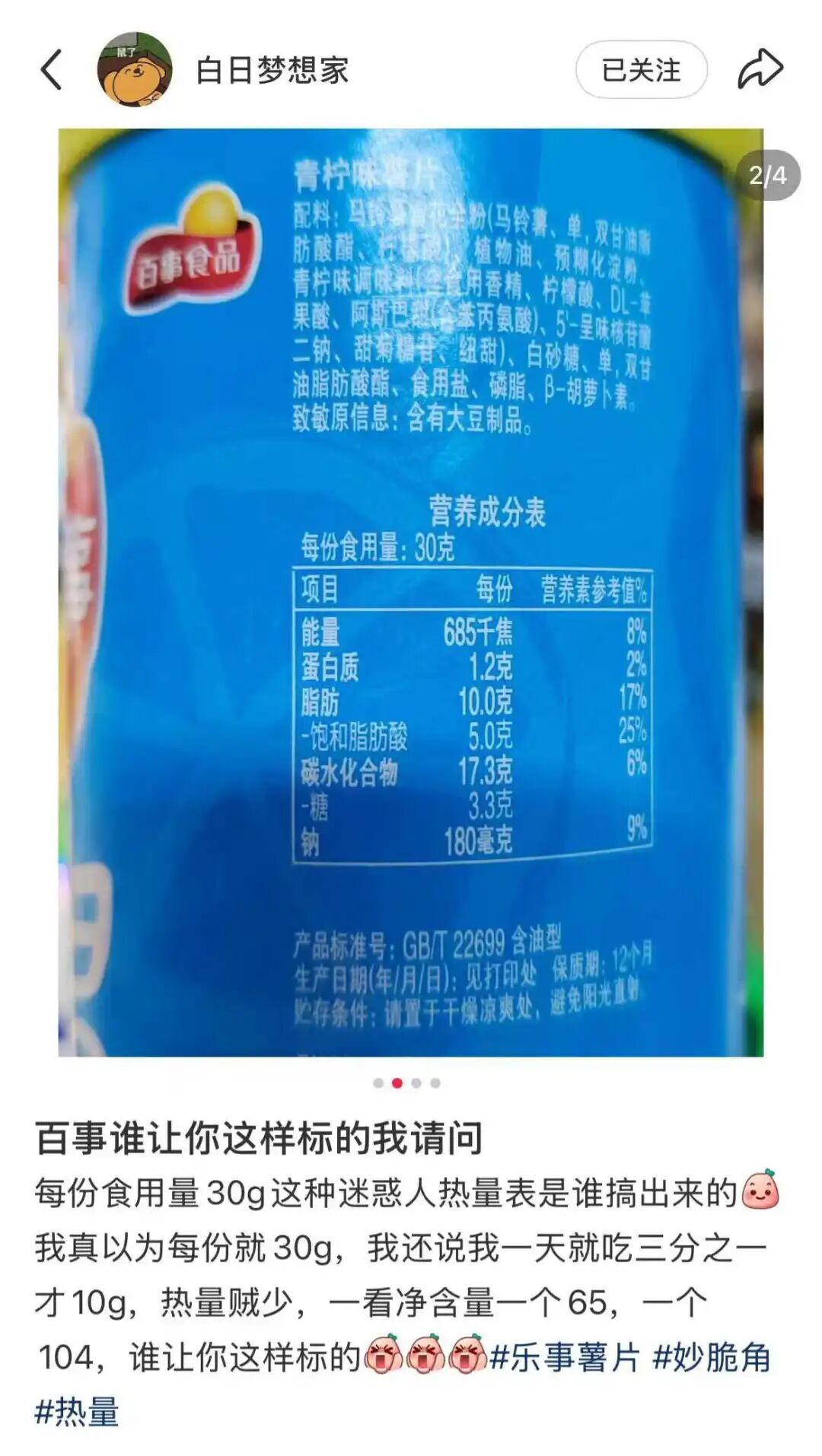
Core Viewpoint - The article highlights the issue of snack packaging labeling calories per "serving" instead of the traditional "per 100g," leading consumers to unknowingly consume higher calories than expected [1][4][25]. Group 1: Consumer Awareness - Consumers are increasingly finding that the calorie counts on snack packaging are based on "serving" sizes, which can be significantly smaller than the total package weight, resulting in higher caloric intake than anticipated [1][4]. - The discrepancy in serving sizes can lead to confusion, as some products may label servings in fractions or specific weights that do not align with consumer expectations [4][9]. Group 2: Regulatory Standards - The labeling of nutritional information per "serving" is compliant with national regulations, as outlined in the GB28050-2011 and GB28050-2025 standards, which allow for both "per 100g" and "per serving" formats [19][20]. - The standards specify that serving sizes can vary based on the type of food, and manufacturers are encouraged to use reference values for serving sizes [20][24]. Group 3: Industry Practices - Many snack brands, such as Orion and Lay's, have adopted the "per serving" labeling to standardize nutritional information across various product sizes, which can create a perception of lower calorie content [24][25]. - The choice of serving size often aims to simplify consumer understanding and calculation of caloric intake, although it may also contribute to misleading perceptions of healthiness [24][25].

Food makers cut prices to reignite growth
Yahoo Finance· 2026-01-05 10:00
Core Insights - After years of price increases, grocery shoppers may see relief as food companies aim to reignite growth [1] Group 1: Price Adjustments - General Mills has cut prices on nearly two-thirds of its grocery products in North America, leading to an increase in product volume [2] - PepsiCo plans to lower prices on some food products this year to enhance affordability [2] Group 2: Consumer Behavior and Inflation - Consumer inflation concerns have negatively impacted product volumes, with PepsiCo reporting a 4% decline in snack volumes and a 3% decline in beverage volumes in North America [3] - Food-at-home prices are projected to rise by 2.3% in 2026, a decrease from the high inflation rates seen during the COVID-19 pandemic [3] Group 3: Commodity Price Influences - Significant price increases in commodities such as coffee (up 18.8%) and ground beef (up 14.9%) have contributed to higher food prices [4] - Consumers earning $100,000 or less are increasingly purchasing discounted food due to high prices [4] Group 4: Strategic Responses - PepsiCo's CEO indicated a need for a reset in affordability as consumers struggle in the U.S. and other Western countries [5] - Despite some price cuts, companies like Hershey are still raising prices in certain categories to counter inflationary pressures, with cocoa prices remaining 70% above 2023 levels [6]
