Bridgewater Associates

Search documents
Ray Dalio says the world is running out of interest in buying U.S. debt—but America is unable to cut back its spending
Yahoo Finance· 2025-09-19 10:14
Core Viewpoint - Ray Dalio emphasizes that America's $37.5 trillion national debt poses a significant crisis risk, with a growing gap between spending and revenue raising concerns about long-term sustainability [1][2]. Debt Situation - The U.S. national debt is projected to incur an additional $1.13 trillion in interest payments for the fiscal year 2025 [1]. - Economists are more concerned about the debt-to-GDP ratio rather than the absolute amount of national debt, as borrowing that outpaces economic growth can lead to investor skepticism regarding the security of debt returns [2]. Government Spending and Economic Growth - Dalio argues that the U.S. government cannot realistically cut spending due to various reasons, indicating that spending cuts are not a viable option [4]. - The Congressional Budget Office (CBO) estimates that U.S. spending will reach approximately $7 trillion in 2025, while revenues will only be around $5 trillion, leading to a widening gap over time [5]. Market Dynamics - Dalio points out a supply-demand imbalance in the market for U.S. debt, suggesting that there is insufficient global demand for this debt, which could exacerbate the crisis [6].
Ray Dalio says gold, non-fiat currencies will be stronger stores of value as U.S. debt mounts
CNBC· 2025-09-19 10:13
Core Viewpoint - Ray Dalio emphasizes that gold and non-fiat currencies are becoming stronger stores of value due to the devaluation risks faced by major currencies amid increasing global debt pressures [1][2]. Economic Concerns - The excessive spending and spiraling debt of the U.S. government are deemed "unsustainable," leading to a potential fiscal crisis that threatens the monetary order [2][3]. - Dalio highlights that the U.S. debt has reached a critical point, with a need for the government to sell an additional $12 trillion in debt to cover a $2 trillion deficit, $1 trillion in interest payments, and $9 trillion in maturing borrowings [5][6]. Investment Recommendations - Investors are advised to diversify their portfolios, allocating around 10% to gold as a hedge against currency devaluation [3]. - The supply-demand imbalance in the market is exacerbated by the government's inability to balance its debt levels, despite proposals to reduce the fiscal deficit to 3% of GDP [6]. Currency Dynamics - The U.S. dollar has depreciated over 10% against other major currencies this year, yet these currencies have also weakened relative to gold, which is now the second-largest reserve currency globally [4]. - While the U.S. dollar will maintain its role as a medium of exchange, the increasing prominence of the Chinese currency in global trade may diminish the dollar's influence [7].


Gold Miners Are Minting Money As The Metal Smashes Record After Record
Forbes· 2025-09-15 17:20
Core Insights - Gold mining equities are experiencing significant growth in 2025, driven by record-high gold prices and favorable market conditions for miners [1][12] - Central banks are increasing their gold reserves, contributing to a surge in gold-backed ETFs, which have seen nearly $50 billion in inflows this year [2] - The current gold market is characterized by disciplined corporate behavior among miners, focusing on operational efficiency and shareholder returns [9] Gold Price Dynamics - Gold has reached its sixth record high in just seven trading days, surpassing its inflation-adjusted record from 1980 and achieving all-time highs in multiple currencies [2] - The average all-in sustaining costs (AISC) for major gold producers range from $1,080 to $1,220 per ounce, while spot prices exceed $3,600, resulting in extraordinary profit margins [7] Mining Stocks Performance - Mining indices, such as the NYSE Arca Gold Miners Index, have hit new all-time highs, with individual companies like Sibanye-Stillwater and SSR Mining seeing gains of over 150% and 220% year-to-date, respectively [7][9] - The current rally in mining stocks is distinct from previous bull markets due to a focus on financial discipline and shareholder value, rather than reckless expansion [9] Broader Economic Context - The U.S. economy is showing signs of strain, with significant job growth revisions and a potential recession looming, which may further drive interest in gold as a safe haven [10][11] - Political uncertainties, including actions by the U.S. government regarding the Federal Reserve, are contributing to market volatility and investor caution [11] Investment Recommendations - A recommended portfolio allocation includes 10% in gold, with 5% in physical bullion and 5% in high-quality gold mining equities, emphasizing the importance of regular rebalancing [12]
What Ray Dalio Learned After A Huge Investment Went So Sour That He Had To Borrow $4,000 From His Father To Stay Afloat
Yahoo Finance· 2025-09-15 14:15
Core Insights - Billionaire investor Ray Dalio reflects on a significant investment loss from over 40 years ago that taught him valuable lessons in investment strategy [1][2][4] - The experience of borrowing $4,000 from his father due to this loss shaped Dalio's approach to investment decision-making [4][5] Investment Strategy - Dalio's early investment strategy was based on the belief that the U.S. had lent more money to foreign nations than they could repay, leading him to predict a debt crisis [3] - The unexpected market surge following the Federal Reserve's easing of lending standards resulted in severe losses for Dalio [4] Lessons Learned - The first critical lesson learned was the importance of humility and self-doubt in decision-making [6] - Dalio implemented a systematic approach by documenting factors influencing his investment decisions, which has become a guiding principle at Bridgewater Associates [6]
Billionaire Ray Dalio Warns Debt-Laden US Economy Faces 'Heart Attack,' Advises Investors To Hold 10–15% Gold
Yahoo Finance· 2025-09-12 23:31
Economic Concerns - Ray Dalio warns about the U.S. economy's mounting debt burden, comparing it to arterial blockage that could lead to a financial "heart attack" [1] - The U.S. national debt has exceeded $37 trillion, with Moody's projecting the debt-to-GDP ratio to rise from nearly 100% in 2025 to approximately 130% by 2035 [2] Investment Recommendations - Dalio suggests investors allocate "somewhere between 10% and 15%" of their portfolios to gold as a hedge against market instability, with gold futures recently reaching record highs near $3,600 [3] - Gold is characterized as uncorrelated with other assets, typically increasing in value during crises when other assets decline [4] Market Valuations - The S&P 500 and Nasdaq Composite have gained over 12.25% and 14.33% year-to-date, respectively, closing at record highs amid expectations of Federal Reserve rate cuts [5] - Dalio's warnings highlight concerns regarding elevated market valuations in the context of underlying fiscal pressures [5]
Ray Dalio Warns AI Will Create Unprecedented Inequality: 'Limited Number Of Winners' - Microsoft (NASDAQ:MSFT), NVIDIA (NASDAQ:NVDA)
Benzinga· 2025-09-12 09:37
Core Insights - Ray Dalio warns that artificial intelligence (AI) will exacerbate economic inequality, benefiting only the wealthiest 1% to 10% of Americans while displacing millions of workers across various industries [1][2] - Dalio predicts that AI and humanoid robots could replace professionals such as accountants, doctors, and lawyers, leading to societal struggles over job roles [2] - He emphasizes the need for a comprehensive redistribution policy beyond just monetary solutions, aligning with views from other AI leaders advocating for universal basic income [3] Economic Implications - The rise of AI stocks, particularly companies like NVIDIA Corporation and Microsoft Corporation, is driving market gains, but Dalio's concerns about inequality suggest potential regulatory and taxation risks for AI-focused investments [5] - Dalio expresses concern that American society may be too fragmented to implement effective solutions to the challenges posed by AI [4]


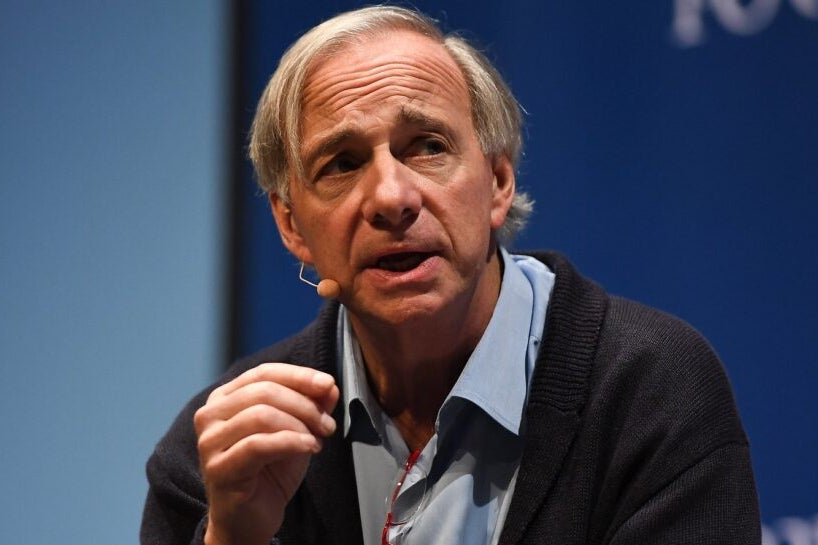
Ray Dalio pushes gold as shield as US markets risk ‘heart attack'
New York Post· 2025-09-11 17:01
Group 1 - Ray Dalio warns that American markets are facing a financial "heart attack" due to rising US debt costs, which are constraining economic growth [1][6] - Dalio recommends that investors allocate 10% to 15% of their portfolios to gold, highlighting its unique uncorrelation with other assets and its tendency to rise during crises [2][3] - Gold is currently trading near record highs, with spot gold at $3,641.10 per ounce, reflecting a nearly 40% increase year-to-date, and gold futures at $3,680.60 per ounce [2][14] Group 2 - Dalio has consistently advocated for gold as a hedge against global risks, emphasizing its importance during periods of money printing and debt accumulation [3][4] - Despite stepping down from Bridgewater, Dalio continues to emphasize the need for investors to reassess their holdings in a debt-laden environment [6][7] - The surge in gold prices indicates that investors are shifting focus from equities to gold as a hedge against potential economic instability and geopolitical tensions [10][14] Group 3 - Central banks, including those in China, India, and Russia, have increased their gold holdings this year, diversifying away from the dollar [14] - Historical data shows that gold has performed well during market downturns, such as in 2008 and 2020, reinforcing Dalio's view of gold as a reliable insurance policy [15]
Keep tech exposure but look to defensive sectors like utilities, says Bridgewater's Patterson
CNBC Television· 2025-09-05 19:03
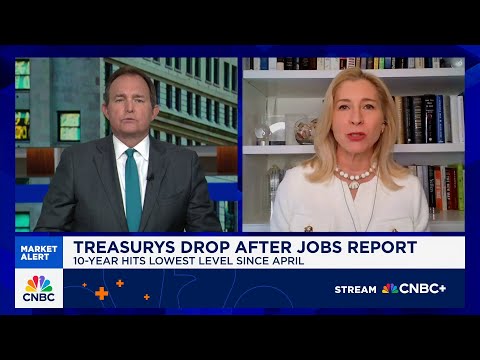
How do you invest in what appears to be a slowing but still growing economy. Rebecca Patterson is former chief investment strategist at Bridgewwater Associates, also a senior fellow at the Council on Foreign Relations. Is it wrong to characterize this economy as slowing but still growing.>> From the labor market perspective, it's definitely slowing. I would even say stalling. You know, the challenge is going to be the disconnect between GDP reports and labor reports in the coming months and maybe quarters, ...
Bridgewater Shies Away From China: Time for Inverse China ETFs?
ZACKS· 2025-08-20 11:36
Group 1 - Hedge fund Bridgewater Associates exited U.S.-listed Chinese equities in Q2 due to rising geopolitical tensions and concerns about China's economic outlook [1] - The firm closed positions in several major Chinese companies, including Baidu, Alibaba, JD.com, PDD Holdings, Nio, Trip.com Group, Yum China, Qifu Technology, and Ke Holdings [1] - Bridgewater trimmed its stake in Apple while increasing holdings in Microsoft and NVIDIA, indicating a preference for U.S. tech companies focused on artificial intelligence [2] Group 2 - Ray Dalio, founder of Bridgewater, has expressed concerns about U.S.-China tensions, shifting from a previously bullish stance on China [3] - Despite selling his remaining stake in Bridgewater and leaving the board, Dalio continues to mentor the investment team [3] Group 3 - The U.S. and China extended their tariff truce by 90 days, preventing a potential increase in tariffs on Chinese goods to 145% and U.S. exports to 125% [4] - Current tariffs are at 30% on Chinese imports to the U.S. and 10% on U.S. exports to China [4] Group 4 - In light of Bridgewater's actions, inverse China ETFs are highlighted as potential investment options [5] - ProShares Short FTSE China 50 seeks to provide inverse daily performance of the FTSE China 50 Index with a fee of 95 bps [6] - ProShares UltraShort FTSE China 50 aims for two times the inverse daily performance of the FTSE China 50 Index, also with a fee of 95 bps [7] - Direxion Daily FTSE China Bear 3X Shares seeks 300% of the inverse performance of the FTSE China 50 Index, with an expense ratio of 1.02% [8]

OpenAI's Sam Altman sees AI bubble forming as industry spending surges
CNBC· 2025-08-18 07:51
"Are we in a phase where investors as a whole are overexcited about AI? My opinion is yes. Is AI the most important thing to happen in a very long time? My opinion is also yes," he was quoted as saying. Altman appeared to compare this dynamic to the infamous dot-com bubble, a stock market crash centered on internet-based companies that led to massive investor enthusiasm during the late 1990s. Between March 2000 and October 2002, the Nasdaq lost nearly 80% of its value after many of these companies failed to ...