Mindray

Search documents
瑞银:中国医疗健康-欧盟对中国医疗科技企业的市场准入限制
瑞银· 2025-06-10 07:30
Investment Rating - The report maintains a "Buy" rating for several healthcare stocks, including Wuxi Apptec and Eyebright, based on their strong growth potential and market positioning [11]. Core Insights - The EU's planned restrictions on Chinese medtech firms' access to public procurements over EUR 5 million are expected to have limited impact on the covered companies, as most do not participate in such procurements and have manageable revenue exposure to the EU market [3]. - The healthcare indices in China showed positive performance, with HSHCI rising by 4.1% and HSHKBIO by 4.5% during the week of June 2-6, 2025, indicating a favorable market trend [2]. - Recent approvals in the drug sector include Akeso's cadonilimab for cervical cancer and Hansoh's aumolertinib for NSCLC in the UK, showcasing ongoing innovation and regulatory progress in the industry [4][5]. Summary by Sections Market Access and Regulatory Environment - The EU's International Procurement Instrument investigation concluded that China has limited EU medical device producers' access to government contracts, leading to the proposed restrictions [3]. - Companies like Mindray and MGI Tech have established local manufacturing facilities, which may help mitigate the impact of these restrictions [3]. Drug Approvals and Developments - Akeso's cadonilimab received approval for treating first-line cervical cancer, while Innovent and Hutchmed's sintilimab + fruquintinib application was accepted for renal cell carcinoma [4]. - Hansoh's aumolertinib has been approved in the UK for specific NSCLC patients, indicating a strong pipeline for innovative therapies [4]. Stock Performance and Recommendations - The report highlights top picks in the healthcare sector, including Wuxi Apptec and Eyebright, based on their expected solid fundamental recovery and market share potential [11]. - The report notes that the chemicals sector outperformed healthcare indices, with a 1.7% increase in A shares and a 3.8% increase in H shares [12].
美银:一位中国股票策略师的日记,中美首次通话后,美中关系呈现试探性缓和


美银· 2025-06-10 05:52
Investment Rating - The report does not explicitly state an investment rating for the industry or specific companies [1]. Core Insights - The report highlights a tentative US-China détente following a call between Trump and Xi, with discussions on trade and potential sanctions [1]. - The HSCEI index increased by 2.5% and the CSI 300 by 0.9% during the week [1]. - China is considering a RMB500 billion investment to accelerate infrastructure projects in AI, digital economy, and consumption [1]. - The report notes that the IT, Communication Services, and Broadline Retail sectors outperformed, while Industrials, Consumer Staples, and Energy sectors underperformed [1]. Key Themes Update - The report identifies key themes in the China market, focusing on index-heavy stocks with high dividend yields and local champions expanding globally [12]. - High yield stocks listed include CCB, ICBC, and PetroChina, with dividend yields ranging from 5.1% to 7.1% [12]. - Local champions going global include companies like BYD and Great Wall Motor, which are less impacted by US/EU tariffs [12]. Market Movements and Capital Flows - The report indicates that the A-share market saw a 22.9% year-over-year increase in new account openings in May [3]. - Preliminary data shows that May passenger vehicle wholesales increased by 14% year-over-year, with NEV sales up by 38% [3]. Earnings Revisions - The report does not provide specific details on earnings revisions for the industry or companies [1]. Recovery Trends - The report notes that the top 100 developers' home sales decreased by 8.6% year-over-year in May [3]. - Average new home prices in 100 cities increased by 0.3% month-over-month in May, while secondary home prices decreased by 0.7% [3]. Key Events - The report mentions that the US made tough requests to Vietnam in trade talks, including reducing reliance on Chinese industrial goods [2]. - The PBOC is set to inject RMB1 trillion via outright reverse repos in June [2]. Key News - The report highlights that the EU voted to limit China's access to its medical device procurement [1]. - China is reportedly considering a major deal to order hundreds of Airbus jets during EU leaders' visit [1].
高盛:中国医疗保健 - 2025 年 4 月中国医院设备招标 - 环比增长高于预期
Goldman Sachs· 2025-05-13 05:39
Investment Rating - The report maintains a "Buy" rating for both Mindray and United Imaging, indicating a positive outlook for their stock performance in the near future [82][83]. Core Insights - The procurement value of main medical devices in China has shown strong year-over-year (YoY) growth, with a month-over-month (MoM) increase of 13% in April, surpassing expectations [1]. - The report anticipates a high level of activity in medical equipment procurement throughout 2025, driven by government funding and a recovery in hospital demand [1][25]. - Mindray is expected to maintain its market leadership with multiple growth drivers, while United Imaging is projected to see significant long-term growth potential due to increasing service-related revenue [82][83]. Summary by Sections Procurement Trends - The total bidding value for nine main medical devices in China has reached a high level, with positive MoM growth observed in seven out of nine devices in March [26]. - The report notes that procurement activities are supported by government funding and the implementation of a trade-in program, which is expected to drive demand in the coming quarters [1][25]. Company Performance - Mindray's revenue growth is projected to be +10% in 2Q24, +40% in 3Q25, and +36.5% in 4Q25, reflecting a recovery in its end markets [9]. - United Imaging's management expressed optimism about the upcoming trade-in program in 2025, expecting a smoother process compared to 2024 [9]. Market Dynamics - The report highlights that both domestic and multinational companies achieved notable YoY growth in April, indicating a balanced competitive landscape in the medical device sector [64]. - The trend of domestic substitution is not particularly evident, as both local and multinational companies are performing well in the procurement market [64].
China Healthcare_ Medical Devices_ Accelerating VBP expansion; focus on targets for next round, with direction likely to remain consistent
2025-03-14 04:56
Summary of the Conference Call on China Healthcare: Medical Devices Industry Overview - The report focuses on the **China Healthcare** sector, specifically the **Medical Devices** industry, and discusses the impact of **Volume-Based Procurement (VBP)** policies on various product categories from 2025 onwards [1][2]. Key Points and Arguments VBP Expansion and Product Coverage - VBP has expanded significantly since its initiation in 2020, now covering a majority of product categories including medical consumables, IVD, insulin, and TCM products [2][11]. - The **6th batch of national VBP** is set to launch in the second half of 2025, which may include high-value consumables and TCM products [2][11]. Policy Maturity and Pricing Impact - The VBP policy has matured, with established rules for initial coverage and renewals, including grouping, ceiling prices, and revival mechanisms [3][14]. - The impact on ex-factory prices for consumables is expected to be largely one-time, focusing on regulating channel markups rather than ongoing price erosion [3][19]. Market Dynamics and Consolidation - Leading domestic players are positioned to consolidate market share post-VBP, benefiting from increased hospital coverage and better alignment with incentives compared to multinational corporations (MNCs) [4][31]. - Smaller players are likely to lose market share due to the competitive pressures from larger domestic firms [4][31]. Stock Implications - Preference is given to companies where the VBP impact is already priced in, with expectations of normalized growth and market share gains, such as **Eyebright**, **SNIBE**, **AK Medical**, and **Weigao** [5]. Earnings Volatility and Inventory Management - Near-term earnings volatility is anticipated for products with high channel inventory, particularly in categories like artificial joints [21]. - Companies like **AK Medical** have issued profit warnings due to inventory destocking and impairment losses [21]. Pricing Trends and Margin Stability - Historical data shows that pricing cuts from VBP have become more moderate over time, with average cuts decreasing from 76% in 2020 to 41% in 2023 for drug-eluting stents [19][30]. - Post-VBP margins for Chinese players have stabilized at 15-20%, comparable to global peers [20][30]. Product Upgrades and Market Share Changes - There is a trend towards product upgrades post-VBP, with higher-end products gaining market share due to increased affordability and reimbursement coverage [32][34]. - MNCs have seen a decline in market share across various product categories, while domestic players have gained significantly [34][36]. Future Considerations - The report highlights the need for clarity on the impact of VBP on large-scale imaging equipment and the upcoming DRG/DIP rules set to roll out in 2025 [46][49]. - Potential savings from VBP are estimated at **Rmb 80 billion** for the insurance fund, contributing to overall healthcare expense reductions [50][53]. Additional Important Insights - The report emphasizes the importance of strategic shifts by MNCs, such as J&J's move to direct sales, which has not yielded expected results [31]. - Companies are advised to monitor the evolving landscape of VBP and its implications for pricing strategies and market positioning [59][64]. This summary encapsulates the critical insights from the conference call regarding the current state and future outlook of the medical devices sector in China, particularly in relation to VBP policies and their implications for market dynamics and company performance.
Ultrasound Image Analysis Software Research Report 2024-2035: AI and Machine Learning Revolutionizing the $2.2 Billion Market
Globenewswire· 2025-03-13 14:57
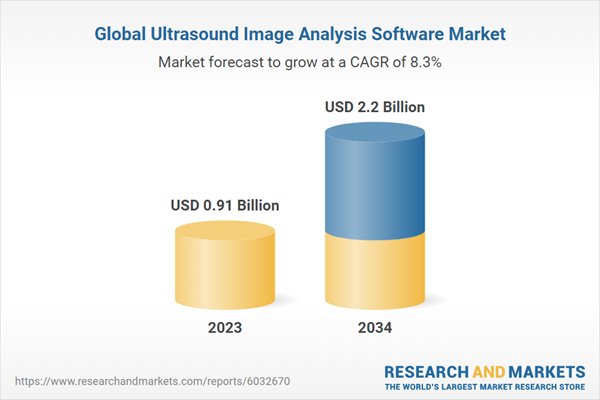
Market Overview - The global ultrasound image analysis software market is estimated to be USD 0.913 billion in 2024 and is expected to reach USD 2.20 billion by 2035, with a CAGR of 8.34% during the forecast period 2025-2035 [1][17]. Technological Advancements - The market growth is driven by advancements in ultrasound technology, particularly in image processing and AI-powered analysis, including developments such as 3D and 4D imaging, elastography, and Doppler imaging [4]. - These technological improvements enhance image quality, automate measurements, and enable real-time visualization, leading to increased demand for sophisticated ultrasound image analysis software [4][5]. Regional Insights - North America is anticipated to have the highest revenue share during the forecast period due to its well-established healthcare infrastructure and high adoption of advanced imaging technologies [6]. - The Asia Pacific region is predicted to grow at the fastest CAGR, driven by an expanding healthcare sector, increasing government investments, and rising prevalence of chronic diseases in emerging markets like China and India [7]. Market Segmentation by Type - The integrated software segment accounted for the highest revenue in 2024, driven by the adoption of comprehensive diagnostic solutions that enhance workflow efficiency [8]. - The standalone software segment is expected to grow at the fastest CAGR, catering to specific clinical needs in smaller clinics and diagnostic centers [9]. Market Segmentation by Product - The Doppler imaging segment accounted for the highest revenue in 2024, widely used in vascular imaging, obstetrics, and cardiology [10]. - The 3D & 4D ultrasound systems segment is predicted to grow at the fastest CAGR due to its advanced imaging capabilities [11]. Market Segmentation by Application - The cardiology segment accounted for the highest revenue in 2024, driven by the increasing prevalence of cardiovascular diseases [12]. - The oncology segment is expected to grow at the fastest CAGR, leveraging advanced image analysis tools for cancer detection and monitoring [13]. Market Segmentation by End-User - The hospitals segment accounted for the highest revenue in 2024, attributed to high patient volume and advanced infrastructure [14]. - The diagnostic centers segment is predicted to grow at the fastest CAGR, driven by the demand for quick and accurate diagnostic solutions [16].