World Gold Council

Search documents
Gold Prices Topped $4,000 For The First Time. Where Do They Go From Here?
Investopedia· 2025-10-07 21:05
Core Insights - Gold reached $4,000 an ounce for the first time, reflecting strong demand amid economic uncertainty and interest from retail investors [2][9] - Gold futures hit an all-time high of $4,014 an ounce, with a year-to-date gain of approximately 50%, outperforming most S&P 500 stocks [2] - The surge in gold prices is driven by concerns over a potential U.S. government shutdown and increased investment in physical gold ETFs [3][4] Investment Dynamics - Record inflows into gold ETFs totaled $17.3 billion last month, attributed to political tensions, options market activity, and a weaker U.S. dollar [5] - The "debasement trade" is a key factor, with retail investors purchasing gold as a hedge against rising federal debt and declining confidence in the U.S. dollar [5] - Central banks are also increasing their gold reserves, seeking stability during geopolitical and economic crises [5] Future Price Projections - Goldman Sachs forecasts gold prices to rise to $4,900 an ounce by the end of 2026, an increase from a previous estimate of $4,300 [6] - Analysts expect continued demand from central banks and Western ETF buyers to drive gold prices higher [7] - The potential for stock market turmoil could further support gold prices, especially during historically volatile periods like October [10] Market Relationships - Historical analysis indicates that gold's performance during stock market corrections is closely tied to the U.S. dollar's movements [10] - Despite the dollar being near its lowest levels in years, gold is expected to benefit from a flight to safety during equity sell-offs [10] - Analysts suggest monitoring support levels for gold, with key thresholds around $3,715 and $3,515 [11]


Gold Continues To Outshine As Silver Caps 14-Year High
Forbes· 2025-09-25 10:20
Group 1: Gold Market Insights - Gold prices are near record highs, with the COMEX gold December delivery contract trading at $3,790.50 per troy ounce, reflecting a 0.6% increase on the day and a rise of over 40% year-to-date in 2025 [3][5] - The recent surge in gold prices was influenced by comments from Fed Chairman Jerome Powell, who indicated a cautious approach to interest rate cuts, which temporarily affected market enthusiasm [4][5] - Central banks are maintaining a strong appetite for gold, with purchases exceeding 1,000 tonnes per year for three consecutive years, reminiscent of the 2008-09 financial crisis [6][7] Group 2: Silver Market Insights - Silver prices reached a 14-year high of $43.81 per troy ounce, marking a nearly 50% appreciation year-to-date, driven by similar market dynamics as gold [9] - The COMEX silver contract for December delivery was up 1.99% to $45.07, indicating continued upward momentum in the silver market [10] - Retail investors are increasingly turning to both physical gold and gold exchange-traded funds as safe-haven investments amid geopolitical tensions and economic uncertainties [8]
Gold Success Absent From Fund Allocation, Survey Shows - GraniteShares Gold Trust Shares of Beneficial Interest (ARCA:BAR), VanEck Gold Miners ETF (ARCA:GDX)
Benzinga· 2025-09-23 09:48
Group 1: Gold Performance and Market Sentiment - Gold is on track for its second-best performance in the last 50 years, with an increase of over 43% as investors hedge against geopolitical and monetary risks [1] - Institutional allocations to gold remain low, with only 2.4% of fund managers' portfolios allocated to gold, despite its strong performance [3][4] - A significant 39% of fund managers reported having zero exposure to gold, while only 6% have allocations of 8% or more [4] Group 2: Institutional Investment Trends - Fund managers are heavily concentrated in equities, particularly technology stocks, with a net 28% overweight position in equities, the highest level since February [4] - Cryptocurrencies are also largely absent from institutional portfolios, with two-thirds of respondents reporting no allocation at all [5] - Risk perception is a key factor in the reluctance to allocate to gold and cryptocurrencies, with 26% of respondents citing a second wave of inflation as the most significant tail risk [5] Group 3: Central Bank Activity and Demand - Central bank purchases of gold were neutral in July, marking a pause after three years of record accumulation, where over 1,000 tons were added annually [7] - China continues to import non-monetary gold above the five-year average as part of its strategy to diversify reserves and reduce reliance on the US dollar [8] - This steady flow of gold imports from China provides structural support for gold, even as institutional allocations lag [8]
The new gold play as investors look to hedge against risk, volatility
CNBC· 2025-08-22 17:06
Core Viewpoint - Global gold ETFs experienced inflows of $3.2 billion in July, indicating strong interest in the gold market, particularly in gold-backed exchange-traded funds, which are on track for their second-strongest year on record [1] Group 1: Market Trends - The gold market has seen unprecedented interest due to factors such as tariffs and inflation, leading to record highs for the precious metal [1] - Gold is traditionally viewed as a safe-haven investment, attracting capital during periods of uncertainty and volatility [2] - The growth in gold investments is primarily driven by U.S. investors, with significant inflows also coming from Asia [3] Group 2: Investment Dynamics - The gold trade continues to gain momentum across various forms, including physical gold, mining stocks, and ETFs, despite some recent tariff concerns that were alleviated [4] - Inflows into gold ETFs have been described as "staggering" compared to previous years, yet investors are less hedged in relation to the equity market than a decade ago, suggesting potential for further allocation into gold ETFs [5] - Gold-focused ETFs represent a smaller segment of the overall gold trade, but the demand for physical gold ownership is also increasing globally [6] Group 3: Comparative Analysis - U.S. bitcoin ETFs account for about 7% of the total market capitalization of bitcoin, while gold ETFs make up less than 1%, indicating room for growth in gold ETFs [7] - Gold ETFs are considered effective vehicles for tracking the spot price of gold and serve as a great allocation option for investors [7]
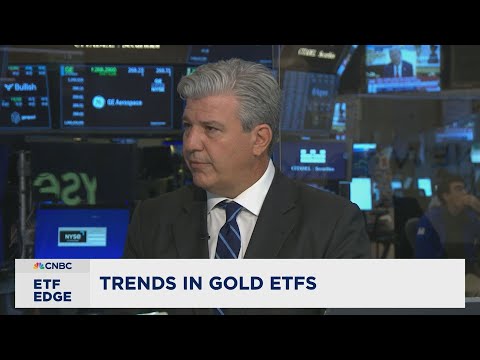
What's behind the rush into gold ETFs and funds to watch
CNBC Television· 2025-08-22 13:44
Gold ETF Market Trends - Gold ETFs are experiencing unprecedented interest, driven by risk and uncertainty in the market [2] - Gold ETFs can serve as a hedge against market downturns and unclear risks in portfolios [3] - While gold ETF flows are strong, their percentage of the S&P 500 market capitalization has decreased from 6% to 03% over the last decade, suggesting potentially less hedging in portfolios relative to the equity market [6] - The European ETF market accounts for approximately 35% of the global gold-backed ETF market [11] - Asia, particularly China, India, and Japan, has seen significant growth in gold ETF markets in the last two years [11] Factors Influencing Gold Prices - Central banks' increasing allocation to gold reserves is a significant driver of gold prices [15] - Central banks are diversifying away from the dollar and into gold [15] - Geopolitical risks, Fed decisions, fiscal spending, and inflation are key factors influencing gold prices [13] Tariffs and Market Impact - The market anticipates that gold in the investment and wholesale context will not be subject to tariffs [17] - President Trump's statement on social media has calmed the market regarding potential gold tariffs [18] Innovation in Gold Products - It is difficult to improve upon existing gold ETFs like GLD for tracking the spot price of gold [22][23] - The industry is exploring digitization to improve access to the gold market, potentially creating a "stable gold" alongside ETFs [25][26]
Central banks are increasingly buying gold from local mines as prices surge
CNBC· 2025-07-15 23:31
Core Viewpoint - Gold prices have recently declined from a near four-week high due to a modest rise in the dollar, but uncertainty regarding the U.S.-China trade agreement has limited the decline. Central banks are increasingly sourcing gold from domestic mines to bolster their reserves [1][8]. Central Bank Strategies - Central banks are turning to local gold mines to secure gold, which supports local industries and avoids impacting foreign exchange reserves. Countries like the Philippines and Ecuador have been doing this for years, and more central banks are considering direct local purchases [2][4]. - According to a World Gold Council survey, 19 out of 36 central banks are currently buying gold directly from domestic artisanal and small-scale miners, with four more considering it. This marks an increase from the previous year [3]. Economic Benefits - Purchasing gold directly from local mines is often cheaper than buying on the international market, as central banks can acquire gold at a slight discount. For instance, Ghana's Gold Board has agreements to buy 20% of gold output from local mining companies [5][8]. - Buying domestic gold allows central banks to grow their reserves using local currency, thus not sacrificing other reserve assets like the U.S. dollar [12]. Geopolitical Context - The rising global debt levels and geopolitical risks are prompting central banks to strengthen their reserve buffers. Approximately 95% of central banks surveyed expect their peers to increase gold reserves in the coming year [13]. Support for Local Industry - Central banks are incentivized to support local mining operations, which generate jobs and bolster local economies. However, purchasing gold from local mines can come with risks related to labor practices and environmental concerns [15][16]. - Central banks have the potential to improve the supply chain for artisanal and small-scale miners, providing a legal and fair outlet for their gold, which can enhance traceability and accountability [17][18].