
Hyundai

Search documents
ICE Officials Arrest 475 in Georgia After Raiding a Hyundai Plant | WSJ News
WSJ News· 2025-09-05 17:13
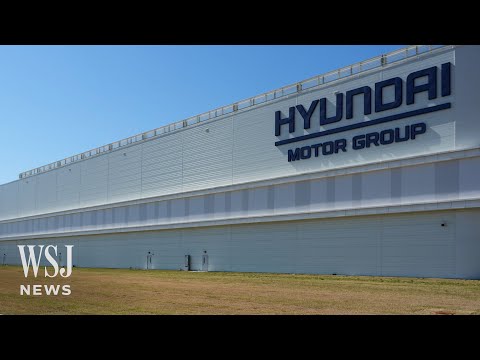
This in fact was the largest single site enforcement operation in the history of Homeland Security Investigations. This operation underscores our commitment to protecting jobs for Georgians and Americans, ensuring a level playing field for businesses that comply with the law, safeguarding the integrity of our economy, and protecting workers from exploitation. Each individual was questioned on their status, their documents were checked, their backgrounds were checked, and ultimately through coordination of o ...

X @The Wall Street Journal
The Wall Street Journal· 2025-09-05 16:23
More than 300 South Korean nationals were among the 475 people arrested in an immigration raid at a Hyundai battery plant in Georgia https://t.co/VGR6Cg4kgl ...
X @CNN Breaking News
CNN Breaking News· 2025-09-05 15:30
An immigration raid at Hyundai's Metaplant in Georgia led to the arrest of 475 people, a DHS official says. https://t.co/oAjp03MVZ0 ...
X @BBC News (World)
BBC News (World)· 2025-09-05 11:01
Legal and Compliance - ICE (Immigration and Customs Enforcement) raided a Hyundai electric vehicle site in Georgia, detaining South Koreans [1]
Prediction: This Chipmaker Will Power AI in Every Electric Vehicle by 2030
The Motley Fool· 2025-09-02 09:30
Industry Overview - The automotive AI market is projected to grow at an average annual rate of nearly 43% through 2034, indicating a significant expansion in the integration of AI technologies in vehicles [1][21] - AI is already present in various vehicles, particularly in self-driving-capable models from companies like Tesla and Mercedes-Benz, utilizing specialized hardware from semiconductor firms like Nvidia [5][6] Company Positioning - NXP Semiconductors is strategically positioned to dominate the automotive AI market despite competition from larger players like Nvidia and Qualcomm [2][16] - NXP's technology is widely used in vehicles, particularly in electric vehicles (EVs), encompassing systems for radar, battery management, and various vehicle functionalities [9][10][11] Technological Advancements - NXP's battery management system enhances the performance and longevity of EV batteries, which are a critical challenge in the industry due to their high replacement costs [12][13] - The company also provides EV charging station technology that optimizes the charging process and ensures digital security for public charging stations [14] Strategic Collaborations - NXP has established partnerships with major automotive manufacturers such as Ford, Volkswagen, BMW, and Hyundai, which utilize its technology for next-generation vehicle designs and safety systems [15][16] Market Dynamics - The automotive industry's current technological landscape is fragmented, which may benefit NXP as many manufacturers lack the core competency in advanced AI technologies [18][19] - NXP's comprehensive AI-powered solutions could serve as a competitive advantage, offering carmakers a complete integration option for their vehicles [19] Analyst Sentiment - Despite recent cyclical performance, analysts maintain a strong buy rating for NXP Semiconductors, reflecting confidence in its long-term growth potential in the automotive AI sector [20]

Is BYD Stock Your Ticket to Becoming a Millionaire?
The Motley Fool· 2025-08-30 08:30
Company Overview - BYD Company (BYDDY) has recently surpassed Tesla to become the world's largest electric vehicle (EV) manufacturer, selling nearly 607,000 battery-powered EVs in Q2 compared to Tesla's 373,728 deliveries [2][3] - The company is not only focused on EVs but also manufactures hybrids, buses, high-speed trains, electronics components, and lithium batteries for other automakers [4][10] Market Position - BYD is highly self-sufficient, producing its own electronic components and batteries, and even owns seven cargo ships for vehicle delivery, enhancing its operational flexibility [5] - The company holds approximately 30% of China's EV market share, significantly ahead of its nearest competitor, Geely, which has just over 10% [11] Growth Potential - The demand for new energy vehicles in China is increasing, with July sales reaching 1.26 million cars, a 27% year-over-year increase, and projections indicate that new energy vehicles could account for 80% of new car sales in China by 2030 [10] - A $100,000 investment in BYD today could potentially grow to $1 million in 15 to 20 years, requiring an average annual gain of 12% to 16%, which, while above historical norms, is plausible given the company's performance and market conditions [14]
全球汽车、电动汽车:下一步动向,美国环境法规放宽,北美利润率有较大上行空间Global Automobiles_ Electric Vehicles_ What’s Next X_ US Environmental Regulations Easing; Major upside to N. America margins
2025-08-28 02:12
Summary of Key Points from the Conference Call Industry Overview - The focus is on the **Global Automobiles** industry, particularly the **Electric Vehicle (EV)** sector and the impact of changing environmental regulations in the US and Europe on traditional automakers [1][2][15]. Core Insights and Arguments 1. **Decline in Global BEV Penetration**: Global Battery Electric Vehicle (BEV) penetration rates are expected to decline outside of specific regions like China, with estimates lowered to 25% for 2030 and 52% for 2040 [3][37]. 2. **Easing of Environmental Regulations**: US and European regulations are shifting towards easing, which will allow traditional automakers to maximize profits by selling a balanced mix of gasoline-powered vehicles and hybrid vehicles (HEVs) [2][15]. 3. **Margin Improvement in North America**: North American margins could improve by 2-3 percentage points, translating to an EBIT upside of US$15-22 billion, significantly impacting the combined estimated operating profits of highlighted stocks [2][23]. 4. **Structural Shift to HEVs**: The shift towards HEVs in the US is deemed structural, driven by updated product plans from OEMs, particularly from Japan and Korea, indicating a long-term trend rather than a temporary adjustment [10][48]. 5. **Stock Recommendations**: Companies such as Ford, GM, Toyota, Honda, Subaru, Hyundai, and Kia are expected to benefit from the easing regulations and the shift towards HEVs [11][13]. Additional Important Insights 1. **Impact of the Beautiful Bill**: The Beautiful Bill has eliminated civil penalties for non-compliance with federal fuel economy standards, providing automakers with more flexibility in their vehicle mix [16][21]. 2. **Environmental Credit Impairment Risks**: Traditional automakers may face potential impairment of environmental credits due to non-compliance with CO2 regulations, with Subaru already booking US$760 million in provisions related to environmental regulations [28][32]. 3. **Consumer Preferences**: Despite low gasoline prices, consumers are showing a preference for HEVs due to their fuel efficiency and performance, indicating a shift in consumer behavior [10][48]. 4. **Regional Sales Trends**: BEV sales are polarized, with significant growth in China (37% YoY) while the US and Europe are experiencing declines [54]. HEV sales in the US are strong, rising 24% YoY in June and 22% in July [57]. Conclusion The conference call highlights a significant transition in the automotive industry, driven by regulatory changes and shifting consumer preferences. Traditional automakers are poised to benefit from these changes, particularly through increased sales of HEVs, while BEV sales face challenges in certain markets. The insights provided suggest a cautious yet optimistic outlook for the industry moving forward.
X @TechCrunch
TechCrunch· 2025-08-27 13:11
Company Initiatives - Uncaged Innovations 与现代合作开发皮革替代品,旨在减少环境影响 [1]