Invesco

Search documents
ETFs Post Record $176B Inflows in October
Yahoo Finance· 2025-11-03 23:00
Core Insights - Investors invested a record $175.6 billion into U.S.-listed ETFs in October, marking the largest monthly inflow in history, bringing total inflows for 2025 to $1.12 trillion, just $4 billion short of the full-year 2024 record [1] - With two months remaining in the year, inflows are projected to reach between $1.3 trillion and $1.5 trillion, surpassing last year's total [1] Inflows Across Asset Classes - U.S. equity ETFs attracted $73.1 billion, while U.S. fixed income ETFs saw inflows of $42.5 billion [2] - International equity ETFs gained $35.4 billion, international fixed income funds added $9.4 billion, and both commodities and currency ETFs received approximately $5.8 billion each [2] - The widespread inflows indicate the growing adoption of ETFs across various asset classes [2] Top Performing Funds - The Vanguard S&P 500 ETF (VOO) led with $17.7 billion in inflows, raising its assets to nearly $800 billion, and has accumulated almost $104 billion this year, on track for a second consecutive year exceeding $100 billion in inflows [3] - The SPDR Portfolio S&P 500 ETF (SPLG) followed with $6.7 billion, and the Invesco QQQ Trust (QQQ) added $6.3 billion, with QQQ up about 24% year-to-date due to AI-driven enthusiasm in large-cap tech stocks [4] Demand for Crypto and Commodities - The iShares Bitcoin Trust ETF (IBIT) attracted $4.3 billion as Bitcoin approached a record near $125,000 before retreating towards $100,000 [5] - The SPDR Gold Shares (GLD) saw inflows of $3.6 billion as gold prices surged above $4,300 an ounce, reflecting a 63% increase year-to-date before slightly declining below $4,000 [5] International Flows - The JPMorgan BetaBuilders Europe ETF (BBEU) led international flows with $4 billion in October, up about 25% for the year [6] - The iShares U.S. Treasury Bond ETF (GOVT) was the only fixed income fund in the top ten, attracting $4.1 billion as the 10-year Treasury yield briefly dipped to 3.94% before rising to 4.09% [6] Outflows from Specific Sectors - The iShares Russell 2000 ETF (IWM) experienced the largest outflows in October, losing $4.1 billion as investors rotated out of small caps [7] - The Direxion Daily Semiconductor Bull 3X Shares (SOXL) saw outflows of $2.7 billion as traders took profits following a strong performance in semiconductor stocks like Nvidia [7]
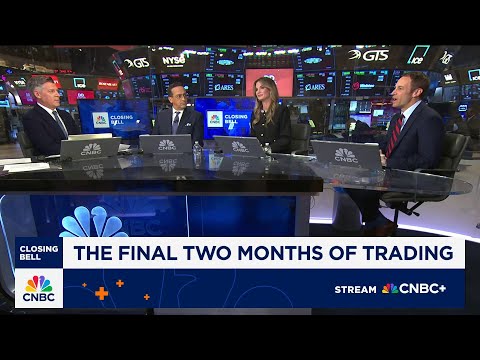
Markets suggest a continued drift and chase higher, says NewEdge Wealth's Cameron Dawson
CNBC Television· 2025-11-03 20:40
Trivariate’s Adam Parker, NewEdge Wealth’s Cameron Dawson and Invesco’s Brian Levitt join 'Closing Bell' to discuss the latest news affecting markets. ...

The QQQ ETF Could Gain 30% From Here, But It’s Also Waving a Giant, Dot-Com Era Red Flag
Yahoo Finance· 2025-11-03 20:10
Group 1 - The 2025 outlook highlights major risks facing the bull market and potential drivers for new highs [1] - The Invesco Nasdaq 100 ETF (QQQ) has shown significant performance, with nearly 30% gain in the past 12 months, contributing to the S&P 500's success [3] - There is a potential for QQQ to rise another 30%, reminiscent of the dot-com bubble era, driven by a hyper-focus on AI stocks [4] Group 2 - The market's current performance is heavily reliant on QQQ, while other stocks in the S&P 500 are lagging behind [5] - The concentration of wealth among the largest stocks has increased, with smaller caps facing challenges due to "debt cliffs" [6] - The outlook suggests that while QQQ may continue to rise, it could eventually roll over, impacting the broader market [7]
These 2 AI ETFs Are Ready to Crush the S&P 500 Over the Next 10 Years
Yahoo Finance· 2025-11-03 13:08
Group 1 - Artificial intelligence (AI) is a transformative technology trend creating investment opportunities, with exchange-traded funds (ETFs) being a suitable option for some investors [1] - Many AI ETFs have high expense ratios compared to average technology index funds and tend to invest heavily in mega-cap AI stocks [2] - The Invesco QQQ ETF provides significant AI exposure at a lower cost, with its top 10 holdings representing major players in the AI sector [4][6] Group 2 - The top 10 holdings of the Invesco QQQ ETF include Nvidia, Microsoft, Apple, Broadcom, Amazon, Tesla, Meta Platforms, Alphabet, Netflix, and Palantir Technologies, which together account for over 56% of the fund's assets [5][6] - The Invesco QQQ ETF has a low expense ratio of 0.20%, making it more beneficial for investors compared to other AI ETFs with ratios of 0.6%-0.8% [6] - Actively managed ETFs, which aim to outperform benchmark indices, can justify higher fees compared to standard index-tracking ETFs [7]
Stocks to Watch: Automobile stocks, IndusInd Bank, HUL, BEML, Dredging Corp, RailTel, AU Small Finance Bank & Lemon Tree
BusinessLine· 2025-11-03 03:20
Group 1: Automotive Industry Performance - Improved consumer sentiment in India, driven by GST 2.0 reforms, discounts, OEM offerings, and financing schemes, led to decent sales by Indian auto makers in October [1] - Maruti Suzuki India reported a double-digit increase in domestic wholesales to 176,318 units in October, compared to 159,591 units in the same month last year [1] - Mahindra & Mahindra reported domestic wholesales of 71,624 units, a 31% year-on-year increase from 54,504 units [2] - Tata Motors saw a 27% year-on-year growth to 61,134 units in October, attributed to record electric vehicle wholesales, which increased by 73% year-on-year to 9,286 units [2] - Hyundai Motor India Ltd reported total sales of 69,894 units in October, including domestic sales of 53,792 units and exports of 16,102 units [2] - TVS Motor Company achieved total sales of 543,000 units, an 11% year-on-year increase from 489,000 units [2] - Escorts Kubota Ltd reported a 3.8% rise in total tractor sales to 18,798 units in October compared to the same month last year [2] Group 2: Corporate Developments - IndusInd International Holdings Ltd and Invesco Ltd completed the formation of their asset management joint venture, with IIHL acquiring a 60% stake in Invesco Asset Management India [3] - Hindustan Unilever received a tax notice for ₹1,986.25 crore from the Income Tax Department, disputing the valuation of certain related-party transactions [4] - BEML Ltd and Dredging Corporation of India Ltd signed three MoUs worth approximately ₹350 crore to enhance India's maritime and dredging capabilities [5] - Responsive Industries successfully executed the first phase of the Kaiga Generating Station Power Plant, using in-house manufactured waterproofing membranes [6] - CFF Fluid Control received a contract for procurement of equipment for the P75 Project from the Indian Navy, totaling approximately ₹10.95 crore [7] - Titagarh Rail Systems Ltd secured a ₹2,481-crore contract from MMRDA for the design and supply of metro coaches for Mumbai Metro Line 5 [8] - RailTel Corporation of India Ltd received a Letter of Acceptance from Rajasthan Council of School Education for ₹32,431,600 [9] - Lemon Tree Hotels launched a new property in Motihari, Bihar, marking its expansion in Eastern India [13]


What This Fund's $6 Million Exit from a 2027 Bond ETF Should Signal to Long-Term Investors
The Motley Fool· 2025-11-02 14:55
Core Insights - Carmel Capital Partners has fully exited its position in the Invesco BulletShares 2027 Corporate Bond ETF (BSCR), selling 301,243 shares for an estimated $5.9 million during the third quarter [2][6][7] Group 1: Company Actions - The complete sale of BSCR shares was disclosed in a regulatory filing, indicating a strategic shift in investment focus [2][13] - This exit is part of a broader trend where Carmel is reallocating investments from shorter-duration debt to higher-yield and longer-maturity credit [6][7] Group 2: ETF Overview - The Invesco BulletShares 2027 Corporate Bond ETF has an Assets Under Management (AUM) of $4.2 billion and a yield to maturity of 4.1% [4][5] - As of the latest market close, BSCR shares were priced at $19.70, reflecting a 1% increase over the past year [3][4] Group 3: Market Trends - The movement away from BSCR aligns with a broader theme among bond investors, as capital is increasingly flowing into intermediate and longer credit due to a more favorable outlook for fixed income [10]

This Fund Dumped 2026 Bonds for 2031 — and BBB Exposure
The Motley Fool· 2025-11-02 13:37
Core Insights - Carmel Capital Partners has completely exited its position in the Invesco BulletShares 2026 Corporate Bond ETF (BSCQ), liquidating 300,704 shares for approximately $5.9 million [2][6] - The move indicates a strategic shift towards longer-dated and higher-yielding corporate credit exposure, as part of a broader repositioning of Carmel's fixed-income strategy [6][7] ETF Overview - The Invesco BulletShares 2026 Corporate Bond ETF (BSCQ) has an Assets Under Management (AUM) of $4.2 billion and was priced at $19.57 as of the market close on Friday [4][5] - The ETF has achieved a 1-year total return of 4.3% [4] Investment Strategy - BSCQ focuses on tracking an index of U.S. dollar-denominated investment-grade corporate bonds maturing in 2026, providing a defined maturity profile for investors [9] - The ETF is designed to be transparent and passively managed, primarily consisting of high-quality corporate bonds [9][12] Market Positioning - Following the sale of BSCQ, Carmel Capital Partners has increased its stakes in the Invesco BulletShares 2031 Corporate Bond ETF (BSCV) and Eldridge's BBB B-rated Corporate Credit ETF (CLOZ), indicating a tactical shift from near-term maturities to longer-duration holdings [6][7] - This rotation suggests that as short-term ETFs like BSCQ mature, reinvestment into longer horizons can help lock in yields while balancing risk [7]

Worried About Record Stock Market Concentration? Us, Too
Yahoo Finance· 2025-11-02 13:00
Core Insights - The concentration of the stock market is at an all-time high, with the top 10 US companies having a market capitalization of nearly $24.4 trillion as of October 23, representing over 43% of the S&P 500 [1][2] - Nvidia alone accounts for nearly 8% of the S&P 500, equating to the total value of all 2,000 small-cap companies in the Russell 2000 index [2] - The concentration of the top 10 companies in the S&P 500 increased by 8.2 percentage points from 34.8% to over 43% in just over 15 months [2] Market Dynamics - Large-cap growth stocks, particularly in the tech sector, have significantly outperformed small-cap value stocks over the past decade [2] - Historical analysis suggests that increased market concentration is typically a sign of a bull market rather than a precursor to a bear market [3] - Despite common perceptions, elevated concentration has often been followed by market rallies rather than declines [3] Investment Strategies - One strategy to mitigate concentration risk is to invest in an equal-weight S&P 500 index fund, which would reduce the influence of the top companies [3] - However, this strategy has underperformed compared to cap-weighted funds, with the Invesco S&P 500 Equal Weight ETF gaining only 7.6% and 14.5% over one and three years, respectively, compared to the Vanguard S&P 500's gains of 16.0% and 23.1% [3]
3 Index ETFs to Buy With $1,000 and Hold Forever
Yahoo Finance· 2025-11-01 15:07
Core Insights - The article emphasizes that average investors should ignore market chatter about bubbles and high valuations, as trying to time the market can lead to missed opportunities for significant gains [2] - A study by J.P. Morgan indicates that missing the best market days can drastically reduce total returns, highlighting the difficulty of market timing [3] - The recommended strategy for retail investors is to dollar-cost average into positions in low-cost exchange-traded funds (ETFs) to achieve diversification and mitigate the impact of market fluctuations [4] Investment Strategies - Investors can start with as little as $1,000 and consistently invest a similar amount monthly to potentially grow a portfolio to over $5.6 million in 30 years with a 15% annualized return [5] - The Vanguard S&P 500 ETF is highlighted as a leading investment option, tracking the performance of the S&P 500 index, which includes the 500 largest U.S. companies [6][7] - The article also mentions the Invesco QQQ Trust for those seeking more exposure to growth stocks and the Schwab U.S. Dividend Equity ETF for balance in a growth-heavy portfolio [8]
Moving Averages of the Ivy Portfolio & S&P 500: October 2025
Etftrends· 2025-10-31 21:55
Core Insights - The article provides an update on the performance of the S&P 500 and the Ivy Portfolio, highlighting that all five ETFs in the Ivy Portfolio remain in an "invest" position as of the end of October [5][7][14]. Ivy Portfolio Overview - The Ivy Portfolio is constructed using an asset allocation strategy similar to that of Harvard and Yale endowment funds, consisting of five ETFs that cover various asset classes [2]. - The strategy involves creating a diversified portfolio with equal weight across asset classes, calculating a 10-month moving average for each fund, and making buy/sell decisions based on whether the fund closes above or below this average [3]. Ivy Portfolio Performance - At the end of October, none of the five ETFs in the Ivy Portfolio closed below their 10-month or 12-month simple moving averages, indicating a continued "invest" position [5][7]. - The percentage above or below the moving average for each fund is tracked, with funds within 2% of the signal highlighted for potential position reversals [6]. S&P 500 Performance - The S&P 500 closed October with a monthly gain of 2.3%, marking the sixth consecutive month of gains, and closed 11.0% above its 10-month simple moving average [8][10]. - The index also closed 11.6% above its 12-month simple moving average, maintaining an "invest" position for six straight months [12]. Moving Averages Strategy - Utilizing a moving average strategy can effectively manage risks associated with bear markets, where holding the index is advised when it closes above the moving average and moving to cash when it closes below [9]. - The article illustrates that a 10- or 12-month simple moving average strategy would have allowed participation in most upside movements since 1995 while significantly reducing losses [10][15]. Psychological Factors - The article discusses the psychology behind momentum signals, noting that human behavior often leads to buying during market uptrends and selling during downturns, which can create cycles of buying and selling momentum [16]. Implementation Considerations - The moving average strategy is most effective when applied to specific investments rather than broad indices, as signals may differ due to factors like dividend reinvestment [17]. - The strategy is recommended for use in tax-advantaged accounts with low-cost brokerage services to maximize gains [18].