
Verizon

Search documents
The Stock of Dividend Darling Verizon Climbs on Upbeat Outlook. Is It Time to Buy the High-Yield Stock?
The Motley Fool· 2025-07-27 08:35
Core Viewpoint - Verizon Communications has shown improvement in its stock performance following solid second quarter results and positive guidance, with a year-to-date stock price increase of approximately 7% and a yield exceeding 6% [1] Financial Performance - Verizon's Q2 revenue increased by 5.2% to $34.5 billion, surpassing analyst expectations of $33.74 billion [6] - Wireless service revenue rose by 2.2% to $20.9 billion, while wireless equipment revenue surged by 25.2% to $6.3 billion [6] - Adjusted earnings per share (EPS) climbed 6% to $1.22, and adjusted EBITDA rose 4.1% to $12.8 billion [6] Subscriber Growth - The broadband business led growth, adding 293,000 net broadband subscribers, totaling 12.9 million, a year-over-year increase of over 12% [3] - The consumer wireless segment lost 51,000 postpaid subscribers but gained 50,000 prepaid subscribers [4] - Business service revenue increased by 1.6% to $3.6 billion, with 65,000 wireless retail postpaid net additions [5] Future Guidance - Verizon maintained its full-year 2025 wireless revenue growth forecast of 2% to 2.8% and increased the low end of its adjusted EPS growth forecast to 1% to 3% [7] - The company raised its operating cash flow outlook to between $37 billion and $39 billion, leading to a projected free cash flow of $19.5 billion to $20.5 billion [8][9] Dividend and Cash Flow - Verizon's dividend yield is approximately 6.4%, with a coverage ratio of 1.5x based on $8.8 billion in free cash flow generated in the first half of the year against $5.7 billion in dividends paid [10] - The company benefits from new tax legislation allowing for immediate 100% depreciation of certain assets, enhancing cash flow [11] Strategic Acquisitions - Verizon's acquisition of Frontier Communications is expected to significantly expand its fiber network, particularly in states like Florida, Texas, and California, enhancing its ability to bundle mobile and home internet services [14][15] Valuation - Verizon trades at a forward price-to-earnings (P/E) ratio of 9x based on 2025 earnings estimates, which is below AT&T's 13x multiple, indicating potential upside [16]


Markets are getting overly complacent, so it may be time to take profits, strategist argues
Yahoo Finance· 2025-07-26 14:00
Another close here, David. Another close. Green all over the screen.Uh, David, I was just talking to Lou about this. Look ahead. We just keep kind of melting up here.David, what are your expectations. You know, unfortunately, I think the market right now is probably getting a little bit overextended. When I look at our valuations, the market overall is trading at about a 2 to 3% premium to a composite of our fair values.Yeah, we cover over 700 stocks that trade on US exchanges. So, we compare our intrinsic ...

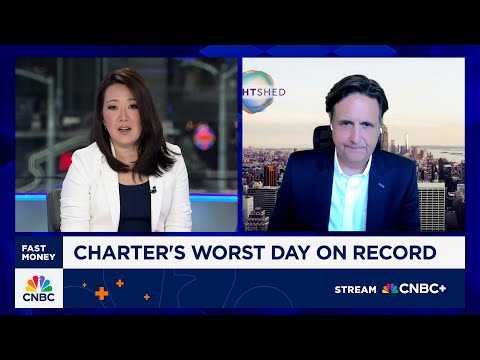
Lightshed's Walter Piecyk on what's ahead for Charter after stock posts worst day on record
CNBC Television· 2025-07-25 22:31
Broadband Market Dynamics - Fiber is a superior service due to faster speeds and better uplink capabilities, leading to increased adoption [1] - T-Mobile and Verizon's "cell phone internet" (mobile broadband) offerings are eroding the subscriber base of traditional broadband providers like Charter and Comcast [1][2][3] - AT&T is pivoting to invest more in fiber and become more aggressive in selling mobile broadband [1][2] Challenges for Cable Companies - Video business is declining, with revenue down 10%, as customers switch to cheaper, skinnier bundles with streaming services [5] - Cable companies are losing customers to fiber and wireless broadband, despite efforts to offer cheaper video options [7] - Net broadband additions are declining, suggesting that efforts to reduce churn are not effectively translating into subscriber growth [6] Strategic Considerations - Vertical consolidation, where companies offer both connectivity and content services, is a potential end game for the industry [8] - Charter was considered a potential acquisition target, but Verizon acquired Frontier instead [8][9] - T-Mobile is not interested in owning cable assets [9] - Regulatory hurdles may make it difficult for Comcast to acquire Charter [10] Company-Specific Observations - Comcast's core business is broadband, and its valuation is discounted compared to Charter [13] - Comcast could improve its valuation by executing better on strategies like offering free mobile lines and reducing losses at Peacock [13]
Verizon(VZ) - 2025 Q2 - Quarterly Report
2025-07-25 13:47
Financial Performance - Verizon Consumer Group's operating revenues for Q2 2025 reached $26.6 billion, a 6.9% increase from $24.9 billion in Q2 2024[166] - Verizon Business Group's operating revenues for Q2 2025 totaled $7.3 billion, reflecting a slight decrease of 0.3% compared to $7.3 billion in Q2 2024[168] - Consolidated operating revenues for the first half of 2025 were $67.99 billion, up 3.4% from $65.78 billion in the same period of 2024[179] - The Consumer segment's operating revenues for the first half of 2025 were $52.3 billion, a 4.6% increase from $50.0 billion in the same period of 2024[166] - The Business segment's operating revenues for the first half of 2025 were $14.6 billion, down 0.8% from $14.7 billion in the same period of 2024[168] - Consolidated net income for the three months ended June 30, 2025, was $5,121 million, an increase of $419 million or 8.9% from $4,702 million in 2024[201] - Consolidated EBITDA for the three months ended June 30, 2025, was $12,883 million, up from $12,215 million in 2024, representing an increase of $668 million or 5.5%[201] - Consolidated adjusted EBITDA for the three months ended June 30, 2025, was $12,807 million, an increase of $506 million or 4.1% from $12,301 million in 2024[201] - Total operating revenues increased by 6.9% to $26,648 million for the three months ended June 30, 2025, compared to $24,927 million in the same period of 2024[229] Operating Expenses - Consolidated operating expenses for the first half of 2025 were $51.84 billion, an increase of 2.8% from $50.44 billion in the same period of 2024[180] - Total operating expenses rose to $19,005 million for the three months ended June 30, 2025, an increase of 9.7% compared to 2024, and $37,199 million for the six months, up 6.3%[234] - Total operating expenses for the three months ended June 30, 2025, were $6,637 million, a decrease of $163 million (2.4%) compared to the same period in 2024[251] Capital Expenditures - Capital expenditures for the first half of 2025 amounted to $8.0 billion, with full-year expectations ranging from $17.5 billion to $18.5 billion[170] - Capital expenditures for the six months ended June 30, 2025, were $8.0 billion, a decrease of $118 million compared to $8.1 billion in 2024[271] Wireless Services - Wireless retail connections increased significantly, driven by a higher volume of wireless devices sold, with upgrades increasing by 31% and 14% for the three and six months ended June 30, 2025, respectively[188] - Wireless service revenue rose by 2.3% to $17,369 million for the three months ended June 30, 2025, compared to $16,985 million in the same period of 2024[229] - Wireless retail postpaid accounts decreased by 0.7% to 32,550,000 as of June 30, 2025, compared to 32,769,000 in the same period of 2024[229] - Wireless retail postpaid ARPA increased by 2.3% to $147.50 for the three months ended June 30, 2025, compared to $144.15 in the same period of 2024[229] - Wireless retail churn rate was 1.58% for the three months ended June 30, 2025, unchanged from the same period in 2024[229] - Wireless equipment revenue increased by 29.6% to $5,369 million for the three months ended June 30, 2025, compared to $4,143 million in the same period of 2024[229] Broadband Services - FWA broadband connections increased by 34.2% to 3,077,000 as of June 30, 2025, compared to 2,292,000 in the same period of 2024[229] - Total broadband connections grew by 9.4% to 10,425,000 as of June 30, 2025, compared to 9,530,000 in the same period of 2024[229] - Total broadband net additions were 181,000 for the three months ended June 30, 2025, a decrease of 21.6% compared to 231,000 in the same period of 2024[229] - Fios revenue increased by 1.0% to $2,924 million for the three months ended June 30, 2025, compared to $2,896 million in the same period of 2024[229] Tax and Income - Verizon anticipates a decrease in its 2025 cash income tax liability due to the One Big Beautiful Bill Act, estimating an increase in deferred tax liability by $1.5 billion to $2.0 billion by year-end 2025[174] - Provision for income taxes increased by $156 million or 11.7% to $1,488 million for the three months ended June 30, 2025, compared to $1,332 million in 2024[192] - The effective income tax rate increased to 22.5% for the three months ended June 30, 2025, compared to 22.1% in 2024, primarily due to higher income before taxes[192] Debt and Cash Flow - Average debt outstanding was $144,695 million for the three months ended June 30, 2025, compared to $151,410 million in 2024, indicating a decrease in debt levels[191] - Total debt as of June 30, 2025, was $146.0 billion, an increase from $144.0 billion at December 31, 2024[277] - Free cash flow for the six months ended June 30, 2025, was $8.804 billion, an increase of $306 million from $8.498 billion in the same period of 2024[290] - Net cash provided by operating activities increased by $188 million to $16,757 million for the six months ended June 30, 2025, compared to $16,569 million in 2024[266] Acquisitions and Investments - Verizon entered into a license purchase agreement to acquire spectrum licenses from UScellular for total consideration of $1.0 billion[304] - Verizon's acquisition of Frontier Communications is structured as a merger with a per share consideration of $38.50, subject to regulatory approvals[305] Risks and Controls - The company faces risks including high levels of indebtedness and significant litigation expenses, which could impact financial performance[313] - The company is involved in various litigation and regulatory proceedings but does not believe any are material as of the report date[314] - The Chief Executive Officer and Chief Financial Officer concluded that the registrant's disclosure controls and procedures were effective as of June 30, 2025[309] - There were no changes in the Company's internal control over financial reporting during the second quarter of 2025 that materially affected internal controls[312] Renewable Energy - Verizon has 28 renewable energy purchase agreements totaling approximately 3.7 gigawatts of anticipated renewable energy capacity[291]
Investors Should Still Avoid Verizon Stock Despite Rising Earnings. Here's Why.
The Motley Fool· 2025-07-25 10:25
Core Viewpoint - Verizon Communications reported solid earnings for Q2 2025, with rising revenue, earnings, and free cash flow, but concerns remain regarding its high debt levels, indicating potential struggles ahead without significant changes [1][12]. Financial Performance - Verizon's total debt reached nearly $146 billion by mid-2025, an increase from $144 billion at the end of the previous year, with unsecured debt rising by $2 billion [3]. - The company's total equity or book value stands at $104 billion, highlighting the strain of its debt obligations on the balance sheet [3]. - Over the past 12 months, Verizon incurred $6.6 billion in interest expenses, translating to slightly over 4% interest costs relative to its total debt of $154 billion, which is considered relatively low [5]. Debt and Interest Rates - Interest rates have increased since 2021, and while only about $2 billion of Verizon's debt is due this year, refinancing at higher rates is anticipated, potentially increasing future costs [6]. - The company has historically relied on debt to finance its telecom network, with a significant acquisition of C-band spectrum costing $52.9 billion in 2021 [4]. Dividend Sustainability - Verizon has maintained an 18-year streak of dividend increases, with a current dividend yield of 6.4%, significantly higher than the S&P 500 average of 1.2% and its competitors AT&T (4.1%) and T-Mobile (1.4%) [8]. - The dividend cost Verizon approximately $11.4 billion over the last year, which it can cover with its free cash flow of just over $20.1 billion, but a dividend cut could allow for debt reduction [9][10]. Market Position and Future Outlook - Despite the attractive dividend, the high cost and heavy debt burden may render the current dividend trajectory unsustainable, leading to potential struggles if a cut occurs [12]. - The low P/E ratio of 10 suggests limited downside risk, and improved financials could attract investors in the long run if the company focuses on reducing its debt [10][11]. - Comparisons with AT&T indicate that even after a dividend cut, a solid financial position could make Verizon stock appealing if it successfully manages its debt [13].
Why I Just Bought More of This Ultrahigh-Yield Dividend Stock
The Motley Fool· 2025-07-25 08:50
Group 1 - Verizon Communications reported better-than-expected second-quarter results and raised its full-year guidance, marking its 35th consecutive year of being recognized for the best wireless network quality by J.D. Power [1] - The company's forward price-to-earnings ratio is below 9.2, significantly lower than the S&P 500's forward earnings multiple of 22.7, indicating that Verizon's shares are not priced for perfection [8] - Verizon's business is largely resistant to the impact of tariffs and overall economic downturns, as wireless services are considered essential by consumers [10] Group 2 - The company is on track to close the acquisition of Frontier Communications in early 2026, which is expected to boost growth [12] - Verizon's forward dividend yield is 6.3%, providing a strong foundation for delivering double-digit percentage total returns, supported by an increase in free cash flow expected this year [13]
Verizon claims it got threats from Byron Allen, owner of the Weather Channel, over alleged race discrimination
New York Post· 2025-07-23 20:08
Core Viewpoint - Verizon is facing threats of legal action and a potential smear campaign from Byron Allen, a media mogul, after the company reduced its advertising budget with his media group, Allen Media Group (AMG) [1][5][10]. Group 1: Legal Threats and Advertising Budget - Byron Allen has threatened to sue Verizon for alleged racial discrimination after the company backed out of a $15 million annual advertising deal with AMG [1][10]. - Verizon claims that the threats from Allen and AMG are baseless and represent an attempted shakedown [4][5]. - The company plans to reduce its advertising spending with AMG by 30% in 2025 and 2026, bringing the budget down to $5 million from $15 million [10][11]. Group 2: Historical Context and Partnerships - Verizon and AMG previously collaborated on a diversity, equity, and inclusion initiative aimed at increasing media spending in Black-owned media companies [12][13]. - Allen has a history of suing major media companies for racial discrimination, having recently settled a $10 billion lawsuit against McDonald's [16][18]. - The political climate has shifted, impacting DEI programs, as seen in Verizon's agreement to end its DEI initiatives during its merger with Frontier Communications [15].

Churn Concerns Weigh On Verizon's Wireless Outlook Despite Financial Gains
Benzinga· 2025-07-23 18:19
Core Insights - Verizon Communications delivered a strong second-quarter performance with healthy financial growth and a significant increase in free cash flow, which is expected to enhance debt reduction and provide flexibility for future investments [1][4] - The company faces challenges with wireless net additions and anticipates a competitive landscape in 2025, expecting flat postpaid consumer phone customer growth [2][5] Financial Performance - The second-quarter results showed encouraging financial growth, with a notable lift to free cash flow from tax reform, allowing for faster de-leveraging post Frontier acquisition [4] - Analyst Benjamin Swinburne raised the price forecast for Verizon shares from $47 to $48, noting that the shares currently trade at a discount compared to peers [3] Market Challenges - Wireless net additions performance remains mixed, with expectations of flat postpaid consumer phone customers in fiscal 2025 compared to fiscal 2024 [5] - Increased churn is anticipated in the second half of 2025 due to a competitive environment, although gross adds growth is expected to remain healthy [6] Broadband Outlook - Broadband additions were lower than expected in the second quarter, impacting the outlook, but Verizon is projected to meet its guidance of 8-9 million FWA customers by 2028 [7] - Factors such as low housing growth, a low move environment, and increased broadband competition are affecting Verizon's net additions [7] Stock Performance - Verizon's stock is currently trading lower by 0.59% at $42.71 [8]

The Association of Former Students announces new corporate partnership with Verizon
GlobeNewswire· 2025-07-23 14:03
COLLEGE STATION, Texas, July 23, 2025 (GLOBE NEWSWIRE) -- The Association of Former Students, the official alumni association of Texas A&M University serving approximately 600,000 members of the Aggie Network, is proud to announce a new corporate partnership with Verizon, one of the world’s leading providers of technology and communications services that power and empower how people live, play and work. This partnership will support The Association’s mission to engage, connect and serve the worldwide Aggie ...
Verizon Delivers a one-two punch with Best Wireless Network Performance results:
Globenewswire· 2025-07-23 13:40
Core Insights - Verizon has been recognized as America's Most Awarded Brand for Network Quality by J.D. Power for an unprecedented 35 consecutive times, highlighting its leadership in the wireless industry [1][2][6] - In the 1H 2025 RootMetrics study, Verizon was named the Best, Most Reliable, and Fastest 5G Network, further solidifying its position in the market [1][2][7] Company Performance - Verizon's ongoing investment in network infrastructure and innovative strategies has allowed it to maintain a high-performing network that serves millions of customers across the U.S. [2][3] - The company emphasizes unmatched reliability and coverage, with its 5G and 4G LTE networks providing extensive coast-to-coast service, reducing dropped calls, and ensuring dependable connectivity [5] Network Quality and Innovation - Verizon's 5G Ultra Wideband service offers high speeds and low latency, reaching over 280 million people with dedicated mmWave and C-band spectrum [5] - The company is committed to powering innovation across critical sectors, including utilities and public safety, by delivering secure, low-latency solutions [5] Customer Satisfaction - Verizon has achieved the highest number of awards in network quality from J.D. Power from 2003 to 2025, reflecting strong customer satisfaction with its network performance [6] - The company’s focus on AI-powered customer experience innovations aims to set new standards for customer expectations in connectivity [3]