TSMC

Search documents
TSMC Expands AI Chip Production to Japan
247Wallst· 2026-02-05 13:25
Taiwan Semiconductor Manufacturing Company ( NYSE:TSM ) is expanding production of advanced AI semiconductors to Japan, marking a significant geographic diversification for the world's leading chipmaker. ...


TSMC Needs to Make More Advanced Chips. Why It's Turning to Japan.
Barrons· 2026-02-05 08:40
Core Viewpoint - Taiwan Semiconductor Manufacturing Company (TSMC) is under pressure to enhance its capacity for producing advanced chips and is planning to manufacture them in Japan for the first time [1]. Group 1: Company Strategy - TSMC is the dominant manufacturer of high-end chips and is responding to increasing demand by expanding its production capabilities [1]. - The decision to establish manufacturing in Japan marks a significant strategic shift for TSMC, indicating its commitment to meeting global chip demand [1]. Group 2: Industry Context - The semiconductor industry is experiencing heightened demand for advanced chips, prompting leading manufacturers like TSMC to explore new production locations [1]. - TSMC's move to Japan reflects broader trends in the semiconductor sector, where companies are diversifying their manufacturing bases to mitigate risks and enhance supply chain resilience [1].

全球经济 - 人工智能进口热潮下的宏微观视角-Global Economic Briefing-AI Imports in Overdrive, Macro and Micro Perspectives
2026-02-05 02:21
Summary of Key Points from the Conference Call Industry Overview - The focus of the conference call is on the **AI-linked imports** and their implications for the **US economy** and **investment landscape**. - AI-linked imports now represent approximately **17%** of total US imports, a significant increase from **6%** two years ago, with an annualized rate of about **$550 billion** as of Q4 2025 [7][11][15]. Core Insights and Arguments - **Investment Growth**: AI spending is expected to contribute approximately **3 percentage points (pp)** to nonresidential fixed investment by **2027** [7][48]. - **Import Dynamics**: The increase in AI-linked imports is attributed to the need for advanced hardware, including GPUs, servers, and other IT equipment, which are primarily sourced from Taiwan and Mexico [17][23][24]. - **Economic Impact**: The contribution of AI-related spending to GDP growth is nuanced; while it directly contributes to growth, the offset from imports limits its overall impact on GDP [41][48]. - **Productivity Gains**: AI investment is projected to add between **0.41% to 0.43%** to real GDP growth in **2026-2027**, with only about **10%** of firms currently utilizing AI technology regularly, indicating significant room for growth [49][50]. Geographical Concentration of AI Imports - **Taiwan** is the largest direct source of AI-linked imports, accounting for about **40%** of the total, primarily due to its leadership in chip fabrication [17][24]. - **Mexico** has emerged as a significant assembly hub, with **25%** of AI-linked imports, reflecting a shift in the supply chain dynamics [17][24]. - **ASEAN countries** collectively account for another **25%** of AI-linked imports, with Vietnam, Indonesia, and Thailand playing key roles [17]. Challenges and Considerations - The complexity of tracking AI-related capital expenditure (capex) is highlighted, as much of the investment is reflected in imports rather than domestic production [51][53]. - The **tariff environment** is favorable for AI-related imports, with low average applied rates, which has facilitated uninterrupted growth in import volumes [28]. - The **memory supply chain** is identified as a critical bottleneck for AI performance, with significant implications for future investment and productivity [58][61]. Future Outlook - The call emphasizes the expectation of continued acceleration in AI capabilities and adoption, necessitating further investment in data and systems integration [56]. - The **US policy agenda** is anticipated to support domestic manufacturing and supply chain resilience, which could influence future investment dynamics [67]. - Key debates for 2026 will revolve around the ROI of AI technology, productivity impacts, and the competitive landscape between US and Chinese AI solution providers [64]. Additional Insights - The **shift in supply chains** away from China has been ongoing since 2018, with increasing reliance on other Asian economies for technology products [33]. - The **memory market** is expected to experience a significant upcycle, driven by AI and hyperscale data center growth, with major players like **Samsung Electronics** and **SK hynix** positioned favorably [60][61]. This summary encapsulates the critical insights and projections discussed during the conference call, focusing on the implications of AI-linked imports for the US economy and investment landscape.
X @Bloomberg
Bloomberg· 2026-02-05 01:34
TSMC will start making advanced 3-nanometer chips in Japan, stepping up plans to manufacture semiconductors in the country in a triumph for Prime Minister Sanae Takaichi’s technology ambitions https://t.co/g32Z7rSmgg ...
TSMC plans 3-nanometre chip production in Japan with $17 billion investment, Yomiuri reports
Reuters· 2026-02-04 23:50
Taiwan Semiconductor Manufacturing Co plans mass-production of 3-nanometre advanced chips at its Kumamoto plant in Japan, investing about $17 billion, Japanese newspaper Yomiuri reported on Thursday. ...
ASML Soars To Record High on AI Demand and Job Cuts
Bloomberg Technology· 2026-02-04 15:46
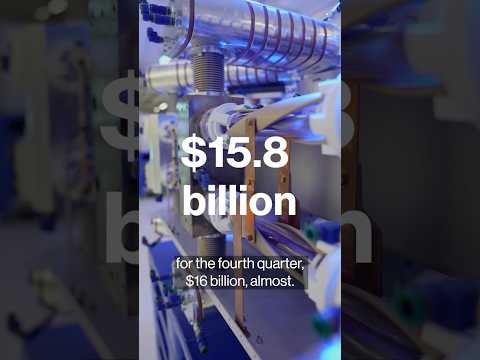
ASML Europe's most valuable company coming out with blowout earnings and yet they are cutting jobs. So what's the story. Let's get you the details in terms of the sales numbers for the fourth quarter 16 billion US almost.That is double the estimates. The forward guidance through 2026 they see sales potentially of 47 billion US above the estimates. They're seeing massive demand for their AI chipm equipment.They have a monopoly when it comes to the most sophisticated cuttingedge kit that goes into the AI chip ...
AMD's $30 Billion Vanishing Act: Why A Massive Earnings Beat Triggered A Brutal Selloff - Apple (NASDAQ:AAPL), Advanced Micro Devices (NASDAQ:AMD)
Benzinga· 2026-02-04 14:11
Core Viewpoint - AMD's recent earnings report showed a revenue beat of $600 million, but the stock price fell 9%, indicating market concerns about future growth and execution risks [1][4]. Financial Performance - AMD reported a revenue beat of $600 million for the fourth quarter, but $390 million of this was attributed to a one-time windfall from unexpected sales in China [5][6]. - For the first quarter of 2026, AMD anticipates only $100 million in revenue from China, a 75% decrease from previous expectations, leading to a potential shortfall of $400 million to $800 million [6]. Cost Management - AMD has consistently failed to control operating expenses, exceeding guidance by approximately $200 million for four consecutive quarters, which has negatively impacted data center operating margins [7][8]. - The company is currently valued at 40 times forward earnings, relying on the assumption that profits will grow faster than revenue, which is contingent on effective cost control [8]. Technology Dependencies - AMD's new MI450 chip relies on UALink switches that will not be available in volume until 2027, which could limit the chip's performance and deployment [9][10]. - The production of necessary HBM4 memory chips is sold out for 2026, with AMD being the third priority supplier, which could lead to increased costs or shipment delays [14]. Customer Financial Health - OpenAI, AMD's largest customer, is facing significant financial challenges, having lost $12 billion in a single quarter and requiring over $100 billion in emergency funding [15][16]. - The deal with OpenAI is contingent on successful funding, and any delays could impact AMD's revenue significantly [16]. Market Sentiment - Wall Street is pricing AMD's stock for perfection, assuming all critical factors align favorably; any failure in two out of six key areas could lead to a valuation drop to 25-30 times earnings, representing a potential downside of 25% to 40% [22]. - Analysts express caution, with some firms downgrading price targets while maintaining buy ratings, indicating a lack of confidence in AMD's near-term execution [23]. Future Outlook - AMD's growth is heavily dependent on external factors, including technology readiness, customer financial stability, and effective cost management, which are currently outside the company's control [24]. - Investors are advised to monitor upcoming earnings calls for indications of revenue trends and management's ability to meet guidance [25].


全球存储、半导体设备与 AI 供应链展望-Global Memory, Semi Cap and AI Supply Chain Outlook
2026-02-04 02:33
Summary of Global Technology Webcast - Morgan Stanley Research Industry Overview - **Industry Focus**: Global Semiconductor and Memory Market - **Key Analysts**: Shawn Kim, Lee Simpson, Nigel van Putten, Charlie Chan, Mason Wayne Core Insights and Arguments - **Subsector Performance**: - Memory sector showed significant growth with a **YTD increase of 241%** and a **3M increase of 38%** [12][13] - Substrates also performed well with a **YTD increase of 164%** [12] - Networking and OSAT sectors had mixed results, with OSAT down **4%** over the last week but up **94% YTD** [12] - **Earnings Revisions**: - Memory earnings revised upwards with a **YTD increase of 148%** [13] - Foundry sector saw a **YTD increase of 57%**, indicating a positive outlook despite recent declines [13] - **AI Impact**: - AI is expected to drive demand in the semiconductor space, with companies like TSMC and SMIC identified as top picks for AI-related investments [24] - The ripple effect of AI on memory demand is highlighted, with companies like Winbond and Phison being top picks in this category [24] - **Market Dynamics**: - Rising costs in wafer, OSAT, and memory are creating margin pressures for chip designers into 2026 [24] - AI cannibalization is noted, with potential job replacements and prioritization of AI semiconductors over non-AI semiconductors [24] Additional Important Insights - **Valuation Comparisons**: - Various companies in the semiconductor space were compared based on P/E ratios and market performance, with notable mentions including TSMC and SMIC [25] - **Long-term Demand Drivers**: - Tech inflation and the diffusion of AI technology across various sectors are expected to sustain demand for semiconductors [24] - **Geopolitical Factors**: - The impact of domestic GPU supply chains in China and the potential dilution from Nvidia shipments is discussed, indicating a complex supply chain landscape [24] - **Cleanroom Space and Advanced Packaging**: - The outlook for semiconductor capital equipment in 2026 is dependent on cleanroom space availability and growth in advanced packaging [19] This summary encapsulates the key points from the Morgan Stanley Research webcast, focusing on the semiconductor and memory sectors, their performance, and the implications of AI on the industry.

Taiwan Semiconductor: Winner Of AI Boom As The Critical Foundry Supplier
Seeking Alpha· 2026-02-03 15:30
I am a full-time analyst interested in a wide range of stocks. With my unique insights and knowledge, I hope to provide other investors with a contrasting view of my portfolio, given my particular background.If you have any questions, feel free to reach out to me via a direct message on Seeking Alpha or leave a comment on one of my articles.Analyst’s Disclosure: I/we have a beneficial long position in the shares of NVDA, AVGO either through stock ownership, options, or other derivatives. I wrote this articl ...

The Future Of AI Stocks? TSMC Commentary Suggests AI Megatrend
Seeking Alpha· 2026-02-03 15:01
Core Insights - Beth Kindig is a veteran technology analyst with over 14 years of experience in both private and public markets, recognized for her accurate predictions on emerging tech trends [1] - She has a unique methodology based on extensive exposure to growth-stage companies, allowing her to identify winning investments ahead of consensus [1] - As the founder of the Tech Insider Network, she has achieved over 210% cumulative returns since 2020, with a 27% annualized return [1] Company Analysis - The Tech Insider Network is noted for blending real tech industry experience with active portfolio management, focusing on providing high-quality research to individual investors [1] - The network has a significant following, with thousands of paying subscribers and over 160,000 Twitter followers, indicating a strong market presence [1] - Beth Kindig's portfolio allocation in AI semiconductors was 45% going into 2023, surpassing notable investors like Stanley Druckenmiller, who had a 29% allocation [1] Industry Trends - Technology surpassed oil as the world's most valuable industry in 2010, with Beth Kindig being at the forefront of this transition in Silicon Valley [1] - The focus on AI semiconductors has been a key area of investment, with Kindig being recognized as the "Queen of Nvidia" for her early calls in this sector [1] - The commitment to empowering individual investors reflects a growing trend in the industry towards democratizing access to high-quality investment research [1]