
Freddie Mac

Search documents
Mortgage Rates Increase
Globenewswire· 2025-10-02 16:00
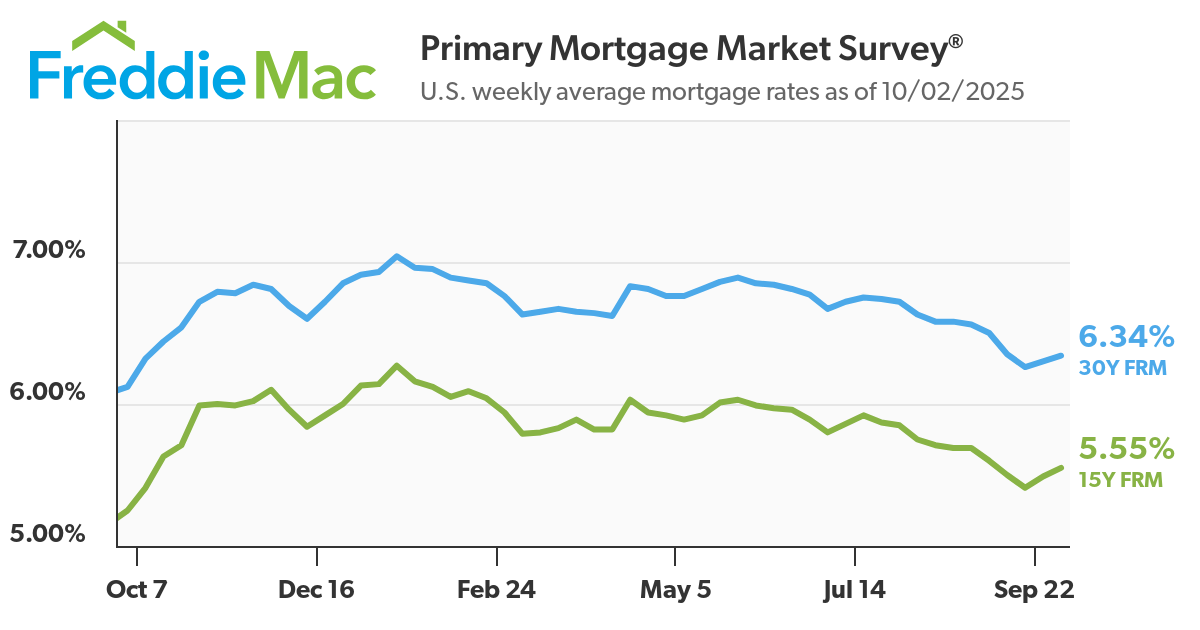
Core Insights - The 30-year fixed-rate mortgage (FRM) averaged 6.34% as of October 2, 2025, showing an increase from the previous week's average of 6.30% and a rise from 6.12% a year ago [1][4] - The 15-year FRM also increased, averaging 5.55% this week compared to 5.49% last week and 5.25% a year ago [4] - Despite the increase, the current 30-year FRM remains below its 52-week average of 6.71%, indicating a potential opportunity for homebuyers [2] Market Context - The increase in mortgage rates comes alongside a reported rise in pending home sales, suggesting that homebuyers are gaining confidence in the market [2] - Freddie Mac's mission focuses on promoting liquidity, stability, and affordability in the housing market, which has been a consistent effort since 1970 [3]

Mortgage Rates Increase
Globenewswire· 2025-10-02 16:00
Core Insights - The 30-year fixed-rate mortgage (FRM) averaged 6.34% as of October 2, 2025, an increase from 6.30% the previous week and up from 6.12% a year ago [1][5] - The 15-year FRM also saw an increase, averaging 5.55% compared to 5.49% last week and 5.25% a year ago [5] - Despite the increase, the current 30-year FRM remains below its 52-week average of 6.71%, indicating a potential opportunity for homebuyers [2] Market Context - The recent months have shown lower mortgage rates, contributing to increased confidence among homebuyers, as evidenced by a rise in pending home sales [2] - Freddie Mac's mission focuses on promoting liquidity, stability, and affordability in the housing market, which has been a consistent effort since 1970 [3]
Mortgage and refinance interest rates today, October 2, 2025: A small move higher for the week
Yahoo Finance· 2025-10-02 10:00
Mortgage Rates Overview - Mortgage rates have increased slightly, with the 30-year fixed-rate home loan rising to 6.34% and the 15-year fixed-rate increasing to 5.55% [1] - The 10-year Treasury yield, which influences mortgage rates, has been declining due to concerns over employment and a potential government shutdown [1] Current Mortgage Rates - Current national average mortgage rates include: - 30-year fixed: 6.29% - 20-year fixed: 5.98% - 15-year fixed: 5.58% - 5/1 ARM: 6.41% - 7/1 ARM: 6.54% - 30-year VA: 5.78% - 15-year VA: 5.41% - 5/1 VA: 6.06% [4] - Another set of current rates shows: - 30-year fixed: 6.44% - 20-year fixed: 6.06% - 15-year fixed: 5.74% - 5/1 ARM: 6.63% - 7/1 ARM: 6.94% - 30-year VA: 5.90% - 15-year VA: 5.77% - 5/1 VA: 5.59% [5] Mortgage Rate Types - Fixed-rate mortgages lock in the interest rate for the entire loan term, while adjustable-rate mortgages (ARMs) have a fixed rate for an initial period before adjusting periodically [8] - A 30-year fixed mortgage offers lower monthly payments but incurs more interest over time, whereas a 15-year fixed mortgage has higher monthly payments but less total interest paid [12][13] Factors Influencing Mortgage Rates - Mortgage rates are influenced by both controllable factors (like credit scores and down payments) and uncontrollable factors (such as economic conditions) [10][11] - Economic conditions, such as employment rates, can lead to lower mortgage rates during economic struggles to encourage borrowing [11] Refinancing Insights - Refinance rates are typically higher than purchase rates, and experts suggest refinancing when a lower rate of 1% to 2% can be secured compared to the current mortgage rate [11][17]
Shutdown tests lenders' plans to keep loans moving
American Banker· 2025-10-02 10:00
With the U.S. government shutdown in effect and little progress made on an eventual reopening, mortgage lenders are busy measuring operational impacts while introducing strategies drawn on past experience to keep business flowing. As of Wednesday, many questions remain about the full extent of the impact on support provided to lenders, with most federal services coming to a halt. The disruption of services provided by government offices essential to home finance, particularly the Federal Housing Agency and ...

Rate-indicative yields dive as partisan war ignites shutdown
American Banker· 2025-10-01 15:37
Core Insights - A government shutdown has occurred due to partisan budget negotiations, impacting bond investor activity and potentially lowering mortgage rates while challenging the housing market [1] - The 10-year yield, which correlates with common mortgage types, decreased to 4.1% from 4.15%, influenced by a slow private payroll report [2] - Experts warn that prolonged shutdowns could raise concerns about U.S. debt credit quality, leading to higher bond yields and mortgage rates [3] Government Sponsored Enterprises (GSEs) - Fannie Mae and Freddie Mac have implemented workarounds for borrower data verifications, allowing for flexibility in the mortgage process during the shutdown [3][4] - These GSEs are also permitting servicers to extend forbearance to borrowers affected by the shutdown [4] Federal Housing Administration (FHA) - The FHA's Office of Single Family Housing announced limited operational capacity for some mortgage insurance programs during the shutdown [5] - The FHA's operational decisions are guided by legal frameworks established by the U.S. Constitution and other statutory provisions [6] Flood Insurance and Lending - The American Land Title Association highlighted the lack of authorization for federal flood insurance, which affects millions of Americans and jeopardizes home sales [6] - Regulatory agencies have re-released guidance allowing lenders to continue making loans subject to federal flood insurance statutes, even when the National Flood Insurance Program is unavailable [6][7] - Lenders are advised to evaluate safety and soundness and manage legal risks during the shutdown period [7]
KBRA Assigns Preliminary Ratings to FREMF 2025-K172 and Freddie Mac Structured Pass-Through Certificate Series K-172
Businesswire· 2025-09-30 15:15
Core Insights - KBRA has assigned preliminary ratings to three classes of FREMF Series 2025-K172 mortgage pass-through certificates and three classes of Freddie Mac structured pass-through certificates (SPCs), Series K-172 [1] - FREMF 2025-K172 represents a $1.2 billion CMBS multi-borrower transaction [1] - Freddie Mac will guarantee five classes of certificates issued in the underlying Series 2025-K172 securitization and will deposit the guaranteed underlying certificates [1]
The “Lock-in Effect” and Mortgage Rates: Update on Unwinding a Phenomenon that Wrecked the Housing Market
Wolfstreet· 2025-09-29 23:30
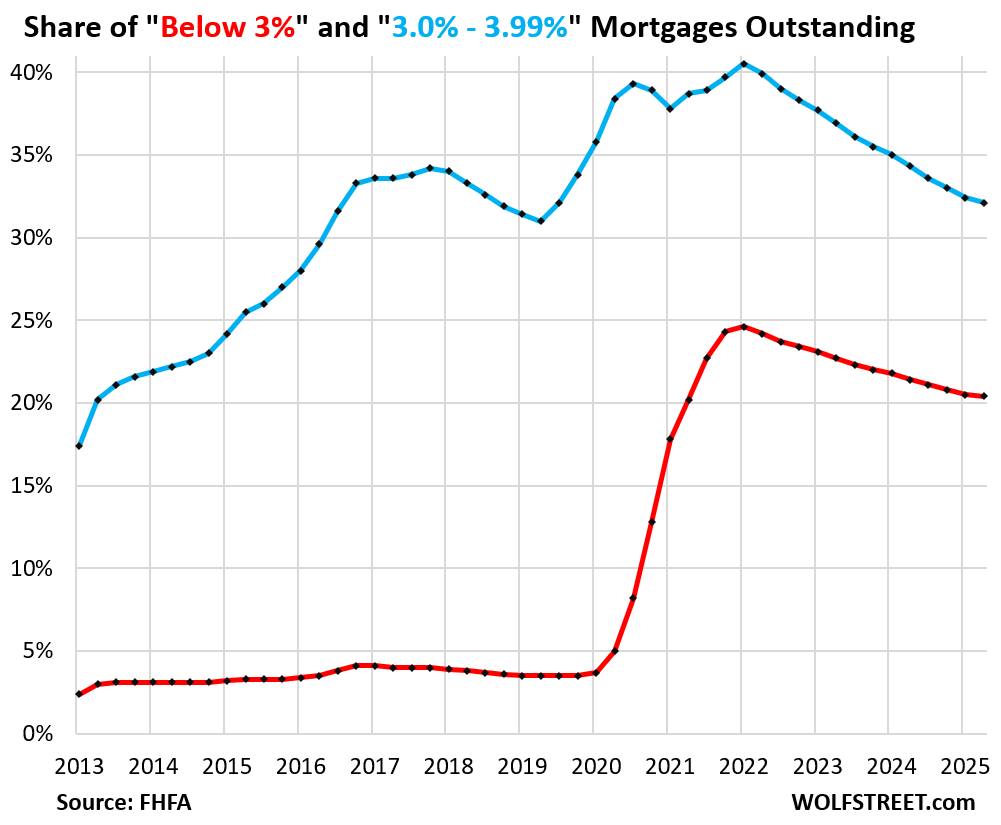
Core Insights - The share of below-3% mortgages has declined to 20.4% in Q2, the smallest since Q2 2021, indicating a slow exit from the "lock-in effect" for homeowners and investors [1][8] - The share of 3%-3.99% mortgages decreased by 30 basis points to 32.1%, the lowest since Q3 2019, reflecting a broader trend of rising mortgage rates [1][8] - The overall mortgage landscape is characterized by a significant decline in ultra-low-rate mortgages, with the share of 4.0%-4.99% mortgages dropping to 17.9%, the lowest since 2013 [8][11] Mortgage Rate Trends - The ultra-low mortgage rates that emerged in early 2020 led to a surge in refinancing, with 65% of all mortgages outstanding having rates of 3.99% or below by Q1 2022 [2][5] - The share of mortgages with rates of 6% or higher rose to 19.7% in Q2, the highest since Q4 2015, as home sales and refinancing activities have significantly declined [11][12] - The share of mortgages in the 5.0%-5.99% range has remained stable at around 9.9% in Q2, indicating a balance between new originations and payoffs [12][13] Economic Context - The ultra-low-rate mortgages were a result of the Federal Reserve's quantitative easing (QE) policies, which began in 2009 and intensified in 2020, leading to historically low mortgage rates [15][16] - The Fed has since initiated quantitative tightening (QT), shedding $2.36 trillion in assets to address the inflation and housing market distortions caused by previous policies [16][18] - The period of negative "real" mortgage rates, where mortgage rates were below inflation, peaked with rates below 3% and CPI inflation exceeding 7%, creating unsustainable conditions in the housing market [18]
Home contract signings jumped in August as mortgage rates dropped
Yahoo Finance· 2025-09-29 14:32
Core Insights - Home contract signings increased by 4% in August, surpassing economists' expectations of a 0.4% gain, indicating a potential recovery in the housing market due to lower mortgage rates [1][5] - The Pending Home Sales Index reached 74.7, with a year-over-year increase of 3.8%, suggesting a gradual improvement in buyer activity [1][3] - The Midwest region experienced the highest growth in contract signings, with an 8.7% increase since July and a 6.7% rise over the past year, attributed to its relative affordability [6] Mortgage Rates - The average 30-year fixed mortgage rate has decreased from approximately 6.7% to around 6.3%, which is believed to be facilitating more homebuyers entering the market [5][6] - Lower mortgage rates are seen as a key factor enabling more homebuyers to sign contracts, according to the National Association of Realtors Chief Economist [5] Market Conditions - The housing market is currently in its third consecutive year of decline, with home sales projected to reach a 30-year low, although there is optimism that falling mortgage rates may stimulate activity in the fall [3][5] - Contract signings showed varied performance across regions, with increases in the Midwest, South, and Western US, while the Northeast saw a decline [1][3]
US Court Throws Out Last Libor Collusion Case Against Global Banks
FinanceFeeds· 2025-09-26 21:15
Core Viewpoint - A federal judge has dismissed the last remaining claims in the litigation against global banks accused of conspiring to manipulate Libor, concluding one of the longest financial antitrust cases in U.S. history [1][13]. Legal Ruling - U.S. District Judge Naomi Reice Buchwald issued a 273-page ruling, stating that investors failed to prove collusion among banks to keep Libor artificially low, indicating that the evidence did not exclude the possibility of independent actions by the banks [2][7]. - The ruling marks the end of over a decade of litigation that began in 2011, with plaintiffs seeking to recover losses linked to the alleged manipulation of Libor [3]. Impact on Investors and Banks - The decision concludes private antitrust claims related to Libor, removing the last legal uncertainty for banks after global investigations resulted in approximately $9 billion in fines [4][9]. - The investor group involved included various entities such as Principal Financial Group, cities like Baltimore and Houston, and mortgage financiers Fannie Mae and Freddie Mac, alleging that banks' actions inflated profits and distorted borrowing costs during the 2008 financial crisis [5][6]. Evidence and Findings - Over the years, investors presented various forms of evidence, including emails and expert analysis, but the judge found that it did not establish a coordinated effort among banks [7]. - Despite uncovering manipulation by traders during investigations, civil courts did not find sufficient evidence to prove a broad conspiracy [9][10]. Libor's Transition - Libor, which influenced interest rates for over $300 trillion in loans and derivatives, was phased out in January 2022 and replaced by the Secured Overnight Financing Rate (SOFR) and other benchmarks [8][14]. - The transition to new benchmarks aims to prevent future manipulation, addressing the issues highlighted by the Libor scandal [14].

What’s the Monthly Mortgage on a $250K, $500K and $1 Million House?
Yahoo Finance· 2025-09-26 15:55
Core Insights - The monthly mortgage payment is influenced by various factors beyond the purchase price of the home [1][3] - Key factors include the loan amount, interest rate, loan term, and additional costs such as mortgage insurance and escrowed items [3][4][8][9] Loan Amount - The loan amount is determined by the purchase price of the home plus any closing costs rolled into the loan, minus the down payment [3] - For example, purchasing a $500,000 home with a 10% down payment and paying closing costs in cash results in a loan amount of $450,000 [3] Interest Rate - The average interest rate for a 30-year fixed-rate mortgage is currently 6.72% as of August 7, according to Freddie Mac [4] - The offered rate may vary based on the borrower's creditworthiness and down payment [4] Loan Term - Most mortgage loans are structured as 15- or 30-year loans, with 30-year loans typically having higher rates but lower monthly payments due to the extended term [5] Sample Monthly Payments - Monthly payments vary significantly based on the loan amount, interest rate, and loan term. For instance: - A $250,000 home with a 10% down payment results in a monthly payment of $1,455 for a 30-year loan at 6.72% [7] - A $1,000,000 home with a 10% down payment results in a monthly payment of $5,819 for a 30-year loan at the same rate [7] Additional Costs - Borrowers with less than 20% down payment typically incur mortgage insurance until they reach at least 80% equity [8] - Many mortgage loans require "PITI" payments, which include principal, interest, taxes, and insurance, with one-twelfth of these expenses paid monthly and escrowed by the lender [9]