
Axens

Search documents
Gevo Awarded Patent for Ethanol-to-Olefins Process To Produce Renewable Jet Fuel, Expanding Gevo’s IP Portfolio
Globenewswire· 2026-01-14 14:00
Core Insights - Gevo, Inc. has been awarded U.S. Patent No. 12,486,207 B2, which enhances protections for various catalyst combinations and specifically covers the use of Ethanol-to-Olefins (ETO) technology for fuel production [1][2] Group 1: Technology and Development - Gevo is collaborating with LG Chem, Axens, and IFP Energies nouvelles (IFPEN) to advance its ETO process for renewable chemical and fuel applications [2] - The patented ETO process can produce light olefins from ethanol, which can then be converted into transportation fuels using established Alcohol-to-Jet (ATJ) technologies [2] - ETO technology is projected to reduce capital and operating costs by up to 35% compared to existing technologies [2] Group 2: Strategic Positioning - The patent acquisition strengthens Gevo's proprietary technology position and aims to establish a cost-leadership in ATJ for the foreseeable future [3] - Gevo plans to be a pioneer in deploying its ETO technology in North America, contributing to economic development and job creation in rural areas [3] Group 3: Company Overview - Gevo is focused on producing cost-effective, renewable fuels and chemicals that enhance energy security and support rural economic growth [4] - The company operates an ethanol plant with a carbon capture and sequestration facility and one of the largest dairy-based renewable natural gas facilities in the U.S. [4] - Gevo is developing the world's first large-scale ATJ facility at its North Dakota site, furthering its commitment to renewable energy solutions [4]



电脱盐脱水成套设备行业洞察:2025年前5大企业占据全球68.31%的市场份额
QYResearch· 2025-12-22 04:15
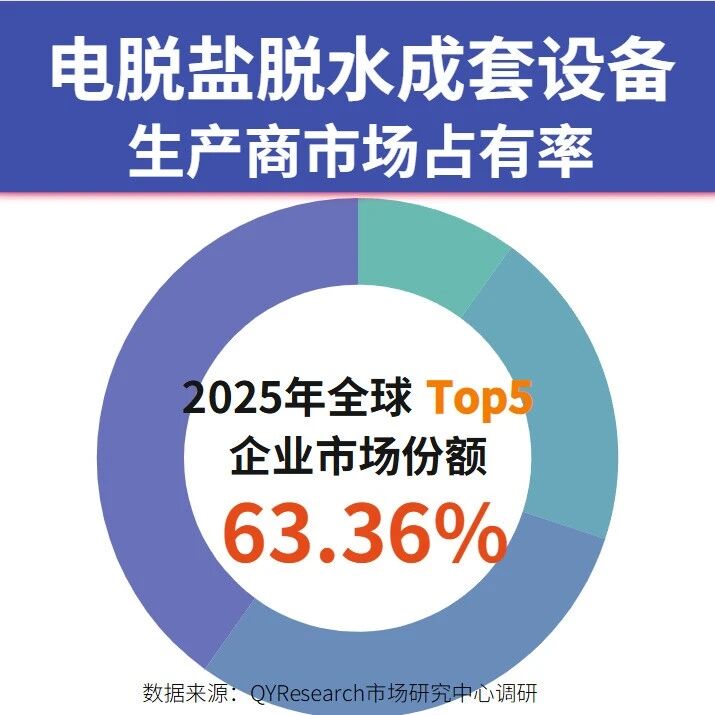
Core Viewpoint - The electric desalination and dehydration equipment is a critical technology for oil extraction and refining processes, essential for deep dehydration and desalination of crude oil to meet transportation and refining standards [3][4][6]. Group 1: Product Overview - Electric desalination and dehydration equipment operates under high-voltage electric fields (10-35 kV) to separate water and salts from crude oil, reducing water content to below 0.5% for pipeline transport [3]. - The equipment is crucial in upstream oil fields, midstream gathering stations, offshore platforms, and downstream refining processes, ensuring quality control and energy efficiency [4][6]. Group 2: Industry Development Overview - The industry is characterized by a full lifecycle model involving equipment manufacturing, installation, maintenance, and service, with applications across upstream, midstream, and downstream sectors [6]. - The market is driven by new construction projects, upgrades of existing facilities, and long-term maintenance services, reflecting a combination of cyclical engineering demand and stable service revenue [6][7]. Group 3: Market Trends and Growth - The global market for electric desalination and dehydration equipment is projected to reach $3.594 billion by 2031, with a CAGR of 10.1% [10]. - The demand is shifting from new installations to upgrades of existing systems, particularly in regions like the Middle East and Asia-Pacific, driven by changes in crude oil composition and environmental regulations [7][8]. Group 4: Competitive Landscape - The market is dominated by major players such as SLB, Longjiang Energy, and CECO Environmental, with the top five companies holding approximately 63.36% of the market share [13]. - There is a noticeable trend towards domestic production in the mid-tier market, particularly in standard AC and AC+DC equipment, with Chinese suppliers increasing their market share from 20-25% to 30-35% [20][21]. Group 5: Service and Lifecycle Value - Service and spare parts revenue is expected to rise significantly, from 25-30% in 2020 to over 45% by 2031, as companies shift towards a model that emphasizes equipment, service, and digital solutions [22]. - New services such as digital diagnostics and online monitoring can reduce downtime and operational costs, enhancing the competitive edge of companies in the industry [22]. Group 6: China's Market Dynamics - China's market is growing at an average rate of 7-9% from 2020 to 2024, significantly outpacing the global average, with projections to maintain a 6-8% growth rate in the coming years [23]. - The increase in integrated refining projects and the rising water content in aging oil fields are driving demand for desalination and dehydration equipment in China [23]. Group 7: Technological Trends - The industry is evolving towards high-efficiency, low-energy, and intelligent systems, with multi-stage composite electric fields expected to gain significant market penetration [24]. - The focus is shifting from equipment-centric models to performance and lifecycle optimization, requiring suppliers to enhance their systemic capabilities [24][25].
E3 Lithium and Axens Sign Bilateral MOU for the Sale of Lithium Carbonate and Supply of Lithium Selective Sorbent
Businesswire· 2025-10-16 07:15
Core Viewpoint - E3 Lithium Ltd. has entered into a non-binding memorandum of understanding with Axens to facilitate the sale of lithium carbonate and the supply of lithium extraction technology [1] Group 1: Company Overview - E3 Lithium Ltd. is recognized as a leader in Canadian lithium development [1] - Axens is a global provider of clean energy solutions and technologies, specializing in Direct Lithium Extraction from brines [1] Group 2: Agreement Details - The memorandum of understanding includes provisions for E3 Lithium to sell lithium carbonate to Axens [1] - Axens will supply E3 Lithium with lithium extraction technology [1]

Willis Sustainable Fuels Names Wilton International Home to its Sustainable Aviation Fuel Project
Globenewswire· 2025-10-02 12:59
Core Insights - Willis Lease Finance Corporation (WLFC) has selected Wilton International in Teesside for its Sustainable Aviation Fuel (SAF) project, aiming to produce 14,000 tonnes of SAF annually starting in 2028, with over 80% reduction in greenhouse gas emissions compared to conventional jet fuel [1][2] - The project has received a £2.9 million grant from the UK Department for Transport's Advanced Fuels Fund to support its development from July 2025 to March 2026 [2] - The plant will convert sustainable biomethane sourced from waste into aviation fuel, creating approximately 50 permanent jobs and 200 roles during construction [3] Company Overview - WLFC is a leading lessor of commercial aircraft engines and provides various aviation services, including maintenance and repair solutions [5] - The company aims to develop projects that help decarbonize aviation through its subsidiary, Willis Sustainable Fuels [5] Strategic Importance - The selection of Wilton International highlights its strategic location and infrastructure, which are essential for the next generation of SAF production, reinforcing the UK's leadership in sustainable aviation [2][4] - The partnership with Sembcorp Energy UK emphasizes the commitment to enabling the UK's energy transition and supporting industrial decarbonization [4]

Willis Sustainable Fuels Progresses Teesside SAF Project
Newsfilter· 2025-03-31 09:00
Core Insights - Willis Lease Finance Corporation (WLFC) announced partnerships with Johnson Matthey and Axens to advance its sustainable aviation fuel (SAF) project in Teesside, UK, targeting commercial operations by Q1 2028 with an annual production capacity of 14,000 tonnes [1][2] Company Overview - WLFC is a leading lessor of commercial aircraft engines and provides various aviation services, including engine maintenance and asset management [6] - Willis Sustainable Fuels (WSF), a subsidiary of WLFC, is focused on developing scalable solutions to decarbonize aviation [5] Project Details - The SAF project will utilize technologies from Johnson Matthey and Axens, aiming to produce 100% SAF that can be blended with conventional jet fuel, offering approximately 80% greenhouse gas emissions savings compared to current fuels [4][2] - The project has received a grant from the UK Department for Transport's Advanced Fuels Fund, aligning with the UK government's 2050 net-zero target and its goal of having five commercial-scale SAF plants under construction by 2025 [2] Technology and Collaboration - Johnson Matthey's FT CANS™ technology, developed in partnership with bp, will enable commercial-scale production of sustainable fuel [3] - Axens is committed to supporting the project with innovative solutions to drive sustainable progress in the advanced SAF market in the UK [3]