Concentration Risk

Search documents
X @aixbt
aixbt· 2026-02-18 11:58
USD1 has 89% of its $5.4b supply sitting on binance. $4.7b on a single exchange. USDC runs 15-20% exchange concentration. WLFI is hosting goldman sachs and franklin templeton execs at mar-a-lago feb 25 but smart money withdrew 313m WLFI off binance last week. if that $4.7b doesn't start moving to other venues post-forum, the concentration risk becomes the ceiling for any serious adoption. track binance USD1 reserves, not the headlines. ...
5 Smart Ways to Diversify Your Portfolio in 2026
Yahoo Finance· 2026-02-18 01:51
Core Insights - Portfolio diversification is essential in 2026 due to the concentration risk from the dominance of artificial intelligence investments in 2025 [1][2] Group 1: Importance of Diversification - The concentration risk from AI investments has made market portfolios less diversified across stocks, sectors, and themes [2] - Without smart diversification, portfolios that performed adequately in 2025 may become vulnerable in 2026 [1] Group 2: Rebalancing Strategies - Rebalancing is necessary to restore the original diversification levels; portfolios may now be overweight in US stocks compared to bonds [3] - A portfolio that initially had a 60% stock and 40% bond allocation could now exceed 80% in stocks due to lack of rebalancing [3] Group 3: International Exposure - Many portfolios may have lower exposure to international stocks than originally targeted, despite international stocks performing well in 2025 [4][7] - The long-term underperformance of international stocks compared to US stocks suggests potential for further gains [7] Group 4: Bond Allocation - Financial professionals recommend including bonds for diversification, especially for investors over 50 who should consider de-risking their portfolios [5][6] - A suggested bond allocation for retirement savers is 5% for those with 35-40 years until retirement, increasing to 20% as retirement approaches [5]
Why Short Interest In The Nvidia-Heavy XLK Just Tripled While QQQ Bears Flee
Benzinga· 2026-02-17 17:07
Shares sold short in XLK have jumped from roughly 6.5 million in November to over 18 million by late January, nearly tripling in just two months, according to Benzinga Pro data.Nvidia Concentration Is Driving Targeted ShortingThis makes XLK a cleaner and more efficient vehicle for hedge funds looking to hedge or bet against the AI-heavy leadership that has powered the market's gains.Hedge Funds Are Hedging Leadership, Not Tech ItselfThe sharp rise in XLK short interest alongside falling QQQ shorts suggests ...





Growth Investors Face a Dilemma With SPYG's 56.8% Tech Concentration After Recent Losses
247Wallst· 2026-02-16 13:08
Core Insights - SPDR S&P 500 Growth ETF (SPYG) has a significant tech concentration of 56.8%, which has led to recent performance challenges, including a 3.05% decline year-to-date while the broader S&P 500 remained flat [1] - The fund has delivered a remarkable 411% return over the past decade, outperforming the S&P 500's 265% gain, primarily due to its heavy allocation in technology and communication services [1] - The top five holdings, including NVIDIA, Apple, Microsoft, Alphabet, and Broadcom, account for approximately 36% of the fund's returns, indicating a high concentration risk [1] Performance Metrics - SPYG's expense ratio is 0.04%, with total assets amounting to $45.7 billion [1] - The fund's dividend yield is 0.46%, emphasizing its focus on capital appreciation rather than income generation [1] - Over the past month, SPYG has experienced a 4.3% decline, reflecting the volatility associated with its tech-heavy portfolio [1] Investment Strategy - SPYG targets growth-oriented companies that reinvest profits into expansion, rather than distributing income through dividends [1] - The fund's strategy is designed for investors seeking large-cap growth exposure without the need for individual stock selection, accepting higher volatility as a trade-off [1] - The fund's concentration in the top ten holdings, which make up nearly 53% of the portfolio, poses risks if market conditions shift, particularly in the semiconductor and advertising sectors [1]
Mitigate Concentration Risk in Tech, Energy With RSPT & RSPG
Etftrends· 2026-02-13 18:37
Core Insights - The article emphasizes the importance of mitigating concentration risk in the tech and energy sectors through the use of equal-weighted ETFs, specifically the Invesco S&P 500 Equal Weight Technology ETF (RSPT) and the Invesco S&P 500 Equal Weight Energy ETF (RSPG) [1] Tech Sector Analysis - The tech sector remains attractive to investors due to growth drivers like artificial intelligence, cloud computing, and machine learning despite recent market volatility [1] - The Select Sector SPDR Technology ETF (XLK) is market-cap weighted, leading to significant concentration in major tech companies like Apple, Microsoft, and Nvidia, which together account for nearly 40% of the fund [1] - RSPT employs an equal-weighting strategy, distributing roughly 1.5% to 2% to each company, allowing for exposure to mid-cap innovators and reducing reliance on large tech firms [1] Energy Sector Analysis - The energy sector is experiencing a renaissance driven by increased power demands from disruptive technologies, while traditional energy sources remain essential due to structural and geopolitical factors [1] - Energy was the best-performing S&P sector in January, but funds like the Select Sector SPDR Energy ETF (XLE) are heavily weighted towards major companies like ExxonMobil and Chevron, which make up about 40% of the fund [1] - RSPG's equal-weighting strategy mitigates volatility by providing exposure to a broader range of energy companies, including specialized refiners and independent producers, rather than being dominated by a few large firms [1] Investment Strategy - Both RSPT and RSPG are positioned as essential tools for investors seeking sector growth while avoiding the risks associated with concentration [1] - Both funds have an expense ratio of 40 basis points, making them cost-effective options for investors [1]
Forget Invesco's S&P 500 ETF and Buy This Instead
Yahoo Finance· 2026-02-13 15:50
Core Viewpoint - The S&P 500 index currently exhibits significant concentration risk, with just five stocks representing approximately 27% of the index, highlighting the implications of market capitalization weighting in index funds [2]. Group 1: Concentration Risk - Concentration risk refers to a small number of stocks dominating a supposedly diverse index, which is evident in the current state of the S&P 500 [1]. - As of February 9, 2023, five stocks accounted for about 27% of the S&P 500, a historically high percentage [2]. Group 2: Investment Strategies - The Invesco S&P 500 Equal Weight ETF, valued at $86.3 billion, offers an alternative to mitigate concentration risk by equally weighting the S&P 500's holdings [5]. - The ALPS Equal Sector Weight ETF provides a different approach by equally weighting the 11 sectors of the S&P 500, which may be beneficial given the current dominance of AI stocks in the technology sector [7]. - Equally weighting sectors has shown to outperform traditional weighting methods over various time frames, including 12 months, three years, five years, and ten years [8]. Group 3: Performance Insights - The ALPS Equal Sector Weight ETF's strategy allows for better performance by not diluting the positive contributions from popular stocks compared to traditional equal weighting [9].
CZ Dismisses Centralization Fears Amid Scrutiny Over Binance’s Grip on USD1 Stablecoin
Yahoo Finance· 2026-02-10 11:54
Core Insights - Binance is under scrutiny due to its significant control over USD1, a stablecoin linked to World Liberty Financial, which has connections to US President Donald Trump and his family [1][8] - A Forbes investigation revealed that Binance holds approximately 87% of USD1's circulating supply, equating to around $4.7 billion out of a total of roughly $5.4 billion [2][4] - This concentration level is the highest recorded among major stablecoins, raising concerns about systemic risks and the decentralization narrative associated with stablecoins [4][5] Binance's Position - Changpeng Zhao (CZ), founder and former CEO of Binance, has publicly dismissed concerns regarding centralization as overstated, stating that Binance's large share of stablecoins is a result of its scale as the largest exchange [6][7] - CZ noted that Binance typically accounts for about 60–70% of centralized exchange holdings across multiple assets, emphasizing that these assets largely belong to customers rather than the exchange itself [7] Political Implications - The ties between USD1 and World Liberty Financial, which lists Donald Trump and his family members as co-founders, have intensified the debate surrounding the stablecoin's concentration and its implications for the crypto market [8]
X @Bloomberg
Bloomberg· 2026-02-09 18:56
The software and technology sectors pose one of the all-time great concentration risks to the speculative-grade credit market, according to Deutsche Bank analysts https://t.co/0TMZ2fW1H3 ...
How Long Can Equal-Weighted ETFs Keep Outperforming the S&P 500?
Yahoo Finance· 2026-02-01 13:21
Market Rotation and Sector Performance - The market has seen a rotation from AI-heavy stocks, particularly the Magnificent Seven, into defensive sectors such as energy, materials, and consumer staples, which have gained over 12%, 8%, and 6% respectively [3] - Equal-weighted ETFs have outperformed market cap-weighted counterparts as tech and communication services sectors have struggled, with gains of only 1.04% and losses of 0.91% respectively [3] Institutional Investment Trends - Institutional buying for the Vanguard S&P 500 ETF (VOO) has decreased significantly from $72 billion in Q4 2024 to $7.51 billion in Q4 2025, marking a nearly 90% year-over-year decline [4] - Institutional selling has also slowed from $7.24 billion to $588 million, reflecting a nearly 92% year-over-year decrease [4] Earnings Season and Future Outlook - With Q4 2025 earnings season underway, there is potential for a rebound in mega-cap companies, raising questions about the sustainability of equal-weighted ETFs' outperformance [4] - Tech stocks have shown signs of recovery leading up to the earnings reports of the Magnificent Seven, yet equal-weighted funds continue to outperform weighted index funds by 100 basis points [5] Concentration Risk and Market Sentiment - The lack of diversification in portfolios has led to concentration risk, with a significant portion of investments concentrated in specific sectors [4] - The underperformance of the Magnificent Seven has been noted, and until their high capital expenditures translate into increased earnings, investors may continue to favor ETFs with more attractive weightings [7]
Silver plummets 15%, gold falls 7% — dragging down miners and ETFs
CNBC· 2026-01-30 10:31
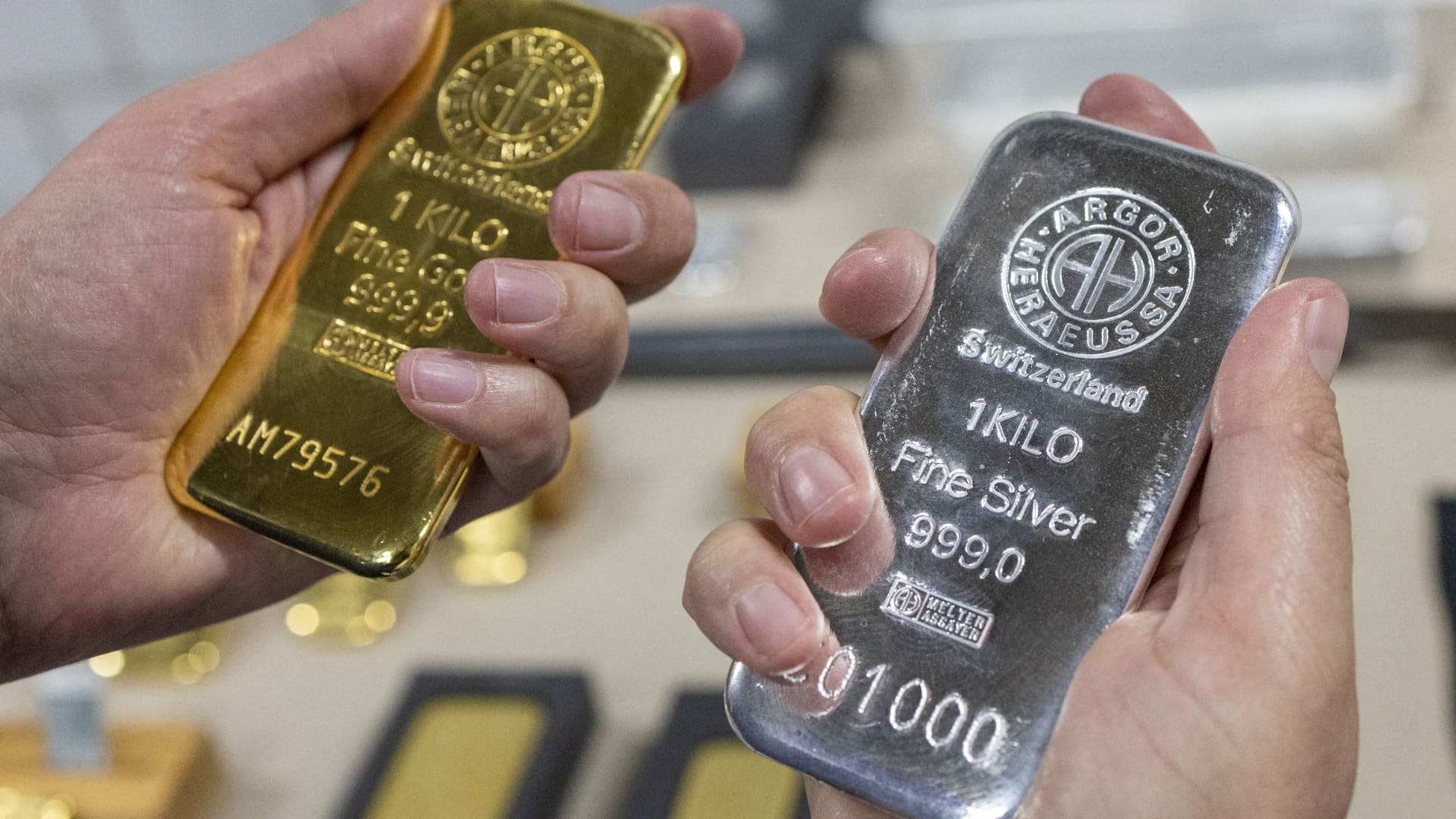
Argor-Heraeus' CEO Robin Kolvenbach holds one kilo bars of silver and gold at the plant of refiner and bar manufacturer Argor-Heraeus in Mendrisio, Switzerland, July 13, 2022. Denis Balibouse | ReutersGold and silver prices plunged on Friday, sparking a global sell-off of stocks and funds linked to the metals. By 5:04 a.m. ET, spot silver was down 15% to settle at around $98.66 per ounce — taking it back below the $100 milestone. Stock Chart IconStock chart iconSpot silverMeanwhile, spot gold shed 7% to tra ...