Job Security

Search documents
Amid Economic and AI Anxieties, US Employees Are Choosing to Stay Put, Mercer Finds
Businesswire· 2026-02-10 16:00
Core Insights - US employees are increasingly choosing to remain with their current employers amid economic uncertainty and AI-related anxieties, presenting an opportunity for companies to foster long-term loyalty [1][2] Economic Pressures - Economic volatility is a significant concern, with 70% of US employees reporting increased financial stress due to inflation and market fluctuations [1] - The leading unmet needs among employees include covering monthly expenses, job security, retirement readiness, and work-life balance [1] - Short-term financial pressures have eased, with fewer employees reducing discretionary spending (38%, down from 51% in 2023) and tapping into savings (32%, down from 37% in 2023) [1] Pay and Benefits - Pay remains the strongest driver for both attraction (37%) and retention (32%), with healthcare benefits as the second most important factor [1] - More than 40% of candidates would not apply for jobs without disclosed pay ranges, indicating a shift towards pay transparency as a baseline expectation [1] AI Adoption and Employee Sentiment - Despite recognizing AI's potential, many employees are anxious about its impact on job security, with 53% believing new technology will affect their job security [1] - Only about 25% of employees regularly use AI tools, highlighting uneven adoption across industries, particularly in retail and healthcare [1] Industry Variations - Employee experiences vary significantly across industries, with lower-income and hourly workers facing heightened financial and mental health challenges [1] - High-tech and financial services sectors report stronger engagement, particularly among on-site workers and those with five to ten years of tenure [1] Flexibility and Engagement - Nearly 78% of employees can fully utilize their paid vacation time, and 70% feel that paid time off supports their mental health and family care needs [1] - Employee engagement remains high, with 73% not seriously considering leaving their organization, an increase from 68% in 2023 [1] Conditional Commitment - Employees are recommitting to their employers but with conditions, closely monitoring internal job postings and development opportunities [2]



ANZ faces backlash from Finance Union over Suncorp layoffs
Yahoo Finance· 2026-01-23 11:25
The Finance Sector Union (FSU) has voiced strong opposition to ANZ’s recent move to reduce headcount at Suncorp Bank, raising concerns about potential breach of commitments made during the bank’s acquisition. According to the union, a total of 197 positions at Suncorp Bank will be affected, with 66 workers to be laid off. Most of the affected roles are in Brisbane. ANZ finalised its purchase of Suncorp Bank in 2024. While securing regulatory approval for the takeover, ANZ made assurances to the Queens ...
Massive Corporate Layoffs Changed Everything, Says Robert Kiyosaki. Calls Going To School For Job Security An 'Obsolete Idea'
Yahoo Finance· 2026-01-15 18:31
Robert Kiyosaki says the recent wave of corporate job cuts shows that the traditional promise of stability through schooling no longer holds up in today's economy. In a recent post on X, the investor and author of “Rich Dad Poor Dad” argued that going to school for job security has become an “obsolete idea,” especially as layoffs hit industries that once symbolized safety, prestige, and high pay. His comments come amid continued workforce reductions across logistics, retail, manufacturing, and technology. ...
X @The Wall Street Journal
The Wall Street Journal· 2025-12-20 03:00
Office workers are hanging on to their jobs for dear life. 🔗 https://t.co/lF14QPVHht https://t.co/xY5AqBTAkh ...
X @Xeer
Xeer· 2025-11-26 04:08
Interviewer: why is there a 6 month gap in your resume?Me: took a “mental health break” that quickly turned into trading memecoins, which then led me to perp trading, which then resulted in me realizing that things can always go lower and that i need a stable 9-5 to put food on the table. which brings us here. ...
X @Bloomberg
Bloomberg· 2025-11-12 11:08
Employment Concerns - A majority of Americans with jobs are concerned about losing them [1] Economic Hardship - Many Americans report finding it difficult to afford everyday items [1] Data Source - The findings are based on a Harris Poll conducted for Bloomberg News [1]
45% of Americans Say the Government Shutdown Makes Them Less Likely to Make a Major Purchase, Up From 21% in Early October
Businesswire· 2025-11-07 19:07
Core Insights - Nearly half of Americans (45%) are less likely to make major purchases due to the ongoing federal government shutdown, a significant increase from 21% in early October [1][2][8] - The shutdown has negatively impacted the financial situation of over a third of Americans, with 35% reporting they are worse off financially [7][9] Consumer Behavior - The percentage of Americans who are much less likely to make a major purchase has risen from 14% to 28% [2] - 21% of Americans are delaying major purchases, up from 17% in early October, while 15% have canceled plans altogether, an increase from 7% [5] - Just over half (51%) report no change in their likelihood of making a major purchase, down from 64% a month earlier [2][5] Economic Impact - The federal government shutdown, which began on October 1, is estimated by the Congressional Budget Office to potentially reduce the U.S. economy by up to $14 billion and slow growth by as much as two percentage points if it continues through the end of November [4] - Nearly half (46%) of Americans say the shutdown is having a negative impact on their lives, with 16% indicating a major negative impact [6] Financial Strain - Among those with monthly housing payments, 7% have missed a payment in the past three months, and 13% have been late [10] - 14% predict they will miss or be late on a housing payment in the next three months [10] - The most cited reason for missed or late payments is a decrease in income or income delays (34%) [13] Job Security Concerns - Approximately 33% of workers express concern about their job security, a figure that remains stable compared to previous surveys [15] - The majority (61%) of employed respondents feel confident about their job security, with 41% very confident [16]



Why Americans won't quit their jobs
CNBC· 2025-10-31 16:01
Labor Market Trends - The US economy has experienced a loss of 1.2 million jobs since April 2024 [1] - The quits rate has decreased to approximately 2% following fluctuations since the pandemic [1] - Employers are hiring at the slowest rate since 2013, excluding the pandemic period [2] - A significant portion, 58%, of US professionals surveyed feel their skills are underutilized in their current roles [3] Employee Sentiment and Engagement - Four out of five employees surveyed indicated they are not thriving at work [3] - There is considerable anxiety regarding the direction of both the economy and the labor market, contributing to job retention [4] - The labor market currently lacks significant churn [3] Company Implications - Companies may be experiencing retention, but this could be masking disengagement among employees [3] Economic Impact - Reduced mobility in the labor market may be slowing down innovation [3]

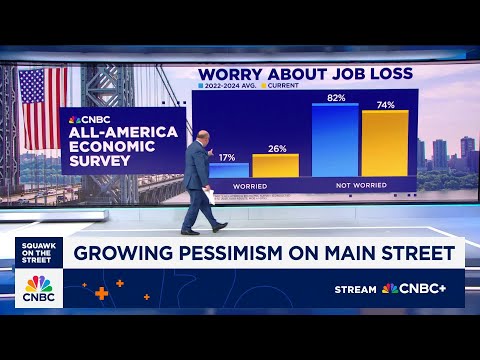
More Americans are worried about losing their jobs, per CNBC's All-America Economic Survey
CNBC Television· 2025-10-17 16:03
Growing pessimism from Americans on the jobs and inflation front according to CNBC's latest All-America economic survey. Let's get over to Steve Leman. He's got some of the key takeaways for us.Steve, >> thanks Dave. Yeah, the public's concern with losing their job grew in the latest allameric survey along with ongoing worries about inflation and wages not keeping up. Take a look.28% or 20 sorry, 26% of the public is worried about losing their job. Uh, and that's up from the average of the last several time ...