Real Economy

Search documents
X @Avalanche🔺
Avalanche🔺· 2026-02-17 18:01
source:Designing Blockchain Infrastructure for the Real Economy at @consensus_hkFeaturing: @el33th4xor, @gbartsmith, and @hosseebFull panel here:https://t.co/Xhq1SGa94G ...
X @Avalanche🔺
Avalanche🔺· 2026-02-12 18:32
Designing Blockchain Infrastructure for the Real EconomyFeaturing: @el33th4xor, @gbartsmith, and @hosseebWatch the full panel from @consensus_hk here:https://t.co/Xhq1SGa94G ...
S&P/TSX composite rises on basic materials stocks, U.S. markets move lower
Investment Executive· 2026-02-03 22:18
Market Overview - The S&P/TSX composite index increased by 204.72 points, reaching 32,388.60 [1] - The Dow Jones industrial average decreased by 166.67 points, settling at 49,240.99 [2] - The S&P 500 index fell by 58.63 points to 6,917.81, while the Nasdaq composite dropped by 336.92 points to 23,255.19 [2] Gold and Silver Market - Gold's price surged by 6.1% in the latest swing, while silver's price rallied by 8.2% [3] - Gold and silver prices had been rising for over a year due to investor concerns about tariffs, a weaker U.S. dollar, and high government debt [4] - Gold's price had previously doubled over 12 months but dropped from nearly US$5,600 to below US$4,500 recently, with silver plunging 31.4% in one day [4] Analyst Insights - Analyst Goulding indicated that the recent pullback in gold prices is natural and does not reflect a long-term trend, citing ongoing demand from central banks [5] - RBC analyst Drew McReynolds noted that content-driven technology providers like Thomson Reuters need to adapt their business models in response to AI disruptions [6] Technology Sector Impact - Major tech stocks, including Nvidia and Microsoft, experienced declines of 2.8% and 2.9% respectively, amid concerns over high stock valuations [7] - Thomson Reuters shares fell by 15.8% due to fears of potential disruption from AI technologies [5]




X @ZKsync
ZKsync (∎, ∆)· 2025-12-10 18:37
"Integrating Ethereum in the real economy and in every business is the highest ROI thing we can do. All L2s powered by ZKsync are connected to Ethereum as the ultimate Capital Hub."@gluk64 sharing how ZKsync's mission and technology align with Ethereum's long term success. https://t.co/BT5FB2D9Bs ...
X @Token Terminal 📊
Token Terminal 📊· 2025-11-15 19:32
Ethereum Network Growth - Ethereum's real economy experienced a growth rate three times faster than the price of ETH [1] - The supply of stablecoins on Ethereum has increased by 6,550% since 2020, indicating strong real-world demand [1] - ETH's fully diluted market cap increased by 2,060% over the same period, lagging behind the chain's economic engine growth [1] Market Valuation - The current gap between economic activity and price valuation is unlikely to persist indefinitely, suggesting potential for price appreciation [2]
Jim Cramer recaps Thursday's slate of earnings and what they signal about the economy
CNBC Television· 2025-10-30 23:39
Hey I'm Cramer. Welcome to Mad Money. Welcome to Cramer aka how to make friends I'm just trying to make you some money.My job is not just to teach and entertain but to do some education. Call me one 800 743 CNBC or tweet me at Jim Cramer. We keep wondering what would it take to make people start focusing on all the other stocks in what I call the real economy, instead of just the speculative stocks in the AI data center stocks.Well, today we found out you need to see a big tech company screw up and then get ...



Mad Money 10/22/25 | Audio Only
CNBC Television· 2025-10-23 00:39
Market Trends & Investment Opportunities - The market shows a sense that many stocks have gotten ahead of themselves after a strong rally [1] - Profit-taking is impacting stock prices, even when companies report terrific quarters [3] - Data center stocks are expected to rebound, while real economy stocks are seen as having low bars for rallying [19] - Speculative stocks are facing challenges due to companies raising money and insiders selling shares [17][18] - Intuitive Surgical rallied nearly 14% due to strong double-digit co-procedure growth, driven by after-hours use, indicating greater leverage of fixed costs [14] Company Performance & Financials - GE Vernova showed excellent order growth, integral to feeding data centers' extreme electricity needs [6] - Thermofisher Scientific reported a better-than-expected quarter with accelerating organic revenue growth of 5% in Q3 [29][33] - Vertiv reported strong organic orders, up 60% year-over-year, with backlog up 30% year-on-year to $95 billion [12][80] - Netflix's Q3 revenue was up 172% year-over-year, but operating income was slightly light due to a $619 million Brazilian tax dispute [52] - Thermofisher Scientific China revenue is about 7% of the company's revenue, with strength in pharma and biotech [42] Strategy & Future Outlook - Thermofisher Scientific is collaborating with OpenAI to improve the drug development process [31][36] - Thermofisher Scientific is investing $15 billion in US manufacturing, primarily for pharmaceuticals, benefiting from reshoring trends [44] - Vertiv's acquisition of Great Lakes strengthens its portfolio in the white space of data centers [84] - Netflix's advertising business is growing rapidly, with potential for further price increases [68]

Jim Cramer: Strong earnings from ‘actual businesses' are driving the ‘real economy'
Youtube· 2025-10-22 00:03
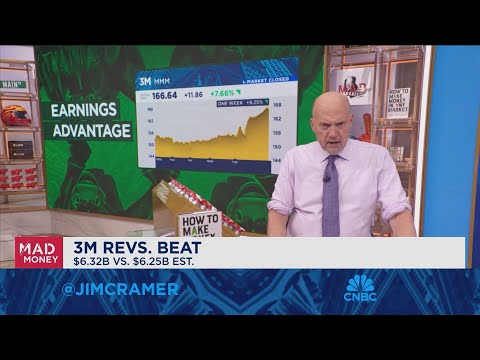
Core Viewpoint - The recent performance of various companies outside the tech sector indicates a robust real economy, which contrasts with the perception of a market dominated by a few major tech firms. This has led to a rally in the Dow Jones Industrial Average, suggesting that there is strength in the broader economy despite concerns about speculative stocks and potential market risks [2][21]. Company Performance - Wells Fargo reported strong credit quality, while Bank of America highlighted robust consumer spending and saving rates [7][11]. - American Express showed significant spending among younger demographics, indicating solid credit metrics [8]. - RTX (Raytheon Technologies) delivered impressive earnings due to increased demand for military systems and aircraft services, rallying 7% [12][21]. - 3M launched 70 new products in the third quarter, leading to a stock increase of 7.66% as the company returns to innovation [14][15]. - GE Aerospace reported strong numbers in commercial jet engines and aircraft services, with expectations for continued strong performance [16]. - General Motors experienced strong demand for trucks, benefiting from a favorable regulatory environment under the current administration [17]. - Danaher provided a promising quarter, suggesting potential for stronger performance in the upcoming year, resulting in a nearly 6% stock increase [19]. - Coca-Cola's CEO reported larger profits through market share gains and successful new product launches, demonstrating resilience in the face of economic slowdown [20]. Market Dynamics - The concentration of major tech companies in the S&P 500, which accounts for about 35% of the index, raises concerns about market stability and the potential for speculative bubbles [4]. - The perception of a dual economy, with a divide between high-growth tech firms and traditional industries, is prevalent, but recent earnings suggest a more balanced economic landscape [3][5]. - The overall market rally led by companies in the real economy, such as RTX, GE Aerospace, and 3M, indicates positive momentum outside the tech sector [21].


Jim Cramer: Strong earnings from ‘actual businesses’ are driving the ‘real economy’
CNBC Television· 2025-10-22 00:03
Market Overview & Investment Strategy - The market is perceived as dominated by data center-related companies and speculative ventures, leading to concerns about concentration and risk [3][4] - A "real economy" exists beyond AI and speculative stocks, offering potential investment opportunities if it shows signs of life [5][6] - The speaker suggests that strong performance from companies in the "real economy" can drive market rallies [6][21] - Parabolic moves in stocks like Micron should be avoided; investors should wait for pullbacks before buying [26] Financial Sector Performance - Wells Fargo showed strong credit quality, and Bank of America indicated robust consumer spending and saving [7] - BlackRock and Morgan Stanley reported extraordinary savings numbers [7] - Goldman Sachs is seeing positive signs from IPO and M&A advisory fees [7] - American Express reported robust spending among younger people and solid credit metrics [8] - Regional banks need lower interest rates to improve business [8] - Concerns about credit quality exist, but fewer bad loans were observed this quarter [9][10] Company-Specific Highlights - RTX (formerly Raytheon) is experiencing strong performance due to demand for military systems and missile replenishment, with the stock rallying 12.7% [12][13][14] - 3M is innovating again, launching 70 new products in Q3 and 196 year-to-date, with the stock rallying 7.66% [14][15] - GE Aerospace is delivering stellar results in commercial jet engines and aircraft service [16] - General Motors is benefiting from strong truck demand and a less stringent attitude toward carbon emissions, though EVs are less profitable [17][18] - Danaher (DHR) delivered a strong quarter, with expectations for an even stronger next year, leading to a nearly 6% stock increase [18][19] - Coca-Cola is showing remarkable execution, increasing profits through market share gains and new product offerings [20]
Jim Cramer says it’s nice to see companies doing well that aren’t tied to the data center
CNBC Television· 2025-10-21 23:48
Market Overview - The market is perceived to be dominated by companies connected to data center buildout and speculative ventures [2] - The "Magnificent Seven" stocks constitute approximately 35% of the S&P 500, raising concerns about market concentration [3] - The market is divided between data center-related companies and speculative ventures, causing unease among investors [4] Economic Indicators - Positive economic data from actual businesses, not just those related to AI and data centers, led to a Dow rally of 218 points [1] - The NASDAQ, heavily influenced by AI stocks, experienced a slight dip of 0.16% [1] - The emergence of a "real economy" showing signs of life could attract significant investment [6] Potential Risks - Concerns exist regarding the ability of companies like OpenAI to secure funding for data center expansion, potentially impacting the AI sector [5] - Over-speculation in areas like uranium companies and quantum computing firms raises concerns about market stability [4]