Separation of powers

Search documents
MS NOW hosts react to Trump’s STUNNING loss on tariffs
MSNBC· 2026-02-21 19:00
And joining me now is host of the beat with Ari Melber on MSNOW, Ari Melber and MSNOW senior legal reporter Lisa Rubin, Yale law school professor and president of the budget lab at Yale, Natasha Sarin and New York Times chief White House correspondent and MSNOW political analyst Peter Baker. Ari, I'm going to start with you. So at first this morning, I think some people thought the chaos was over now because of this decision from the Supreme Court. But after listening to the president speak, I think it's ve ...

Why the supreme court's tariffs ruling is a win for world trade – but also tricky
The Guardian· 2026-02-20 21:52
Core Viewpoint - The US Supreme Court's decision to strike down Donald Trump's tariffs is a positive development for the rule of law and the separation of powers, but it does not restore the US's credibility in the global economy [1][2][3]. Group 1: Court Ruling and Economic Impact - The Supreme Court ruled that the International Emergency Economic Powers Act (IEEPA) does not grant the president the authority to impose tariffs, which are a form of taxation reserved for Congress [3]. - The ruling will reduce the average trade-weighted tariff in the US from 15.3% to 8.3%, benefiting consumers and businesses reliant on imports [5]. - Tariffs against imports from China will decrease from 36.8% to 21.2%, Brazilian imports from 26.3% to 6.8%, and Japanese goods from 14.9% to 9.9% [6]. Group 2: Ongoing Economic Uncertainty - Despite the reduction in tariffs, the 8.3% average tariff remains historically high, and the court did not address the underlying issues of Trump's trade war [7]. - The court's decision adds to economic uncertainty as existing trade deals may be disrupted, and the loss of tariff revenue could create a budget deficit estimated at $120 billion [9]. - The Supreme Court did not limit the president's ability to justify tariffs based on dubious claims of national emergencies, allowing for continued economic unpredictability [8][10]. Group 3: Future Trade Actions - Following the ruling, Trump announced a new 10% global tariff under section 122 of the 1974 Trade Act, which requires congressional approval for extensions beyond 150 days [11][12]. - Trump may also utilize section 301 and section 232 of the Trade Acts to impose tariffs, but these actions come with procedural limitations [13][14]. - The Supreme Court's decision may complicate future trade negotiations, leaving uncertainty about the ease of establishing new trade deals [15].

'The law held': Ari Melber breaks down Supreme Court's tariff ruling
MSNBC· 2026-02-20 20:51
And joining me now is host of The Beat with Ari Melber on MSNOW, Ari Melber and MSNOW senior legal reporter Lisa Rubin, Yale Law School professor and president of the Budget Lab at Yale, Natasha Sarin, and New York Times chief White House correspondent and MSNOW political analyst Peter Baker. Ari, I'm going to start with you. So at first this morning I think some people thought the chaos was over now because of this decision from the Supreme Court.But after listening to the president speak, I think it's ver ...
Supreme Court Strikes Down Trump Tariffs: What's Next?
Youtube· 2026-02-20 20:30
Core Viewpoint - The Supreme Court ruled that the president does not have the authority to impose tariffs under the statute used by Donald Trump, invalidating more than half of the tariffs imposed since he took office [2][10]. Group 1: Tariff Authority and Legal Implications - The Supreme Court's decision limits the president's tariff authority, stating that the statute for economic emergencies does not include tariff powers [2][10]. - The president may attempt to use other, more limited tariff authorities, but these are expected to be more cumbersome [3][5]. - The ruling indicates that Congress retains the primary authority over tariffs, and the president cannot assume powers not explicitly granted [10][14]. Group 2: Future Legal Battles and Refunds - There will be ongoing litigation regarding refunds for the $170 billion collected in tariffs under the invalidated law, which may take years to resolve [4]. - The president has indicated plans to impose a 10% global tariff using a different, limited authority that lasts for only 150 days [5]. Group 3: Political Context and Executive Power - The ruling reflects a separation of powers issue, emphasizing that tariff authority is constitutionally assigned to Congress [14]. - The Supreme Court's decision may signal limits on executive power, contrasting with previous deference shown to the president in other legal matters [13][14].

About half of Trump's tariffs are now null and void - but his trade war is not over
Sky News· 2026-02-20 18:37
Core Viewpoint - The Supreme Court's decision to rule against President Trump's tariffs represents a significant setback for his administration, emphasizing the constitutional requirement that tariffs must be decided by Congress rather than imposed unilaterally by the president [1][2][4]. Group 1: Historical Context and Legal Framework - The U.S. Constitution established that tariffs should be determined by Congress, which is a fundamental aspect of the separation of powers [2]. - Over the years, exceptions have been created to allow presidents to impose tariffs unilaterally in specific situations, such as national security crises [3][4]. - The Trade Expansion Act of 1962 and the International Emergency Economic Powers Act (IEEPA) of 1977 provide legal grounds for the president to impose tariffs under certain conditions [5][6]. Group 2: Impact of the Supreme Court Ruling - The Supreme Court's ruling nullifies a significant portion of Trump's tariffs, particularly those imposed under the IEEPA, raising questions about potential refunds for tariffs already collected [8]. - The ruling may compel the administration to explore other legal loopholes to impose additional levies, allowing the White House to attribute political challenges to judicial obstruction [9]. Group 3: Political Ramifications - The timing of the ruling coincides with a decline in Trump's poll ratings, suggesting that the tariffs may not be achieving the desired political support [12]. - This situation could force Trump to acknowledge that his tariff strategy is not yielding the expected results, contributing to ongoing uncertainty in the trade landscape [12].
NOW: Supreme Court hears landmark Trump FTC firing case today
MSNBC· 2025-12-08 17:18
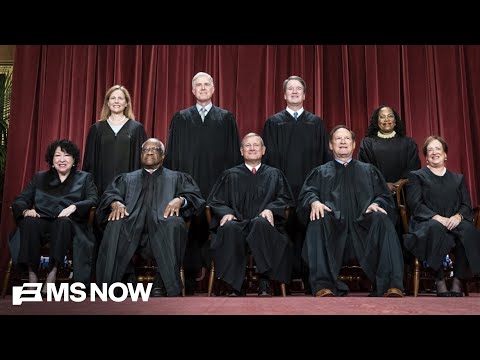
Let's get to MS Now senior legal reporter Lisa Rubin and Paul Butler, a former federal prosecutor and MS Now legal analyst. Lisa, bring us up to speed. What stands out so far in today's arguments.I think what stands out to me is some of what you've already pointed out, right. So that the liberal justices are playing out the consequences of the logic being employed by the administration, which is this isn't just about the FTC. This isn't even just about similarly situated multimemember agencies in the alphab ...
Ruling on Texas map is 'very aggressive assertion' of Supreme Court's power: Journalist
MSNBC· 2025-12-05 21:39
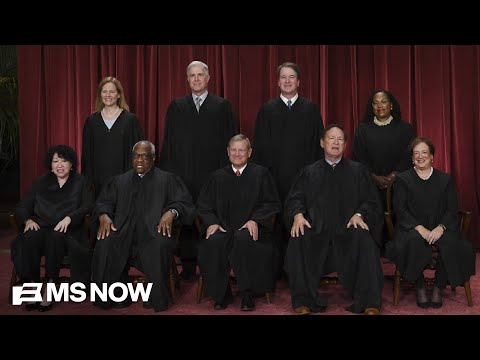
Joining us, late senior writer and co-host of the Amicus podcast, Mark Joseph Stern, investigative reporter for the Austin American Statesman Tony Pitky, former deputy assistant attorney general Tom Dri, and MS Now senior legal reporter Lisa Rubin. So Mark Joseph Stern um yet again using the shadow docket. Then again, they needed to do something about this if they were going to act at all before the December 7th deadline. They're arguing the uh lower court got in the way of a midterm, but wouldn't the lower ...
MSNBC Exclusive: Fmr. FTC Commissioner blasts Supreme Court for allowing Trump to fire her
MSNBC· 2025-09-24 10:47
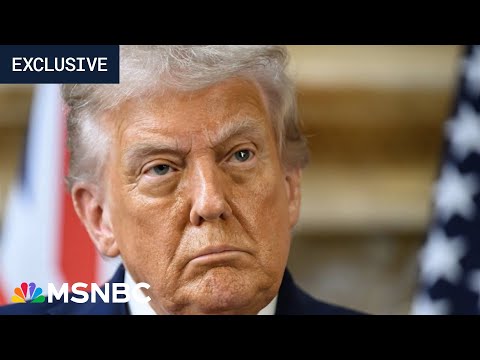
Conservative justices on the Supreme Court have just cleared the way for Donald Trump to fire Rebecca Slaughter, the lone Democrat on the Federal Trade Commission, at least for now, as the court decides whether to append 90 years of legal precedent and give the executive branch more authority over supposedly independent government agencies. In her descent, Justice Elena Kagan blasted the decision, writing, "Our emergency docket should never be used, as it has been this year, to permit what our own precedent ...
Not possible for congress to delegate broad tariff authority to president: Fordham law professor
CNBC Television· 2025-09-02 21:09
Legal & Regulatory Analysis - A court ruling challenged the legality of many of President Trump's tariffs, leading to an appeal to the Supreme Court [1] - The Constitution grants 100% of the authority to impose tariffs to the legislative branch, which can delegate some power to the executive branch, but not too broadly [4] - The President used the International Emergency Economic Powers Act for tariffs, but questions arise whether Congress granted the power for the tariffs on those goods at that magnitude for that period of time [5] - Even if Congress affirms the tariffs through a procedural vote, the delegation of power might still be unconstitutional if it's too broad [7][8] - The tariffs are imposed on almost every type of good out of 7,800 types of goods and originating in close to 200 countries, which is considered too broad for Congress to delegate [8] Market & Investment Implications - Investors should consider that these tariffs may not be permanent [3] - The executive branch's agility is reshaping the separation of powers, impacting the stability and predictability of trade policies [2] - The constitutional balance of power among the three branches prevents substantial shifts of power without a constitutional amendment [10]
Why don't Republicans check Trump's power? 'Very few brownie points' in it for them
MSNBC· 2025-08-12 20:30
Political Landscape & Republican Party - The Republican Party, largely due to primary challenges, doesn't check Donald Trump's authority, acting as an arm of the White House [2][3][5] - A primary motivation for Republicans and conservatives is "triggering liberals," influencing policy and political decisions [7] - Trump's success lies in generating attention and capitalizing on outrage, controversy, and backlash [9][10] Crime & Political Strategy - Trump's actions, like deploying the National Guard to Washington DC, are partly designed to provoke a reaction from the left, which he can then exploit [10][12] - Democrats find it difficult to counter Trump's narrative on crime, struggling to defend nuanced realities and avoid being seen as tolerant of crime [13][20][25] - Some Democrats believe the crime issue in DC is politically advantageous for Trump [19] Executive Power & Political Debate - Trump is seen as creating emergencies to declare authorities he can't obtain through legislation [16] - Deploying the military on American streets is considered unprecedented and potentially dangerous [22][26]