
Tariffs

Search documents
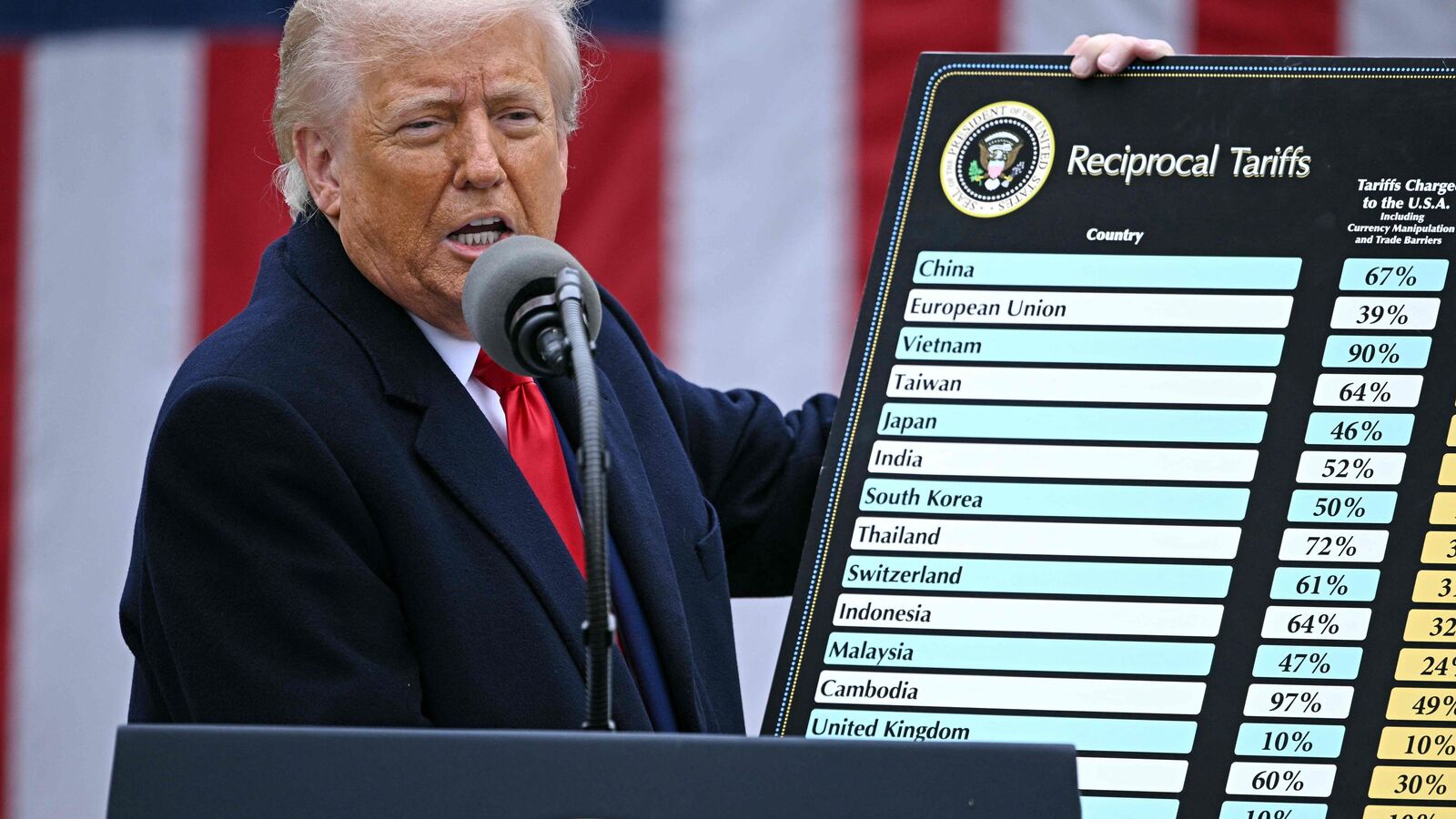
Trump boasts General Motors and Ford executives thanked him for truck tariffs — ‘Their stock has gone through the roof’
MINT· 2025-10-22 17:58
Group 1 - Executives from General Motors and Ford expressed gratitude to President Trump for the tariffs on medium- and heavy-duty trucks, indicating a positive impact on their stock prices [1] - The tariffs are positioned as a national security measure, with Trump asserting that they strengthen the US economy [2] - The tariffs will impact various vehicle types, including delivery trucks, garbage trucks, public utility trucks, transit buses, school buses, and semi-trucks [2] Group 2 - Prior to the new tariffs, the US had a 15% tariff on light-duty vehicles as part of trade agreements with Japan and the EU [3] - In April, a 25% tariff was imposed on all automobile imports, which was later extended to auto parts in May [3] - Producers are permitted to deduct the value of US components from tariffs on light-duty vehicles assembled in Canada and Mexico [3]


Best Buy Stock Might Be Bargain If China Tensions Keep Subsiding
Investors· 2025-10-22 17:14
Group 1 - Best Buy (BBY) stock is currently near a buy zone as tensions with China show signs of easing [1] - The retail giant has made efforts to reduce reliance on Chinese imports but remains sensitive to tariff policy changes [1] - If the Trump administration acts quickly on tariffs, Best Buy could benefit significantly [1] Group 2 - Meta Platforms has launched its third generation of smart glasses, with Apple and Google also preparing to enter the market [2] - Retailers are experiencing uncertainty due to Amazon and other retail earnings, with concerns about tariffs affecting summer spending [4] - Best Buy delivered a mixed Q1 report and cut its outlook due to the impact of Trump tariffs [4]

Trump says GM, Ford execs thanked him for tariffs, soaring stocks
Reuters· 2025-10-22 17:10
President Donald Trump said the chief executives of General Motors Co and Ford Motor Co called to thank him on Wednesday for putting tariffs on mid- and large-sized trucks, saying their companies stock has soared. ...

Mattel Misses on Earnings Due to Trump Tariff Uncertainty
Youtube· 2025-10-22 15:33
Let's stick with earning shares of. It's now taking a hit as retailers delay orders over tariff uncertainty impacts and the current. Joins us now for more.And there we're starting to see it might not be a big stock market issue but a company turning around is saying some retailers are holding back, waiting for clarity. How much of an economic issue might that be. Well, it's a big question, a big missing piece of the jigsaw.When will these tariffs start to flow through to more broadly goods on the shelf. Jon ...


X @Bloomberg
Bloomberg· 2025-10-22 15:20
WEG, a Brazilian maker of industrial machinery, expects to offset the impact of US tariffs by the first half of 2026, following a bigger hit than anticipated for the final quarter of this year https://t.co/aohR3m1ysB ...
U.S. Trade Rep. Jamieson Greer: China's rare earths move was 'totally disproportional'
CNBC Television· 2025-10-22 14:30
It was incredibly aggressive. It was totally disproportional to anything that uh the US, the EU or Canada or anybody did because remember these are global measures that the Chinese have put in place to purport to control the movement or export of any item containing certain rare earth from one country to another, right. Even if China is not uh you know one of the parties uh in the agreement.So in Geneva we had an agreement where they would limit their rare earth export controls. they'd keep their retaliator ...
X @Bloomberg
Bloomberg· 2025-10-22 14:04
Malaysia’s Prime Minister Anwar Ibrahim said the nation was on the verge of wrapping up a trade deal with the US after President Donald Trump slapped hefty tariffs on its exports to the world’s largest market https://t.co/DiGUJQeleT ...
U.S. Trade Rep. Jamieson Greer: China's rare earths move was totally disproportionate
CNBC Television· 2025-10-22 13:03
US-China Trade Relations - The possibility of a meeting between President Trump and President Xi remains uncertain, pending mutual agreement [1][2] - The US expresses willingness to engage in trade talks with China, especially given China's recent measures [2] - The US believes a more balanced trade relationship is needed, as China currently enjoys broader access to the US market than the US has to the Chinese market [10][11] - The US is open to a constructive trading relationship with China, but it must be actively managed [10] Rare Earths and Export Controls - China has implemented new measures on rare earths, raising concerns for the US [3] - China's actions regarding rare earth export controls are viewed as aggressive and disproportionate by the US [4][5] - The US accuses China of expanding controls on rare earths globally, despite a previous agreement to limit them [7] - China's restrictions on rare earths are seen as an attempt to exert economic control [7] - The US has concerns about China potentially using access to semiconductors to gain access to rare earth minerals [14] - The US uses export controls on high-end goods, but China's controls on basic inputs like rare earths are considered broad and indiscriminate [15][16] National Security and Technology - The US prioritizes national security when considering technology exports to China [19] - The US aims to maintain its technological edge and prevent other countries from gaining a competitive advantage [20] - The US government uses inter-agency processes to analyze new technologies and determine appropriate export controls, considering industry input and foreign availability [21]
Gold and related stocks are falling for a second day. The metal is off 8% from high
CNBC· 2025-10-22 12:27
Core Viewpoint - Gold prices have experienced a significant decline after a prolonged rally, with a notable selloff attributed to profit-taking by investors rather than macroeconomic or geopolitical factors [2][3]. Price Movement - Gold futures fell by $61.30, or 1.49%, to $4,053.10 per ounce, marking a two-day selloff after reaching an intraday record of $4,398 per ounce [1][2]. - The precious metal lost 5.74% on Tuesday, closing at $4,109.10, representing its worst performance since 2013 [2]. Market Analysis - Analysts from UBS indicated that the recent decline in gold prices is largely technical, driven by slowing price momentum and rising option volatility, leading speculative investors to take profits [3]. - Despite the recent pullback, gold prices remain up over 50% year-to-date and nearly 5% for the month, with underlying fundamentals such as inflation and political instability expected to persist [3][4]. Future Outlook - UBS analysts believe it is premature to adopt a negative outlook on gold, suggesting that the factors driving its price increases are likely to continue [4].

Waller, a Top Fed Chair Contender, Backs Rate Cuts Without Bowing to Trump
Yahoo Finance· 2025-10-22 10:00
Core Viewpoint - The article discusses the potential influence of former President Trump on the Federal Reserve's policies, particularly regarding interest rates, and highlights Christopher Waller's position as a key figure in this dynamic as he is considered a candidate to replace Jerome Powell as Fed chair [1][2][12]. Group 1: Waller's Position and Influence - Waller is seen as a proponent of central bank independence and has a reputation for making data-driven decisions, which he is not willing to compromise for political gain [3][12]. - Despite pressure from Trump and his allies for aggressive rate cuts, Waller has maintained a cautious approach, advocating for a quarter-point reduction rather than a more drastic half-point cut [5][6]. - Waller has expressed concerns about the Fed's role in political issues and has pushed for cost-cutting measures within the Fed, including a reduction of about 350 staffers in 2023 [18][20]. Group 2: Political Pressure and Fed Independence - Trump's administration is actively seeking to exert more control over the Fed, which could undermine its independence and have negative implications for the US economy and global markets [2][15]. - The potential for a board with a majority of Trump appointees raises concerns about the pressure to remove regional bank presidents, which could further compromise the Fed's autonomy [16][17]. - Waller's commitment to defending the Fed's independence is evident in his public statements emphasizing the importance of keeping politics out of monetary policy decisions [14][20]. Group 3: Economic Outlook and Policy Recommendations - Waller has been vocal about the need for lower interest rates, citing risks in the labor market and the impact of tariffs on inflation, which he believes should not be a persistent concern [9][10]. - His approach to monetary policy reflects a balance between advocating for necessary changes while maintaining the Fed's core mission and credibility as an inflation fighter [8][14]. - Analysts expect Waller to remain true to his economic analysis and not yield to political pressures for rate cuts that lack a clear economic justification [12][13].