
中微子振荡

Search documents
中微子实验国际合作增进认知 或助力探索宇宙正反物质不对称
Zhong Guo Xin Wen Wang· 2025-10-23 02:20
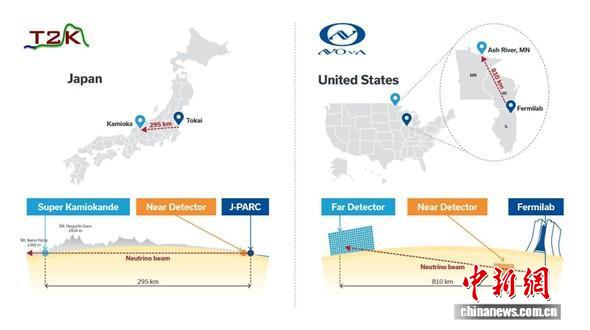
Core Insights - The recent paper published in the journal "Nature" discusses advancements in understanding neutrino behavior through international collaboration between the NOvA and T2K experiments, which may aid in exploring the matter-antimatter asymmetry in the universe [1][3]. Summary by Sections - **Neutrino Research**: Neutrinos are fundamental particles that could reveal the origins of cosmic matter, but their weak interaction with matter makes them difficult to study. Different "flavors" of neutrinos evolve during oscillation, which can provide insights into neutrino mass and the mixing of these flavors, including potential differences in oscillation between neutrinos and their antiparticles [3][5]. - **Experimental Collaboration**: The NOvA and T2K experiments are long-baseline neutrino oscillation experiments that analyze data from neutrinos traveling hundreds of kilometers from an accelerator facility to a large detector. The collaborative analysis of their datasets has led to new constraints related to neutrino mass and fundamental symmetries, enhancing the statistical significance of the results [3][5]. - **Findings and Implications**: The collaborative research team has provided precise estimates of parameters controlling the differences in oscillation between neutrinos and antineutrinos. Although direct observation of asymmetry has not been achieved, the data suggests a potential violation of symmetry between the two types of particles. This analysis highlights the complementary sensitivity of the NOvA and T2K experiments and underscores the value of collaboration [5].

美日联手获取中微子更精确测量结果 助力解释宇宙中正反物质不对称之谜
Ke Ji Ri Bao· 2025-10-22 23:05
Core Insights - The NOvA and T2K experiments have achieved more precise measurements regarding neutrino mass differences and neutrino-antineutrino oscillation asymmetry, enhancing the understanding of neutrino behavior [1][2] - These findings may contribute to exploring the matter-antimatter asymmetry in the universe, which is crucial for understanding the origin of cosmic matter [1] Group 1: Experimental Findings - The joint analysis of data from NOvA and T2K has improved the statistical significance of results, leading to more accurate measurements of neutrino mass differences and oscillation asymmetry [2] - The results provide precise estimates of parameters controlling the differences between neutrino and antineutrino oscillations, suggesting potential violations of symmetry between the two [2] Group 2: Collaboration and Methodology - The combined analysis enhances the sensitivity of both experiments, highlighting the value of collaboration in particle physics research [3]
科学家测定最精确中微子质量上限
Ke Ji Ri Bao· 2025-04-11 01:15
Core Insights - The KATRIN experiment has provided the most precise upper limit on the mass of neutrinos, measuring it to be less than 0.45 electron volts (eV), which is less than one-millionth of the mass of an electron [1][2] - This finding constrains the properties of neutrinos, one of the most mysterious fundamental particles in the universe, and pushes the boundaries of physics beyond the Standard Model [1][3] Experiment Details - The KATRIN experiment analyzes the beta decay of tritium to explore neutrino mass, where a tritium nucleus transforms into a helium nucleus, releasing an electron and an electron antineutrino [2] - Between 2019 and 2021, the KATRIN collaboration conducted five measurement campaigns, collecting data over 259 days and measuring the energy of approximately 36 million electrons, achieving a data volume six times greater than previous efforts [2] - The upper limit for the effective mass of electron neutrinos was set at less than 0.45 eV with a confidence level of 90%, marking the strictest laboratory limit on neutrino mass to date [2] Future Prospects - The KATRIN experiment is expected to conclude in 2025 after a total of 1000 days of data collection, with researchers anticipating the ability to estimate the effective electron neutrino mass close to the predicted value of 0.3 eV at a 90% confidence level [2]