
中微子振荡

Search documents
创新中国 攀高向新——二〇二五年我国重大科技成果盘点(科技视点)
Ren Min Ri Bao· 2025-12-30 22:37
Core Insights - In 2025, China made significant technological breakthroughs across various fields, contributing to high-quality development and global progress in civilization [1][2] Group 1: Technological Innovations - The "artificial sun" achieved a world record of 1 million degrees Celsius for 1066 seconds, marking a significant step in nuclear fusion research [9] - The successful launch of the Tianwen-2 probe initiated China's first asteroid exploration mission, enhancing capabilities in deep space exploration [10] - The DeepSeek AI model broke traditional paths by optimizing algorithms to achieve top performance with limited computing power, promoting an open ecosystem for global developers [7] Group 2: Scientific Research Achievements - The first large-area production of two-dimensional metal materials was achieved, marking a new frontier in material science [3] - Research on lunar samples from the far side of the moon revealed new insights into its geological history, challenging previous understandings [4] - The Jiangmen Neutrino Experiment (JUNO) achieved a measurement precision 1.5 to 1.8 times better than the previous international standard, advancing the study of neutrinos [4] Group 3: Economic Impact and Industry Development - The integration of AI technologies across various sectors, including healthcare and transportation, is driving high-quality development and enhancing productivity [12][14] - The approval of 69 innovative drugs in 2025 set a new record, reflecting the rapid advancement in the pharmaceutical industry [13] - The promotion of carbon capture technology in the cement industry and digital transformation in the steel industry are part of a broader shift towards sustainable practices [14] Group 4: Strategic Initiatives - The establishment of a comprehensive innovation system is underway, with a focus on self-reliance in technology and the cultivation of new productive forces [15] - The development of advanced technologies such as brain-computer interfaces and quantum computing is positioning China as a leader in these fields [8]
地下700米,中国科学家正在探寻宇宙演化的奥秘
Xin Lang Cai Jing· 2025-12-27 15:37
Core Viewpoint - The article discusses the significance of neutrinos in particle physics and highlights the recent achievements of the Jiangmen Neutrino Experiment, which has made substantial advancements in understanding neutrinos and their properties [1][3][5]. Group 1: Neutrino Characteristics and Misconceptions - Neutrinos are fundamental particles that are ubiquitous in the universe, with each person generating approximately 5,000 neutrinos per second [3]. - The claim that neutrinos could cause a catastrophic event on Earth, as depicted in movies, is scientifically unfounded due to their weak interaction with matter [3]. Group 2: Jiangmen Neutrino Experiment - The Jiangmen Neutrino Experiment features the world's largest liquid scintillator detector, constructed with nearly 1,000 tons of stainless steel, 263 pieces of acrylic, 20,000 tons of liquid scintillator, 40,000 tons of ultra-pure water, and 45,000 photomultiplier tubes [7][8]. - Within just 59 days of operation, the experiment reported its first results, achieving a precision increase of 1.5 to 1.8 times in measuring the oscillation frequency and amplitude of solar neutrinos compared to the highest precision from the past 50 years [8]. Group 3: Future Directions and Innovations - A new neutrino experiment is being developed near the Taishan Nuclear Power Plant, which aims to provide reference data for the Jiangmen Neutrino Experiment and features the world's only low-temperature liquid scintillator detector [10][12]. - Despite challenges faced during the setup, the team remains optimistic about the project's potential, emphasizing that even with minor losses in precision, the Taishan experiment will still be among the best globally [12].

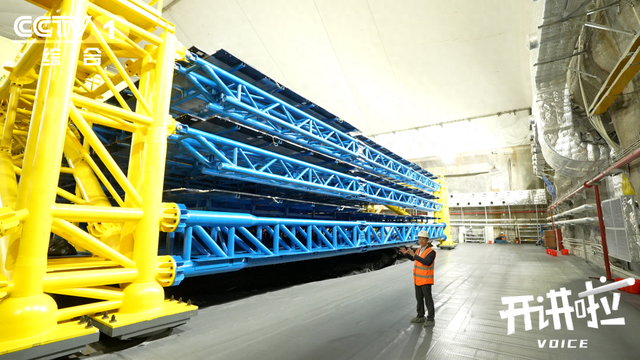
【人民日报】聚开放之力,探宇宙精微
Ren Min Ri Bao· 2025-12-04 06:47
Core Insights - The Jiangmen Underground Neutrino Observatory (JUNO) has achieved significant scientific results by measuring two parameters related to neutrino oscillation, improving precision by 1.5 to 1.8 times compared to previous experiments [1] - The experiment aims to support global research on neutrinos from various sources, including the sun, supernovae, atmosphere, and Earth, thereby facilitating breakthroughs in the field [1] Group 1: Research and Development - The JUNO project was proposed in 2008 and was officially established five years ahead of similar international projects, laying the foundation for China's leading position in neutrino research [2] - The experiment utilizes a core detector made of 20,000 tons of liquid scintillator housed in a giant acrylic sphere, located 700 meters underground, which is crucial for expanding human understanding of fundamental physics [1][2] Group 2: International Collaboration - The project involves over 700 researchers from 75 institutions across 17 countries, highlighting the importance of international cooperation in achieving significant scientific breakthroughs [3] - The success of the JUNO experiment is seen as a result of more than a decade of collaboration, emphasizing China's commitment to open innovation and global scientific resource integration [3] Group 3: Technological Advancements - Chinese scientists developed a photomultiplier tube with the highest photon detection efficiency globally, overcoming previous foreign monopolies and revitalizing related industries [2] - The advancements in technology and research capabilities are viewed as essential for achieving major original innovations and breakthroughs in key technologies [3]
捕捉“幽灵粒子”的中国突破(院士讲科普)
Ren Min Ri Bao· 2025-11-28 22:00
Core Insights - The Jiangmen Underground Neutrino Observatory (JUNO) has successfully completed its construction and released its first scientific results, marking a significant advancement in neutrino research [3][4][6] - The experiment aims to explore the properties of neutrinos, particularly their mass hierarchy, which is crucial for understanding the universe's evolution and the mystery of matter-antimatter asymmetry [4][5][8] Summary by Sections Experiment Overview - JUNO is a next-generation neutrino experiment designed to study "ghost particles" known as neutrinos, which are fundamental to understanding cosmic evolution [3][4] - The facility is located 700 meters underground in Jiangmen, Guangdong, and features a large detector with a diameter of 35.4 meters, containing 20,000 tons of liquid scintillator, making it 20 times larger than similar international facilities [8][9] Scientific Achievements - The first physical results from JUNO, reported after analyzing 59 days of effective data, have improved the measurement precision of the solar neutrino oscillation parameters by 1.5 to 1.8 times compared to previous experiments [3][6] - The experiment confirmed the "solar neutrino anomaly," suggesting the existence of new physics beyond current understanding [3][4] Historical Context - The success of JUNO builds on the foundation laid by the Daya Bay Neutrino Experiment, which was pivotal in measuring the mixing parameter θ13 and achieving the highest precision in neutrino measurements before JUNO [6][7] - The Daya Bay experiment, initiated in 2006, led to significant breakthroughs in neutrino oscillation studies, paving the way for the current JUNO project [6][7] Future Prospects - JUNO's design life is projected to be 30 years, with expectations to expand its research scope beyond mass hierarchy to include solar and terrestrial neutrinos, and potentially detect neutrinos from supernovae [9] - The project involves over 700 researchers from 17 countries and aims to produce significant scientific breakthroughs and train the next generation of physicists [9]
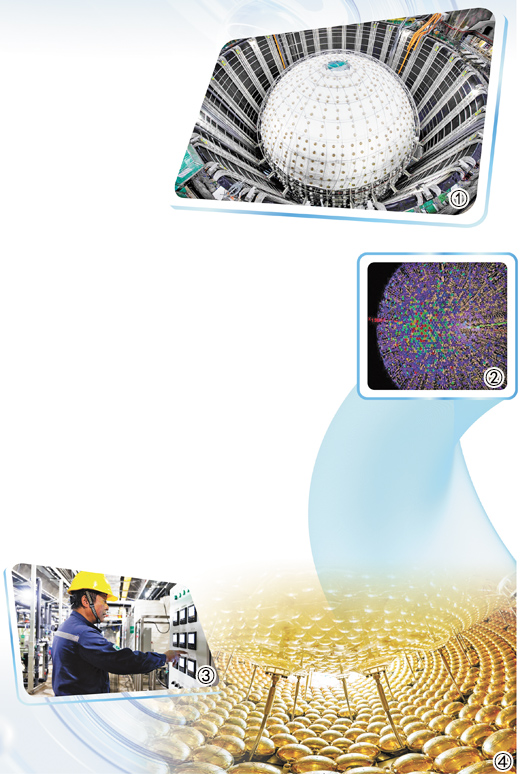
江门中微子实验发布首个重大科学成果
Nan Fang Ri Bao Wang Luo Ban· 2025-11-20 07:50
Core Insights - The Jiangmen Neutrino Experiment has achieved significant scientific results by measuring two key parameters of neutrino oscillation with a precision improvement of 1.5 to 1.8 times compared to the previous best international levels, surpassing over a decade of efforts from similar foreign experiments [1][2] Group 1: Experiment Overview - The Jiangmen Neutrino Experiment, located 700 meters underground in Guangdong, officially began operations on August 26 and is the world's first next-generation large-scale, high-precision neutrino detection facility [1] - The core detector is equipped with 20,000 tons of liquid scintillator and 45,000 photomultiplier tubes, capable of capturing extremely weak neutrino signals [1] Group 2: Scientific Achievements - Researchers achieved breakthroughs in measuring the two key parameters of neutrino oscillation—mixing angle θ12 and mass-squared difference Δm²₂₁—using only 59 days of effective data from the device [1] - The experiment confirmed the long-standing discrepancy between reactor neutrino and solar neutrino measurements, providing clues for exploring new physical laws [2] Group 3: Future Prospects - The device has a designed lifespan of 30 years and can be upgraded to become the world's most sensitive experiment for neutrinoless double beta decay, exploring whether neutrinos are their own antiparticles [2] - The Jiangmen Neutrino Experiment is a model of international collaboration in large-scale basic scientific research, involving over 700 researchers from 75 institutions across 17 countries [2]
“超级眼睛”捕捉“幽灵粒子”测量精度提升1.5至1.8倍
Nan Fang Du Shi Bao· 2025-11-19 23:12
Core Insights - The Jiangmen Neutrino Experiment (JUNO) has achieved significant milestones in neutrino physics, measuring two key oscillation parameters with unprecedented precision, surpassing international standards by 1.5 to 1.8 times in just two months [5][6][7]. Group 1: Experiment Overview - The Jiangmen Neutrino Experiment is designed to detect neutrinos, often referred to as "ghost particles," and is set to officially begin data collection on August 26, 2025 [5][6]. - The experiment's core detector, located 700 meters underground, has a total mass of 20,000 tons and includes a 41.1-meter diameter stainless steel shell and a 35.4-meter diameter acrylic sphere [8][9]. - The project has been in development for over a decade, receiving support from the Chinese Academy of Sciences and international collaborations [10][11]. Group 2: Scientific Achievements - The first results from JUNO indicate that the detector's performance metrics have met or exceeded design expectations, enabling advanced research in neutrino physics [9][12]. - The experiment aims to determine the mass hierarchy of three types of neutrinos and to explore potential new physics beyond the current particle physics standard model [7][9][14]. - JUNO's measurements have confirmed discrepancies in previous solar neutrino experiments, suggesting the possibility of new physical laws [7][15]. Group 3: Future Implications - JUNO is expected to lead the field of neutrino physics for the coming years, with a design lifespan of 30 years and potential upgrades for further experiments [9][12]. - The experiment will not only focus on neutrino mass ordering but also on precise measurements of oscillation parameters and studies of solar, supernova, atmospheric, and terrestrial neutrinos [9][14]. - The research conducted at JUNO is anticipated to yield significant scientific contributions and foster the development of the next generation of physicists [12][14].
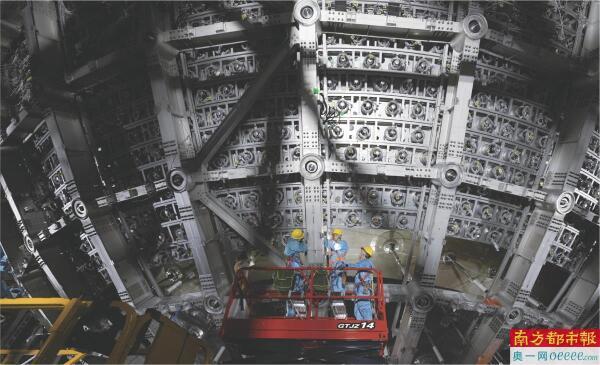
江门中微子实验发布首个科研成果
Xin Hua She· 2025-11-19 06:25
Core Insights - The Jiangmen Underground Neutrino Observatory (JUNO) has achieved its first physical results, measuring two parameters related to neutrino oscillation with an accuracy improved by 1.5 to 1.8 times compared to previous experiments [2][3] - The JUNO project, proposed by the Chinese Academy of Sciences in 2008, officially commenced operations on August 26, 2023, and is recognized as the world's first large-scale, high-precision neutrino experiment [2] - The project involves over 700 researchers from 75 institutions across 17 countries and regions, showcasing China's commitment to international scientific collaboration [2] Project Details - The JUNO collaboration has successfully analyzed data from August 26 to November 2, 2023, leading to the high-precision measurement of solar neutrino oscillation parameters [3] - The performance of the JUNO detector has met or exceeded design expectations, allowing for rapid determination of neutrino mass ordering and testing of the three types of neutrino oscillation frameworks [3] - The success of JUNO is seen as a significant milestone reflecting the dedication and creativity of the international team involved in the project [3]
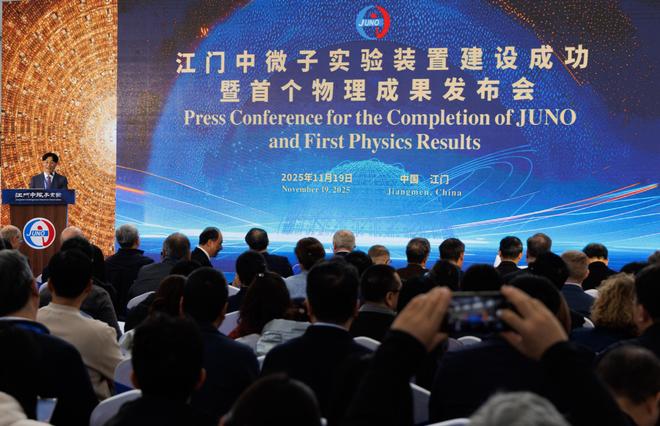
【新华社】捕捉“幽灵粒子” 江门中微子实验测量精度创新高
Xin Hua She· 2025-11-19 06:03
Core Insights - The Jiangmen Neutrino Experiment has achieved significant advancements in measuring neutrino oscillation parameters, improving precision by 1.5 to 1.8 times compared to previous experiments [3][5][6] - This experiment is crucial for understanding the mass hierarchy of neutrinos, which are fundamental particles that play a key role in the evolution of the universe [5][6] Group 1: Experiment Overview - The Jiangmen Neutrino Experiment is located 700 meters underground in Jiangmen, Guangdong, and has been operational for two months, yielding promising results [3][4] - The experiment's core detector consists of a giant acrylic sphere containing 20,000 tons of liquid scintillator, making it the largest of its kind globally, enhancing detection capabilities significantly [6][7] Group 2: Scientific Significance - The experiment aims to capture elusive neutrinos, often referred to as "ghost particles," which are challenging to detect due to their extremely small mass and minimal interaction with matter [5][6] - The project is expected to contribute to groundbreaking scientific discoveries and foster collaboration with global scientists to produce impactful research outcomes [7]
中国江门中微子实验取得重大成果:证实太阳中微子偏差的存在,为探索未知物理世界打开新窗口
Ge Long Hui· 2025-11-19 03:29
Core Viewpoint - The Jiangmen Neutrino Experiment, a major scientific facility operated by the Institute of High Energy Physics of the Chinese Academy of Sciences, has officially commenced operations and achieved its first significant research result: the confirmation of the existence of solar neutrino oscillation deviations [1] Summary by Categories Scientific Achievements - The experiment confirmed the existence of solar neutrino deviations by analyzing data from 59 days of reactor neutrino observations [1] - Two oscillation parameters were measured, enhancing the precision of the measurements [1] Research Objectives - The primary scientific goal of the experiment is to address the neutrino mass ordering problem, which could open new avenues for exploring unknown aspects of the physical world [1]
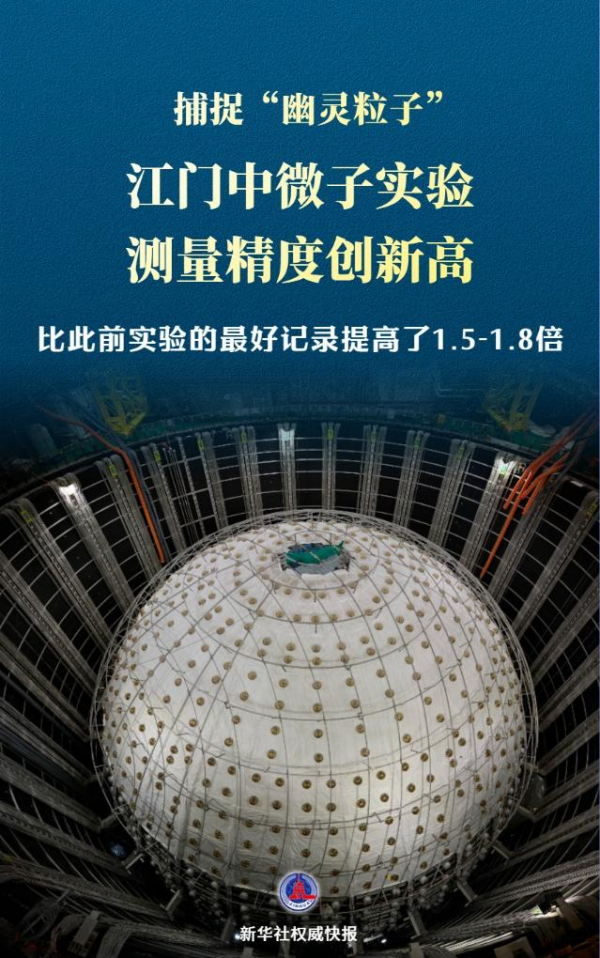
新华鲜报|捕捉“幽灵粒子” 江门中微子实验测量精度创新高
Xin Hua She· 2025-11-19 03:10
Core Insights - The Jiangmen Neutrino Experiment has successfully measured two parameters describing neutrino oscillation with a precision 1.5-1.8 times better than previous experiments, marking a significant advancement in neutrino research [1][2] - The experiment's performance has met or exceeded design expectations, bringing humanity closer to determining the mass hierarchy of neutrinos [1] Group 1: Experiment Overview - The Jiangmen Neutrino Experiment is designed to capture "ghost particles" known as neutrinos, utilizing a detector that contains 20,000 tons of liquid scintillator housed in the world's largest organic glass sphere, increasing the volume by 20 times compared to existing facilities [2] - The experiment has been operational for two months, analyzing data from August 26 to November 2, totaling 59 days of effective data collection [1] Group 2: Scientific Significance - Neutrinos are fundamental particles that play a crucial role in understanding the evolution of the universe, yet they are extremely difficult to detect due to their minuscule mass and weak interaction with matter [1] - The project team aims to collaborate closely with global scientists to produce original scientific results with significant impact [3]