中微子

Search documents
江门中微子实验:藏在地下700米的国之重器 捕捉“幽灵粒子”的超级工程
Xin Lang Cai Jing· 2026-02-12 23:44
Core Insights - The Jiangmen Neutrino Experiment aims to capture neutrinos, which are fundamental particles that can provide insights into the origins of the universe and support future technological advancements in human life [1][4]. Research and Development - The experiment is located 700 meters underground in a granite layer, which serves as a protective barrier against cosmic rays and other interference, creating an ideal environment for neutrino detection [2]. - The core device of the experiment is a giant acrylic sphere, over 35.4 meters in diameter, filled with 20,000 tons of liquid scintillator that can detect faint light signals produced when neutrinos interact with the liquid [3]. - The experiment began construction in 2015 and is expected to officially start data collection by August 26, 2025, with initial results anticipated by November 2025 [3]. Scientific Breakthroughs - The experiment's design allows for a significant increase in measurement precision of neutrino oscillation parameters, achieving a 1.5 to 1.8 times improvement in accuracy within just 59 days of data analysis [3]. - The results from this experiment could lead to a better understanding of neutrino mass ordering and validate frameworks for three types of neutrino oscillations, potentially achieving in two months what similar international experiments have accomplished in 10 to 20 years [3]. Practical Applications - Neutrino research could fill gaps in the standard model of particle physics and may lead to new theories, aiding in the exploration of dark matter and dark energy [4]. - In the energy sector, neutrino detection technology can enhance nuclear power plant efficiency and safety, while in geological exploration, it can improve the accuracy of subsurface structure assessments [4]. - Medical applications may arise from neutrino-related technologies, potentially leading to advancements in early disease diagnosis and imaging techniques [4][5]. - The experiment's technological innovations, such as photomultiplier tubes and the giant acrylic sphere, could have broader applications in aerospace and precision instruments, contributing to high-quality industrial development [5].
什么?!科学家正在地下捉“鬼”?
Huan Qiu Wang Zi Xun· 2025-11-19 04:54
Core Viewpoint - The article discusses the ongoing efforts of Chinese scientists to capture neutrinos, referred to as "ghost particles," through the Jiangmen Underground Neutrino Observatory (JUNO), highlighting the significance of neutrinos in understanding the universe and the technological challenges involved in the experiment [1][5][22]. Group 1: Neutrino Characteristics - Neutrinos are one of the fundamental particles of the universe, with an estimated 300 neutrinos per cubic centimeter present everywhere due to the remnants of the Big Bang [2][5]. - They travel at nearly the speed of light and have a very weak interaction with matter, making them extremely difficult to detect [2][4]. Group 2: Scientific Importance - Neutrinos carry crucial information about the universe, including insights into the nature of antimatter and the fundamental properties of matter [5][6]. - The study of neutrinos has been a significant area of research in physics, with major discoveries leading to Nobel Prizes [9]. Group 3: Experimental Setup - The JUNO facility is located 700 meters underground to minimize interference from cosmic rays, which can disrupt neutrino detection [10][12]. - The experimental setup includes a large central detector submerged in a water pool, designed to capture neutrinos produced by nearby nuclear power plants [10][17]. Group 4: Technological Innovations - The project has required the development of new technologies, including advanced photomultiplier tubes and high-purity liquid scintillator systems, to achieve unprecedented detection capabilities [14][16]. - The JUNO experiment is noted for being the world's largest and most precise neutrino detection facility, with a design lifespan of 30 years [12][16]. Group 5: Future Prospects - The experiment began data collection in August 2023, with expectations of significant findings in the next three to five years, potentially coinciding with rare astronomical events like supernovae [20][22]. - The research aims to position China at the forefront of fundamental scientific research, contributing to global knowledge in the field [22].

中微子实验国际合作增进认知 或助力探索宇宙正反物质不对称
Zhong Guo Xin Wen Wang· 2025-10-23 02:20
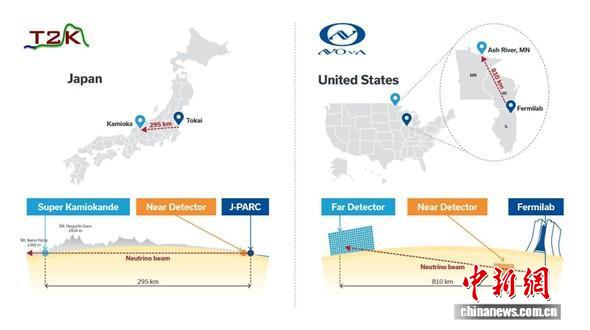
Core Insights - The recent paper published in the journal "Nature" discusses advancements in understanding neutrino behavior through international collaboration between the NOvA and T2K experiments, which may aid in exploring the matter-antimatter asymmetry in the universe [1][3]. Summary by Sections - **Neutrino Research**: Neutrinos are fundamental particles that could reveal the origins of cosmic matter, but their weak interaction with matter makes them difficult to study. Different "flavors" of neutrinos evolve during oscillation, which can provide insights into neutrino mass and the mixing of these flavors, including potential differences in oscillation between neutrinos and their antiparticles [3][5]. - **Experimental Collaboration**: The NOvA and T2K experiments are long-baseline neutrino oscillation experiments that analyze data from neutrinos traveling hundreds of kilometers from an accelerator facility to a large detector. The collaborative analysis of their datasets has led to new constraints related to neutrino mass and fundamental symmetries, enhancing the statistical significance of the results [3][5]. - **Findings and Implications**: The collaborative research team has provided precise estimates of parameters controlling the differences in oscillation between neutrinos and antineutrinos. Although direct observation of asymmetry has not been achieved, the data suggests a potential violation of symmetry between the two types of particles. This analysis highlights the complementary sensitivity of the NOvA and T2K experiments and underscores the value of collaboration [5].