
土壤污染防治

Search documents
河北深入推进土壤污染防治工作 3.32亿平方米建设用地可安全利用
Zhong Guo Xin Wen Wang· 2025-07-29 17:05
Group 1 - Hebei Province has completed a total of 6,805 soil pollution investigation and remediation projects, providing approximately 3.32 billion square meters of safe construction land [1] - By the end of 2024, 436 priority regulated plots will have implemented soil pollution control, exceeding the national target of 75% with a completion rate of 85.8% [1] - Nearly 1,000 enterprises have been included in the key regulatory list for soil pollution, focusing on industries such as heavy metal mining, to eliminate pollution risks [1] Group 2 - As of the end of 2024, Hebei Province has completed sewage treatment in 27,502 villages, achieving a treatment rate of 55.9% [2] - In the first half of this year, an additional 1,586 villages were treated, raising the treatment rate to 59% [2] - The comprehensive utilization rate of straw in Hebei Province is stable at over 97%, and the recovery rate of agricultural film remains above 90% [2]
云南省环科院助力个旧市破解冶炼废渣治理难题
Zhong Guo Huan Jing Bao· 2025-06-11 02:55
Core Insights - Yunnan Provincial Ecological Environment Science Research Institute (referred to as the Institute) is a comprehensive environmental research institution established in 1976, focusing on ecological environment science research and technology application [1] - The Institute has developed in-situ risk control technology for historical smelting waste residue, successfully applied in over ten remediation projects, managing more than 20 million tons of waste residue [1][2] Project Overview - Gejiu City, known as the "World Tin Capital," faces significant challenges due to the disorderly accumulation of historical smelting waste, which poses serious risks to surrounding soil and water [2] - The Institute has created an innovative technology model centered on in-situ risk control to address the waste residue management challenges, providing robust technological support for sustainable regional ecological and economic development [2][5] Technical Features - The in-situ risk control technology model is designed based on local geological and hydrological conditions, offering strong operational feasibility, short remediation cycles, and minimal secondary pollution risks [3] Key Technical Modules - The project includes three core engineering modules: 1. Reshaping and enclosing waste piles to ensure stability [4] 2. Pollution barrier and surface runoff control to prevent dust and leachate [4] 3. Ecological restoration and functional reconstruction to enhance ecosystem stability [4] Project Advantages - The project leverages the Institute's strong research capabilities and integrates resources from enterprises and universities, achieving significant breakthroughs in technology innovation [5] - The in-situ risk control technology reduces high costs and long remediation periods, significantly improving remediation efficiency and providing a model for similar pollution management projects [5] Benefit Analysis - The project has effectively blocked the migration of heavy metals, transforming waste sites from pollution-dispersing to pollution-reducing, thus enhancing the safety of agricultural land and improving regional water quality [6] - It has preserved over 500,000 tons of potential metal resources, providing replicable practices for green transformation in resource-depleted cities and establishing a benchmark in the national waste residue management field [6]

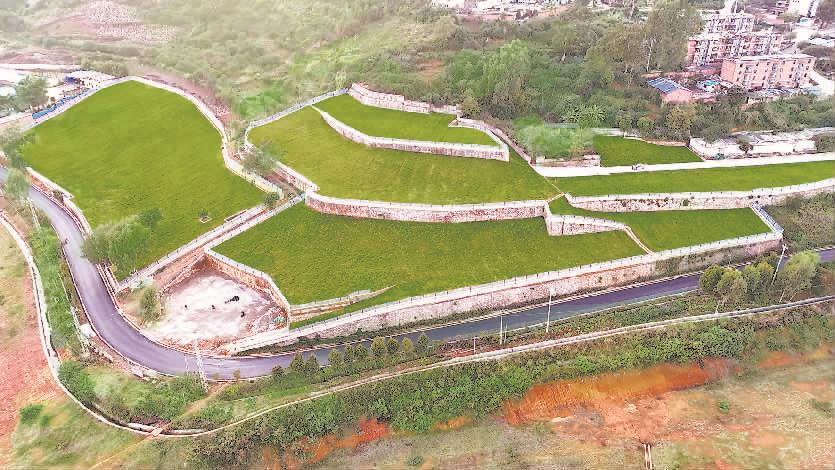
泸州推动土壤污染防治先行区建设
Zhong Guo Huan Jing Bao· 2025-04-30 03:42
Group 1 - The demolition of the entire site of Luzhou Xinfeng Chemical Co., Ltd. has officially started, which is significant for eliminating major environmental risks along the Yangtze River [1] - The demolition action is monitored by an environmental management unit using various technical methods to prevent secondary pollution during the process [1] - Luzhou City has introduced an environmental supervision mechanism to ensure industrial enterprises achieve "ecological exit" through comprehensive soil pollution prevention and risk control [1] Group 2 - Luzhou City focuses on key regulatory units and risk points in soil pollution prevention, establishing a comprehensive monitoring system for soil and groundwater pollution [2] - Key enterprises have invested over 140 million yuan in green upgrades to reduce soil pollution risks in critical areas [2]