土壤污染防治

Search documents
菏泽“十四五”期间重点建设用地安全利用率稳定保持100%
Qi Lu Wan Bao· 2026-02-11 00:04
Group 1 - The core viewpoint of the news is the progress made by Heze City in soil pollution prevention since the start of the 14th Five-Year Plan, highlighting legislative and management improvements [1] - The local legislation has been enhanced with the introduction of the "Heze City Soil Pollution Prevention Regulations," clarifying responsibilities and ensuring public safety [1] - A management system for construction land access has been implemented to prevent illegal development, with a focus on soil pollution status investigations as a prerequisite for land use permits [1] Group 2 - Strengthened source prevention of soil pollution has been emphasized, with increased regulatory oversight on key pollution sources and timely updates to the list of monitored units [2] - The establishment of a dynamic updating mechanism has prioritized 46 sites for regulatory oversight, ensuring that soil pollution risks are effectively managed [2] - Annual control requirements have been strictly enforced to maintain the soil pollution risk at prioritized sites within acceptable limits [2]
守一方净土 护生态根基
Xin Lang Cai Jing· 2026-02-07 20:47
Core Viewpoint - Hohhot City has effectively implemented the "Green Water and Green Mountains are Gold and Silver Mountains" concept, focusing on improving soil and agricultural rural ecological environment quality, achieving significant results in soil pollution prevention, groundwater protection, agricultural rural environment governance, and industrial solid waste comprehensive utilization [1][2]. Group 1: Soil Pollution Prevention - The city maintains a 100% safe utilization rate of key construction land, with no polluted arable land reported, ensuring public safety [1]. - Annual monitoring and control of soil pollution in priority regulatory plots is conducted at 100%, with comprehensive monitoring of key regulatory units and surrounding soil environments [3]. Group 2: Groundwater Protection - Hohhot is a pilot city for groundwater environmental control and remediation, with significant progress in groundwater management projects, including the initiation of the Jinshan High-tech Industrial Development Zone groundwater control project [4]. - Regular monitoring and evaluation of groundwater quality at sites with exceedances are conducted, enhancing the groundwater environmental protection network [4]. Group 3: Agricultural and Rural Environment - The city has successfully guided the New District in completing the "Beautiful Countryside" construction, earning recognition as a "National Beautiful Countryside Construction Pilot Area" [5]. - By 2025, the city aims to create 100 model villages for rural sewage treatment, increasing the rural sewage treatment rate to 60% [5]. Group 4: Solid Waste Management - The city has made significant strides in solid waste pollution prevention, with successful actions against illegal dumping and exploration of new paths for resource utilization of coal-based solid waste [6]. - A comprehensive plan for industrial solid waste and hazardous waste pollution prevention for 2024-2028 has been developed to guide future efforts [6]. Group 5: Future Outlook - Hohhot will continue to strengthen ecological civilization construction, focusing on soil and groundwater protection, and improving the rural ecological environment [8].
2025年成都遥望雪山天数创新高
Xin Lang Cai Jing· 2026-01-23 18:53
Core Viewpoint - By the end of 2025, Chengdu aims to achieve significant improvements in environmental quality, including soil pollution prevention and noise reduction, contributing to a healthier ecosystem and enhanced living conditions for residents [1] Group 1: Soil Pollution Prevention - By the end of 2025, 100% of the 24 national groundwater monitoring points in Chengdu will meet standards, and the safe utilization rate of contaminated arable land will reach 96.39% [1] - The city will exceed the heavy metal reduction targets set for the 14th Five-Year Plan, indicating proactive measures in soil health management [1] Group 2: Noise Pollution Control - During the noise pollution prevention campaign, complaints via the "12345" hotline decreased by 11.9% year-on-year, reflecting improved noise management [1] - By 2025, the nighttime compliance rate for sound environment functional areas is expected to increase to 85.5%, enhancing the quality of life for residents [1] Group 3: Future Environmental Initiatives - In 2026, Chengdu will develop a national "Beautiful Blue Sky" project plan, exploring pilot projects for NOx emissions reduction and establishing a system for indicator recovery [1] - The city aims to provide integrated incentives such as warning exemptions and credit support for environmentally friendly enterprises, targeting over 80% of key industry enterprises to be advanced within three to four years [1] - A five-year water environment protection plan will be implemented, focusing on projects for water environment governance, ecological restoration, and resource protection [1]
华锦北沥公司建空中管廊保护土壤生态
Xin Lang Cai Jing· 2026-01-22 22:14
Core Viewpoint - The project by Huajin Group's Beili Company for the renovation of the wastewater discharge system has been completed and selected as one of the 124 national soil pollution source control projects, receiving 15 million yuan in central funding for soil pollution prevention [1] Group 1 - The renovation project took over two years to plan and construct, resulting in the establishment and modification of 3,020 meters of overhead green pipelines, along with the construction of five lift stations and inspection wells [1] - The upgrade allows for a visualized upgrade of the wastewater transport network from the tank area and production facilities to the treatment station, enhancing the safety of the soil and underground ecological environment [1] - The implementation of this upgrade effectively addresses issues related to the insufficient anti-seepage protection of the original transport pipelines and facilities, significantly reducing risks in the wastewater transport process [1] Group 2 - The project achieves precise management of rainwater and sewage separation, making daily operations more convenient and efficient [1] - The operational costs have been significantly reduced, with an estimated annual savings of approximately 500,000 yuan in related disposal and maintenance expenses [1]
规范建设用地“环境修复+”模式,生态环境部酝酿新规
Di Yi Cai Jing· 2025-10-30 01:07
Core Viewpoint - The government aims to regulate the "environmental remediation + development" model for construction land to ensure safe utilization of land while minimizing blind remediation, reducing idle land, and coordinating treatment and use [1][5]. Group 1: Regulatory Framework - The draft notice is currently seeking opinions and is based on the established soil environmental management system since the 18th National Congress, which has initially curbed the worsening trend of soil pollution [1]. - The draft encourages local governments to explore the "environmental remediation +" model within the legal framework, ensuring that the concept is not misused and that risk control or remediation measures are tailored to local conditions [2][5]. Group 2: Implementation Strategies - Local governments are encouraged to promote remediation through development, allowing for conditional transfer of polluted land and supporting the establishment of remediation factories [5][6]. - The draft outlines conditions for adopting the "environmental remediation +" model, emphasizing the need for clear responsibilities and urgent development needs for polluted land [5]. Group 3: Financial and Technical Support - The draft encourages the establishment of provincial soil pollution prevention funds and the involvement of social capital in "environmental remediation +" projects, exploring a "polluter pays" principle [5][6]. - The Ministry of Ecology and Environment reported that in 2021, 15,000 units conducted pollution risk assessments, revealing that nearly 70% of enterprises had some level of soil pollution risk [6].

共18类!两部门联合发布《重点控制的土壤有毒有害物质名录(第一批)》
仪器信息网· 2025-09-28 03:57
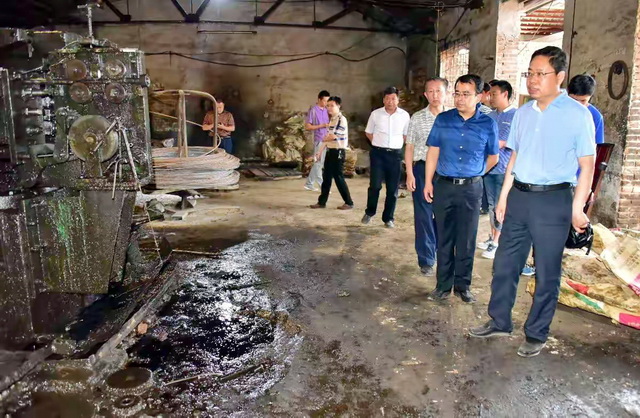
Core Viewpoint - The Ministry of Ecology and Environment and the National Health Commission jointly released the "List of Key Controlled Toxic and Harmful Substances in Soil (First Batch)", which includes 18 types of pollutants [3]. Summary by Relevant Sections List of Pollutants - The list includes the following pollutants: 1. Cadmium and cadmium compounds 2. Mercury and mercury compounds 3. Lead and lead compounds 4. Arsenic and arsenic compounds 5. Hexavalent chromium compounds 6. Cyanides 7. 1,1-Dichloroethylene 8. 1,2-Dichloropropane 9. Benzene 10. Dichloromethane 11. Toluene 12. Trichloromethane 13. Trichloroethylene 14. Tetrachloroethylene 15. 2,4-Dinitrotoluene 16. Benzo[a]pyrene 17. Benzo[b]fluoranthene 18. Benzo[k]fluoranthene [4]. Legal Framework - The release of the list is in accordance with Article 20 of the Soil Pollution Prevention and Control Law of the People's Republic of China, which mandates the identification and assessment of toxic and harmful substances in soil to protect public health and the ecological environment [3]. Importance of the List - The establishment of this list is crucial for ensuring soil environmental safety and enhancing monitoring and regulation of key toxic and harmful substances [3].

【行业深度】一文洞察2025年中国土壤调理剂行业发展前景及投资趋势研究报告
Sou Hu Cai Jing· 2025-08-26 05:46
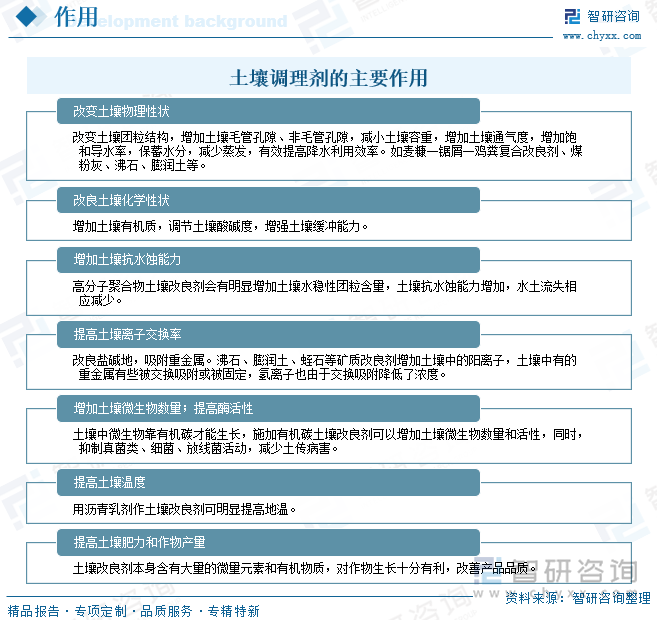
Core Viewpoint - The soil conditioner industry in China is experiencing significant growth due to increasing soil issues such as acidification, salinization, and nutrient deficiencies, with the market expected to reach 7.332 billion yuan in 2024, a year-on-year increase of 15.6% [2][10]. Industry Overview - Soil conditioners, also known as soil improvers, are materials that improve soil physical properties and promote nutrient absorption without providing nutrients themselves [3][6]. - They enhance soil structure, increase moisture retention, and improve temperature, which can advance crop growth by 2 to 7 days and increase soil moisture by approximately 5% [4][5]. Market Size and Growth - The market size for soil conditioners in China is projected to reach 7.332 billion yuan in 2024, reflecting a 15.6% increase compared to the previous year [2][10]. Related Policies - The Chinese government has implemented various policies to promote the use of soil conditioners, including financial support for projects addressing soil pollution and encouraging local governments to initiate subsidized loan trials [2][8]. - Key policies include the 2021 notice on promoting soil conditioners in severely affected areas and ongoing efforts to prevent soil pollution through various action plans [8][9]. Industry Chain - The soil conditioner industry consists of an upstream segment that includes organic materials, minerals, and synthetic polymers, a midstream segment focused on production, and a downstream segment that applies these products in agriculture [9]. - The use of soil conditioners is crucial for improving soil productivity and crop quality, especially in areas affected by long-term chemical fertilizer and pesticide use [9]. Types of Soil Conditioners - Soil conditioners are categorized into four main types: mineral-based, organic-based, chemical-based, and agricultural water-retaining agents, each serving different functions in soil improvement [6][7].
2025年中国土壤修复行业区域发展情况 江苏省在土壤修复行业更具竞争力【组图】
Qian Zhan Wang· 2025-08-25 08:10
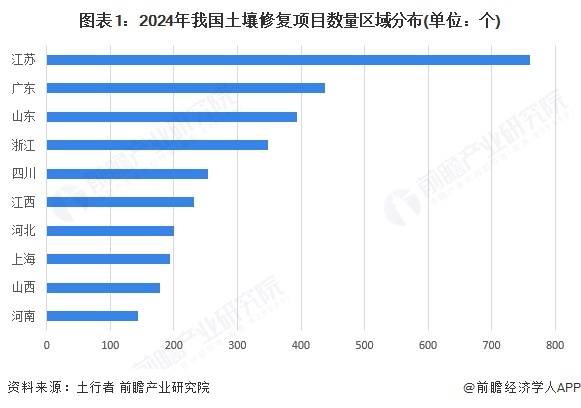
Group 1 - The core viewpoint of the article highlights the significant growth and scale of soil remediation projects in China, particularly in Jiangsu province, which leads in both project quantity and contract value for 2024 [1][2] - In 2024, Jiangsu province has 760 soil remediation projects, accounting for 16.3% of the total annual projects, with a total contract value of approximately 2.128 billion yuan, reflecting a 15% year-on-year increase [1] - The second-ranking province, Guangdong, has around 437 projects, representing 9.37% of the total projects for 2024 [1] Group 2 - Jiangsu province leads in contract value for soil remediation projects in 2024, with approximately 2.128 billion yuan, which constitutes 19.51% of the total annual contract value, showing a 25% increase from the previous year [2] - Guangdong province's contract value is about 999.7 million yuan, making up 9.14% of the total, with a year-on-year growth of 7%, rising from fifth to second place [2] Group 3 - For 2025, the Ministry of Finance has allocated significant funding for soil pollution prevention, with Hunan province receiving 587 million yuan, which is 19.0% of the total budget [4] - The funding for Hunan is aimed at addressing severe heavy metal pollution issues due to historical mining practices, with Guangxi and Yunnan following with budgets of 270 million yuan and 290 million yuan, respectively [4] Group 4 - In terms of the distribution of qualified soil pollution risk management and remediation companies, Jiangsu province has 974 qualified firms, including 77 large enterprises with registered capital over 50 million yuan [7] - Other provinces with a high number of firms include Shandong, Guangdong, and Hebei, each exceeding 800 qualified companies [7]
研判2025!中国土壤调理剂行业政策汇总、产业链、市场规模、竞争格局及未来趋势分析:土壤修复热潮下,行业市场规模增长至73.32亿元[图]
Chan Ye Xin Xi Wang· 2025-08-20 01:19
Core Viewpoint - The soil conditioner industry in China is experiencing significant growth due to increasing soil issues such as acidification, salinization, and nutrient deficiencies, with the market expected to reach 7.332 billion yuan in 2024, a year-on-year increase of 15.6% [1][13]. Industry Overview - Soil conditioners, also known as soil improvers, are materials that enhance soil physical properties and promote nutrient absorption without providing nutrients themselves. They improve soil structure, moisture retention, and temperature, leading to earlier crop growth and increased soil humidity by approximately 5% [3][5]. - The industry is categorized into four main types: mineral-based, organic-based, chemical-based soil conditioners, and agricultural water-retaining agents, each serving different functions in soil improvement [5][6]. Market Dynamics - The Chinese government is actively promoting soil pollution remediation and providing financial support for projects aimed at improving saline-alkali and acidic soils, which further drives the market for soil conditioners [1][13]. - The industry faces competition primarily from small and medium-sized enterprises, which often rely on price competition due to product homogeneity. However, some companies focus on niche markets, offering customized products and services [15][16]. Industry Chain - The soil conditioner industry chain consists of three segments: upstream (raw materials like organic matter and minerals), midstream (production of soil conditioners), and downstream (application in agriculture) [9][11]. - The use of soil conditioners is crucial for enhancing land productivity and crop quality, addressing issues caused by long-term chemical fertilizer and pesticide use [9]. Development Trends - The industry is expected to evolve towards multifunctional products that not only improve soil quality but also serve as nutrient carriers and provide additional benefits such as water retention and pest control [21]. - There is a growing demand for personalized solutions due to the diverse soil types across China, making customization a key competitive advantage for companies [22]. - Technological innovation is essential for the industry's growth, with new products like nano soil conditioners showing promise in enhancing soil fertility and restoring damaged soils [24].
陕西发布上半年生态环境“成绩单”
Zhong Guo Huan Jing Bao· 2025-08-19 01:33
Core Viewpoint - The ecological environment quality in Shaanxi Province has shown continuous improvement in the first half of 2025, with better air quality, stable soil quality, and overall good river water quality [2][11]. Group 1: Air Quality Improvement - The air quality index for the 10 national monitoring cities in Shaanxi improved by 2.9% year-on-year, with a comprehensive index of 4.08 [14]. - The average concentration of PM2.5 improved by 3.2% year-on-year, with the five cities in the Guanzhong area showing a comprehensive index of 4.48, improving by 4.7% [14]. - The number of good air quality days increased by 46 days compared to the same period last year, averaging 119 good days [14]. Group 2: Water Quality Management - In the Han-Dan River basin, all 35 national control sections maintained water quality at Class II or above, with 12 sections achieving Class I quality, accounting for 34.3% [15]. - The Han River, a major tributary of the Yangtze River, is crucial for the South-to-North Water Diversion Project, and efforts have been made to ensure its water quality remains stable [15][16]. - A total of 31 wastewater treatment plants in the basin achieved Class A discharge standards, with 1,053 administrative villages completing wastewater treatment [15]. Group 3: Soil and Groundwater Management - The soil and groundwater quality in Shaanxi has remained stable, with effective management of contaminated farmland and key construction sites [17]. - A comprehensive plan for soil pollution source prevention has been developed, focusing on agricultural land and involving 61 enterprises in pollution source remediation [17][18]. - The province has initiated investigations and remediation plans for groundwater pollution in chemical parks, with 20 parks starting their assessment and remediation processes [18]. Group 4: Industry and Emission Control - The province has eliminated over 30,000 old diesel trucks and has a significant number of new energy vehicles, ranking 14th nationally in terms of ownership [13]. - 82% of the steel industry capacity has completed ultra-low emission transformations, with 110 out of 268 planned modifications in the cement industry already completed [13][14]. - The province has implemented a performance upgrade program for enterprises, resulting in 43 new enterprises achieving B-level or above performance ratings this year [13].