
Zhong Guo Huan Jing Bao

Search documents
环境监测也可借鉴环评信用管理模式
Zhong Guo Huan Jing Bao· 2026-02-27 06:40
生态环境部日前发布《关于2025年下半年环评信用管理对象列入"黑名单"情况的通报》,两名环评编制 人员因所编制的环境影响报告存在严重质量问题,被禁止从业五年并列入环境影响评价失信"黑名单"。 通过对环评编制单位和从业人员实行信用管理,有效维护了环评服务市场秩序。 统一的全国信用平台是确保信用监管结果落到实处的关键。在环评信用管理上,生态环境部建设了统一 的环境影响评价信用平台,确保失信人员信息全国可查、失信人员无所遁形。笔者建议,要积极推进全 国监测信用大平台建设,实现监测失信信息一网共享、一体运用,确保信用管理落到实处。此外,还要 建立失信信息修复制度。近期国家发改委发布的《信用修复管理办法》在强调失信惩戒的同时,更加注 重失信行为的动态管理,促进失信主体积极改善自身信用状况。可对照当前信用管理动态化、监管差异 化的要求,同步明确失信修复机制,将恶意违法与管理过失区分开来,将拒不履职者与积极修复者区分 开来,积极营造"失信者人恶之,守信者人敬之,诚信者人爱之"良好氛围,推进第三方服务市场健康有 序发展。 当前,环评信用管理模式已成为行政处罚、刑事制裁的有效补充。与行政处罚处理具体违法行为人不 同,环评信用管 ...
“扫码入企”给环境执法带来哪些转变?
Zhong Guo Huan Jing Bao· 2026-02-27 05:34
日前在河南开展环境执法检查有了新规矩,执法人员到企业检查不再"推门就进",而是需要先用手机扫 描一个专属二维码,显示绿色意味着可以进,显示橙色则慎进,显示红色则代表企业有权拒绝。这 套"扫码入企"机制在优化营商环境的同时,也对传统执法模式提出了新要求。 "扫码入企"能够将每一次执法检查都转变为全流程可追溯、可监督的"阳光作业"。这意味着从扫码时的 登记检查事项,到检查过程中对程序规范的严格遵守,再到检查结束时将结果按时上传平台,每一个环 节都在数字平台留下了痕迹。这种对行使执法权的系统性规定,不仅能够维护企业的合法权益,也是对 执法人员的保护,从而营造一个更加公平、透明的执法环境。 "扫码入企"旨在实现"无事不扰",减少随意、重复甚至是选择性检查,但这绝不等于放松监管。相反, 其倒逼执法力量从"人防"向"技防"升级,生态环境执法人员必须掌握并善用"非现场监管"的本领。比如 安阳市通过污染源自动监控、用电用能监控、卫星遥感等手段,在指挥中心进行大数据分析,精准筛选 违法线索。执法人员不仅要读懂在线监测数据曲线,还要会分析用电用能异常,甚至能从卫星遥感影像 中识别出生态环境风险。这种能力的提升,使执法力量能够实现 ...
节后企业复工复产环保自查不可少
Zhong Guo Huan Jing Bao· 2026-02-27 03:09
Core Viewpoint - Companies must prioritize environmental self-inspection before resuming operations after the Spring Festival holiday to prevent pollution control facilities from operating with hidden risks [1][2][3] Group 1: Environmental Management Issues - Some companies have encountered environmental management problems upon resuming operations after the holiday, such as a specific company whose pollution control facility was not operational during the holiday, leading to a significant decrease in adsorption efficiency [1] - The risk of pollution control facilities malfunctioning or underperforming increases due to external factors like humidity and freezing conditions after long periods of inactivity [2] Group 2: Responsibilities and Regulations - Companies are urged to take responsibility for pollution control and conduct thorough self-inspections before resuming operations, ensuring compliance with environmental management requirements [2] - Regulatory authorities should enforce strict management protocols for companies, especially those with higher environmental risks, to ensure that self-inspections are conducted before resuming operations [2] Group 3: Monitoring and Prevention - Regulatory bodies should utilize advanced monitoring techniques such as online surveillance, drone inspections, and big data analysis to track pollution emissions during the resumption phase [3] - A proactive approach, including sending reminders and guidelines to companies about environmental safety before resuming operations, has shown positive results in compliance and awareness [3]
锚定四大着力点 推动粤港澳大湾区绿色金融改革创新走深走实
Zhong Guo Huan Jing Bao· 2026-02-27 01:46
Core Viewpoint - The "Action Plan" aims to establish a modern financial support system for green development in the Guangdong-Hong Kong-Macao Greater Bay Area, positioning "green financial reform and innovation" as one of the three key breakthrough directions for the region's transformation towards a low-carbon economy [1] Group 1: Standard Coordination - The "Action Plan" emphasizes the need to implement green finance and transition finance standards to address the inconsistency in green finance standards within the Greater Bay Area, which is crucial for aligning with national guidelines [2] - Current discrepancies in green finance standards include differences in project certification, environmental information disclosure, and policy execution among financial institutions in Hong Kong, mainland China, and Macau [2] - Establishing effective mechanisms for standard coordination and mutual recognition is essential to facilitate the free flow and efficient allocation of green funds across regions [2] Group 2: Product Innovation - The Greater Bay Area has developed a diverse framework of green financial products, leveraging the unique advantages of cities like Guangzhou, Shenzhen, Hong Kong, and Macau [3] - There is a need for innovation in green financial products, particularly for small and micro enterprises, to enhance the existing product offerings such as green loans and green bonds [3] - Encouraging financial institutions to establish specialized green finance divisions can improve service capabilities and market vitality [3] Group 3: Cross-Border Cooperation - The unique "one country, two systems" framework of the Greater Bay Area provides a natural testing ground for cross-border green finance collaboration [4] - Significant progress has been made in cross-border green finance cooperation, including the successful implementation of the first ESG data cross-border transaction [4] - Challenges remain, such as insufficient standard alignment and regulatory cooperation, which need to be addressed to enhance the efficiency of cross-border capital flows [4] Group 4: Technological Empowerment - The Greater Bay Area's advanced technological resources should be leveraged to integrate cutting-edge technologies with green finance risk control systems [6] - Implementing a unified environmental information disclosure platform can standardize key indicators and provide reliable data for green finance activities [6] - Utilizing artificial intelligence for dynamic risk monitoring and intelligent early warning can enhance the precision and efficiency of green finance product pricing and risk assessment [6] Group 5: Future Directions - Future efforts should focus on streamlining the process for mainland enterprises to issue green bonds in Hong Kong and Macau, and promoting mechanisms to attract low-cost long-term green capital [5] - Establishing a green finance cooperation platform between the Greater Bay Area and Portuguese-speaking countries can facilitate project collaboration [5] - Strengthening regulatory cooperation in cross-border green project evaluation and risk monitoring is essential to enhance China's influence in global green finance governance [5] Conclusion - By driving standard coordination, product innovation, cross-border cooperation, and technological empowerment, the Greater Bay Area is poised to build an efficient, transparent, and robust green finance ecosystem, providing strong financial support for the realization of the "Beautiful China" initiative [7]
续写“人均一百棵树”的绿色奇迹
Zhong Guo Huan Jing Bao· 2026-02-27 00:39
Group 1 - The core achievement of China’s afforestation efforts is the impressive statistic of approximately 1.426 trillion trees, equating to about 100 trees per person in China, reflecting a significant increase in the country's green assets [1][2] - During the 14th Five-Year Plan period, China has completed 5.49 million acres of land greening and rehabilitated 1.52 million acres of desertified land, showcasing a commitment to both quantity and quality in ecological restoration [2][3] - The integration of advanced technologies and scientific principles in land greening efforts has led to improved efficiency and precision in afforestation, moving from mere planting to scientific management [2][3] Group 2 - The "Three-North Shelter Forest Program" has successfully completed over 20 million acres, significantly reducing sediment input into the Yellow River and enhancing ecological resilience [3][4] - Urban green coverage in China has reached 43.49%, with an average of 15.91 square meters of park green space per person, contributing to improved living conditions and public well-being [3][4] - The annual carbon sink from forests and grasslands exceeds 1.2 billion tons of CO2 equivalent, positioning China as a leader in carbon neutrality efforts and contributing to a projected forestry industry output value of nearly 11 trillion yuan by 2025 [3][4] Group 3 - The initiative of "100 trees per person" symbolizes a collective national effort and institutional advantage in promoting ecological sustainability, supported by over 1.7 million forest rangers and innovative collaboration mechanisms [4] - The ongoing commitment to afforestation is not only a current achievement but also a foundation for future ecological endeavors, with goals set for 2035 to reach a forest stock of over 24 billion cubic meters [4]
强化检察履职 推进大气污染区域共治
Zhong Guo Huan Jing Bao· 2026-02-26 23:29
Group 1 - The core viewpoint emphasizes the importance of collaborative governance in addressing air pollution, which transcends administrative boundaries and enhances environmental air quality improvement [1][2] - The role of prosecutorial agencies is highlighted as crucial in promoting cross-regional cooperation in air pollution control, leveraging their legal supervisory capabilities [2][3] - The article discusses the challenges posed by uneven regional development, local protectionism, and varying standards, which complicate enforcement and judicial cooperation in environmental protection [1][2] Group 2 - Prosecutorial agencies, while not traditional environmental governance bodies, possess unique advantages in regional governance due to their constitutional role in legal supervision [2][3] - The article suggests that prosecutorial agencies can enhance their effectiveness by integrating with ecological and environmental departments, focusing on evidence collection and case management in air pollution cases [2][3] - The potential for AI to assist in legal supervision is explored, proposing the establishment of systems that analyze environmental data and track compliance with judicial decisions [3] Group 3 - Systematic governance is identified as a fundamental requirement for regional collaboration in air pollution control, with a focus on the integration of criminal prosecution and public interest maintenance [3] - The article recommends specific pathways for enhancing prosecutorial effectiveness, including the development of mechanisms for evidence discovery and optimizing criminal prosecution processes [3]
陕西召开第三轮中央生态环境保护督察整改工作推进会 持续健全秦岭常态化长效化保护体制机制
Zhong Guo Huan Jing Bao· 2026-02-26 08:43
Core Viewpoint - The meeting emphasized the importance of ecological environment protection and the need for effective implementation of rectification measures in Shaanxi Province to enhance the construction of a beautiful environment [1][2] Group 1: Political Commitment and Responsibility - The provincial leadership highlighted the need to strengthen political awareness and responsibility in ecological civilization construction, learning from past mistakes such as the Qinling illegal construction incident [1] - There is a call for a firm commitment to the central government's decisions on ecological protection, ensuring that the correct performance view is upheld [1] Group 2: Focus on Key Issues - The meeting stressed the need to address prominent ecological issues with stricter requirements and practical measures, particularly in reinforcing ecological safety barriers and improving water resource management in the Yellow River basin [1] - Specific attention was directed towards pollution prevention and control, including air quality improvement in the Guanzhong area and comprehensive management of rivers and lakes [1] Group 3: Green Transformation and Sustainable Development - The leadership called for a comprehensive green transformation, optimizing land development patterns, and advancing a new energy system while promoting carbon peak initiatives [1] - There is an emphasis on fostering a green production and lifestyle to ensure sustainable development [1] Group 4: Implementation and Accountability - The meeting outlined the necessity for detailed, project-based rectification plans, emphasizing closed-loop management and accountability in ecological protection efforts [2] - It was highlighted that responsibilities must be clearly defined, ensuring that environmental protection is integrated into all levels of governance and industry [2]
家风故事|九江市生态环境局王新民:年夜饭后,我与女儿女婿算了笔账
Zhong Guo Huan Jing Bao· 2026-02-26 01:48
闲聊之间,女儿问起我何时退休,到时候去帮他们带带孩子。我当兵20多年,从部队转业到生态环境 局,一晃快15年了,离退休还有两三年,即将步入人生的下一程。看着女儿女婿30刚出头,正值干事创 业的好时候,我打心眼里替他们高兴。作为父母,我们既不会找什么人脉资源帮他们,也攒不了多少财 富资助他们,却也想让他们未来的路走得顺畅稳当一些。我和妻子能给予他们的,就是自己这辈子悟出 来的一个理——清清白白做人,干干净净做事。 春节前夕,驻江西省九江市生态环境局纪检组组长为全市生态环境系统干部职工上了一堂廉政党课。他 在授课中引用了江苏省徐州市建设局原局长靖某某在忏悔书中算的 "七笔账",在我脑海里留下了深刻 印象。 这个春节,远在无锡工作的女儿女婿带着孩子来九江陪我们过年。小两口都是独生子女,如今均在政府 部门工作。除夕吃过年夜饭后,一家人围坐着聊天,说起当下的生活,都由衷地感到日子安稳顺心。 在那一刻,我突然想起节前那堂党课上讲到的"七笔账",便跟他们一笔一笔细细算了起来。 第一笔是政治账。一步踏错,满盘皆输——个人政治生命将被彻底葬送,多年的坚守与付出付诸东流。 第二笔是经济账。一家人皆是公职人员,薪资虽不丰厚,却能安 ...
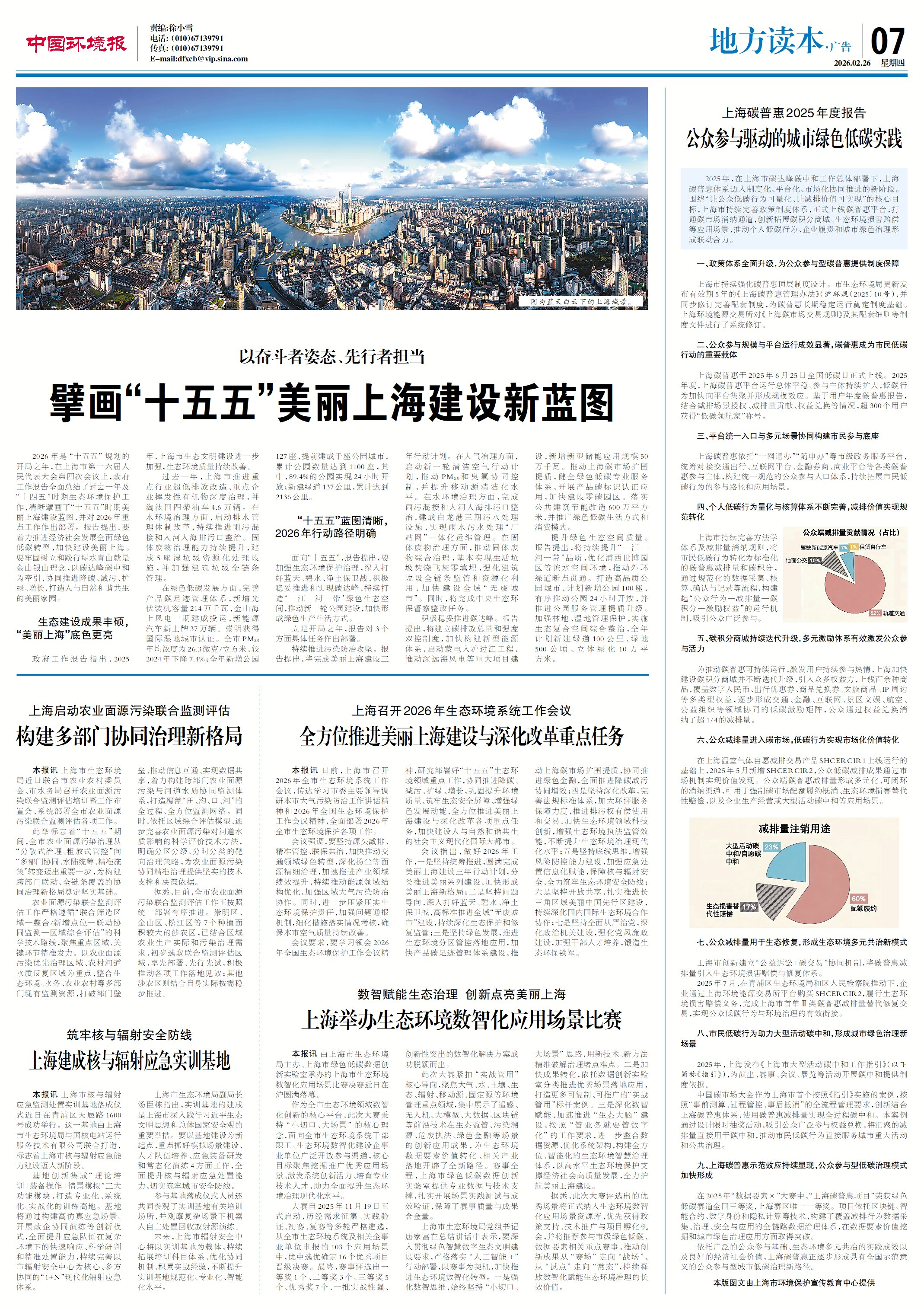
擘画“十五五”美丽上海建设新蓝图
Zhong Guo Huan Jing Bao· 2026-02-26 01:14
Core Viewpoint - The Shanghai government report outlines the blueprint for the "15th Five-Year Plan" focusing on ecological and environmental protection, aiming for a green and low-carbon transformation of the economy and society by 2026 [4][11]. Group 1: Achievements in Ecological Construction - In 2025, Shanghai's ecological civilization construction will be further strengthened, with continuous improvement in environmental quality [12]. - Key achievements include the retrofitting of key industries for ultra-low emissions, deep treatment of volatile organic compounds in major enterprises, and the elimination of 46,000 National IV diesel vehicles [13]. - The city has initiated reforms in drainage management, improved rainwater and sewage treatment, and enhanced solid waste management capabilities, including the establishment of five wet waste resource treatment facilities [13]. Group 2: Green and Low-Carbon Development - Shanghai has improved its product carbon footprint management system, added 2.14 million kilowatts of photovoltaic capacity, and registered 370,000 new energy vehicles [13]. - The average annual PM2.5 concentration in the city is 26.3 micrograms per cubic meter, a 7.4% decrease from 2024 [13]. - The city has added 127 parks, achieving a total of 1,100 parks, with 89.4% open 24 hours, and constructed 137 kilometers of new greenways, totaling 2,136 kilometers [13]. Group 3: Action Plan for the "15th Five-Year Plan" - The report emphasizes the need for enhanced ecological protection and governance, focusing on blue sky, clear water, and clean land, while steadily advancing carbon peak and neutrality goals [14]. - Specific tasks include completing the three-year action plan for beautiful Shanghai, launching a new clean air action plan, and improving the management of rainwater and sewage treatment [14]. - The report also outlines plans for solid waste comprehensive management, aiming for zero landfill of incinerated fly ash and strengthening the regulation of construction waste [14]. Group 4: Carbon Peak and Green Space Quality - The report proposes establishing a dual control system for total carbon emissions and intensity, accelerating the construction of a new energy system, and promoting major projects like offshore wind power [15]. - Plans include enhancing the quality of green ecological spaces, optimizing waterfront environments, and adding 100 new parks while ensuring 24-hour access [15]. - The city aims to construct 100 kilometers of new greenways, 500 hectares of green land, and 100,000 square meters of vertical greening throughout the year [15].

锻造生态环境监测铁军需抓住“关键少数”
Zhong Guo Huan Jing Bao· 2026-02-26 00:30
监测工作的深刻变革,对领导干部的能力素养提出了全新挑战。从传统手工监测到智能监测,从数据提 供到决策支撑,生态环境监测系统的领导干部不能仅满足于当"管理员",而要成为懂技术、善攻坚、能 创新的"指挥员"和"领军人"。生态环境监测系统领导干部的能力培养要紧跟技术变革,针对"天地一体 化"监测、大数据分析、人工智能预警等新趋势,对领导干部开展系统化、实战化的专业轮训,帮助他 们克服"本领恐慌",提升其运用现代科技手段解决复杂问题的能力。实践锻炼要直奔"问题现场",打破 部门壁垒,推动干部跨区域交流、跨岗位轮换、上下挂职锻炼,特别是要到环境本底复杂、治理任务 重、技术挑战大的地方去"墩苗"历练。让他们在直接指挥溯源解析、优化监测网络、应对跨界污染等一 线工作中,磨炼统筹协调和科学决策的真本领。鼓励领导干部牵头组建技术攻关小组,在破解治理难题 的实战中成长为生态环境监测领域的领军人才。 监测数据容不得丝毫虚假,廉洁是监测工作的生命线。手握监测权力的领导干部,必须成为数据诚信最 坚定的守护者,同时也必须接受最严格的监督。监督要精准发力,聚焦权力运行的关键环节,完善监测 设备采购、第三方服务委托、监测报告审核等制度设计, ...