水价改革

Search documents
环保行业跟踪周报:侨银股份推进人形机器人城服应用,固废板块提分红验证+供热IDC拓展提ROE
Soochow Securities· 2025-05-12 10:23
Investment Rating - The report maintains an "Accumulate" rating for the environmental protection industry [1]. Core Insights - The report highlights the collaboration between Qiaoyin Co. and Guodi Center to advance humanoid robot applications in urban services, marking a significant development in the industry [9]. - It emphasizes the trend of decreasing capital expenditures in waste incineration, leading to improved free cash flow and increased dividends, while also noting the enhancement of ROE through efficiency improvements in heating and IDC collaborations [10][11]. - The water utility sector is experiencing stable growth and high dividends, with water price reforms expected to reshape growth and valuation [12][13]. Summary by Sections Humanoid Robot Development - Qiaoyin Co. has signed a cooperation agreement with Guodi Center to launch humanoid robots for urban services, with an initial order of 1,000 robots aimed at street sanitation applications [9]. Waste Incineration Sector - The report identifies two key factors for the solid waste sector: a decrease in capital expenditures leading to improved free cash flow and increased dividends, and a focus on efficiency improvements during the industry's maturity phase [10]. - Specific dividend forecasts for 2024 include: - Junxin Co.: cash dividend of 507 million yuan (+37%), dividend ratio of 94.59% (+22.78 percentage points), and a dividend yield of 4.4% - Green Power: cash dividend of 418 million yuan (+100%), dividend ratio of 71.45% (+38.23 percentage points), with A-share and Hong Kong dividend yields of 4.2% and 8.2% respectively - Hanlan Environment: proposed dividend of 652 million yuan (+67%), dividend ratio of 39.20% (+11.83 percentage points), and a dividend yield of 3.5% [10]. Water Utility Sector - The water utility sector is projected to see stable growth, with 2024 revenues of 65.5 billion yuan (-2%) and a net profit of 11.2 billion yuan (+27%), excluding one-time gains [12]. - Water price reforms in Guangzhou and Shenzhen are expected to drive a new round of price adjustments, enhancing profitability and stability in the sector [13][14]. Environmental Equipment and Renewable Energy - The report notes a 51% increase in sales of new energy sanitation vehicles in early 2025, with a penetration rate of 14.36%, reflecting a growing trend towards electrification in the sanitation equipment sector [29]. - The average price of biodiesel has decreased slightly, with a narrowing price gap between biodiesel and waste oil, impacting profitability [36]. Lithium Battery Recycling - The report indicates a slight decline in profitability in lithium battery recycling due to fluctuating metal prices and a stable discount coefficient, with average unit profits showing a minor decrease [39].
环保行业跟踪周报:侨银股份推进人形机器人城服应用,固废板块提分红验证+供热IDC拓展提ROE-20250512
Soochow Securities· 2025-05-12 07:39
Investment Rating - The report maintains an "Accumulate" rating for the environmental protection industry [1] Core Views - The report highlights the collaboration between Qiaoyin Co. and Guodi Center to advance humanoid robot applications in urban services, marking a significant development in the industry [9] - It emphasizes that the solid waste sector is experiencing a decrease in capital expenditure, leading to improved free cash flow and increased dividends, while also enhancing return on equity (ROE) through efficiency improvements in heating and IDC [10][12] - The water services sector is noted for its stable growth and high dividends, with water price reforms expected to reshape growth and valuation [12][14] Summary by Sections Humanoid Robot Development - Qiaoyin Co. has signed a cooperation agreement with Guodi Center to launch humanoid robots for urban services, with an initial order of 1,000 robots aimed at street cleaning and maintenance [9] Solid Waste Management - The report identifies two key trends: a reduction in capital expenditure leading to improved free cash flow and increased dividends, and a focus on efficiency improvements as the industry matures [10] - Specific dividend forecasts for 2024 include: - Junxin Co.: cash dividend of 507 million yuan (+37%), dividend ratio of 94.59% (+22.78 percentage points), and a dividend yield of 4.4% - Green Power: cash dividend of 418 million yuan (+100%), dividend ratio of 71.45% (+38.23 percentage points), with A-share and Hong Kong stock dividend yields of 4.2% and 8.2% respectively - Hanlan Environment: proposed dividend of 652 million yuan (+67%), dividend ratio of 39.20% (+11.83 percentage points), and a dividend yield of 3.5% [10] Water Services - The water services sector is projected to see stable growth, with 2024 revenues of 65.5 billion yuan (-2%) and net profits of 11.2 billion yuan (+27%), excluding one-time gains [12] - Water price reforms in Guangzhou and Shenzhen are expected to drive a new round of price adjustments, enhancing profitability and stability [13][14] Industry Trends - The report notes a 51% increase in sales of new energy sanitation vehicles in the first quarter of 2025, with penetration rates rising to 14.36% [29] - The bio-diesel market is experiencing a decline in prices for both bio-diesel and waste oil, leading to a narrowing price gap [36] - The lithium battery recycling sector is facing slight declines in profitability due to fluctuating metal prices and discount coefficients [39]
中信证券:广州水价价改落地 价格机制理顺有望提速 推荐中国水务(00855)等
智通财经网· 2025-05-07 01:49
Core Viewpoint - The water price reform plan in Guangzhou will take effect on June 1, 2025, addressing the long-standing cost pressures faced by local water supply companies and potentially catalyzing similar reforms in other cities [1][2] Summary by Sections Water Price Adjustment Details - The new pricing scheme will increase residential water prices to 2.55, 3.82, and 7.65 CNY per ton for the first, second, and third tiers, representing increases of 29%, 29%, and 93% respectively compared to the current rates [2] - Non-residential water prices will rise to 4.40 CNY per ton, reflecting a 27% increase [2] Financial Performance of Water Supply Companies - Guangzhou's water supply companies have faced continuous losses, with profits dropping from 333 million CNY in 2017 to a loss of 334 million CNY in 2023, excluding other income [2] - The current water pricing has not changed for over 12 years, leading to a ranking of 28th among 36 major cities in terms of residential water prices [2] Cost Transmission Mechanism - The lack of a smooth cost transmission mechanism is identified as a core reason for the declining profitability of Guangzhou's water supply companies [3] - The implementation of new management measures in 2021 aims to enhance the market-oriented nature of water pricing and establish a regulatory cycle for pricing adjustments every three years [3] Historical Context and Future Implications - Historical data indicates that price adjustments in major cities can catalyze reforms in other regions, with recent adjustments in cities like Shanghai, Nanjing, and Shenzhen [4] - As of April 2025, 39 cities have adjusted their water prices since the new management measures were introduced, indicating a trend towards improving the long-term returns of the water supply industry [4] Investment Recommendations - The ongoing improvements in water pricing policies and mechanisms are expected to benefit water utility assets significantly, with recommendations for companies such as China Water Affairs, Yuehai Investment, and others [5]


公用环保|广州水价价改落地,价格机制理顺有望提速
中信证券研究· 2025-05-05 07:59
Core Viewpoint - The water price reform plan in Guangzhou will take effect on June 1, 2025, with a 29% increase in the first-tier residential water price and a 27% increase in non-residential water price, aimed at alleviating the financial pressure on local water supply companies [1][2]. Summary by Sections Water Price Adjustment Details - The new residential water prices will be set at 2.55, 3.82, and 7.65 yuan per ton for the first, second, and third tiers respectively, reflecting increases of 29%, 29%, and 93% compared to the current rates [2]. - The non-residential water price will rise to 4.40 yuan per ton, marking a 27% increase from the existing price [2]. Financial Performance of Water Supply Companies - Guangzhou's current water prices have not changed for over a decade, leading to continuous losses for local water supply companies, with profits dropping from 333 million yuan in 2017 to a loss of 334 million yuan in 2023 [3]. - Excluding other income, the losses have increased from 188 million yuan in 2017 to 500 million yuan in 2023, indicating a worsening financial situation since 2019 [3]. Cost Transmission Mechanism - The lack of an effective cost transmission mechanism is identified as a core reason for the declining profitability of Guangzhou's water supply companies [4]. - The implementation of the new management measures in October 2021 aims to enhance the market-oriented nature of water pricing and establish a regulatory cycle of three years for urban water pricing [4]. Historical Context and Future Implications - Historical data suggests that price adjustments in major cities catalyze broader water price reforms across the country, with recent adjustments in cities like Shanghai, Nanjing, and Shenzhen indicating a trend towards faster price mechanism alignment [5][6]. - Since the introduction of the new management measures, 39 cities have adjusted their water prices, with 32 cities making changes in 2023, 2024, and early 2025, which is expected to improve the long-standing low returns in the water supply industry [7]. Investment Strategy - The ongoing improvements in water pricing policies and the alignment of industry pricing mechanisms are anticipated to enhance overall returns in the water supply sector, benefiting water operation assets significantly [9].

广州中心城区水价6月1日起上调,但低于去年听证会上多数代表赞成的方案
Zhong Guo Chan Ye Jing Ji Xin Xi Wang· 2025-05-02 23:04
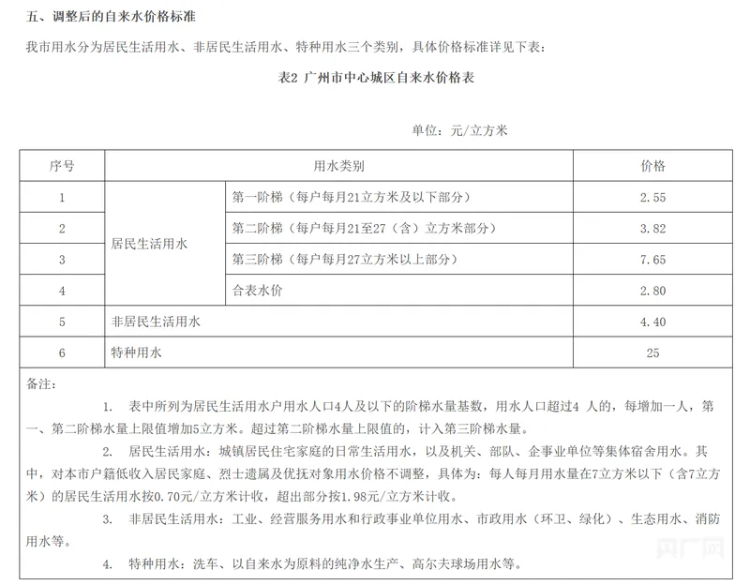
Core Viewpoint - Guangzhou's municipal government has announced a water price reform effective June 1, 2025, aimed at adjusting water prices for residential and non-residential users in the central urban area, reflecting changes in supply costs and infrastructure investments [1][2]. Pricing Adjustments - Residential water prices will be adjusted to 2.55 CNY/m³ for the first tier, 3.82 CNY/m³ for the second tier, and 7.65 CNY/m³ for the third tier, with a new combined meter price set at 2.80 CNY/m³ [1]. - Non-residential water prices will increase to 4.40 CNY/m³, while special use water prices will be set at 25 CNY/m³ [1]. Historical Context - The current water pricing structure has been in place since 2012, and the city has seen significant changes in supply costs due to economic growth and infrastructure investments [2]. - Over the past 13 years, the Guangzhou Water Supply Company has invested approximately 170 billion CNY in infrastructure, including the construction of water plants and pipeline upgrades [2]. Service Expansion - The population served by the water supply system has increased from 8.9 million to 11.43 million, with daily water supply capacity rising from 4.65 million m³ to 5.19 million m³ [2]. - The total length of the water supply network has expanded from 5,915 kilometers to 10,661 kilometers, indicating significant improvements in service coverage and infrastructure [2].
广州中心城区水价6月1日起上调,低于去年听证会上多数代表赞成的方案
Yang Guang Wang· 2025-04-29 06:01
Core Viewpoint - Guangzhou's municipal government has announced a water price reform effective June 1, 2025, adjusting the water prices for residential and non-residential users in the central urban area [1][4]. Pricing Adjustments - The new residential water prices will be set at 2.55 CNY/m³ for the first tier (up to 21 m³), 3.82 CNY/m³ for the second tier (21 to 27 m³), and 7.65 CNY/m³ for the third tier (above 27 m³) [1][3]. - The combined water price will be 2.80 CNY/m³, while non-residential water prices will be adjusted to 4.40 CNY/m³, and special water usage will be priced at 25 CNY/m³ [1][3]. Historical Context and Infrastructure Investment - The current water pricing has been in place since 2012, and the city has invested approximately 170 billion CNY in water supply infrastructure, including the construction of new water plants and the renovation of old pipelines [4]. - The population served by the water supply has increased from 8.9 million to 11.43 million, with the daily water supply capacity rising from 4.65 million m³ to 5.19 million m³ [4]. Financial Impact - The average water supply price will decrease compared to the previously proposed plan, resulting in an annual reduction of 118 million CNY in user water expenses [1][4].
完善价格治理机制意见有望加速水价改革 中国水务(00855)、粤海投资(00270)等供水运营商受益
智通财经网· 2025-04-03 01:02
Group 1 - The central government has issued opinions to optimize the pricing mechanism for water, electricity, and gas, emphasizing the need for a reasonable operation of price levels and important commodity prices [1] - The new pricing policy aims to enhance the profitability of water supply operators by implementing a progressive pricing system for non-residential water usage, which is expected to drive profit recovery and growth [1] - The 2021 urban water pricing management measures have been reiterated, focusing on cost auditing as the basis for setting water prices, ensuring that water supply companies can achieve reasonable returns [1] Group 2 - Shenzhen's water price adjustment hearing is scheduled for April 11, with proposed increases of 13.1% to a new price of 3.8991 yuan per cubic meter [2] - Historical trends indicate that price adjustments in major cities can catalyze water price reforms, potentially improving the long-term low returns in the domestic water supply industry [2] - Companies such as China Water Affairs (00855) are expected to benefit significantly from the ongoing improvements in water pricing policies, with a notable portion of their revenue derived from water supply operations [2]
公用环保|深圳启动水价价改,价格机制理顺有望提速
中信证券研究· 2025-03-25 00:14
Core Viewpoint - Shenzhen's water price reform is set to address rising cost pressures on water supply companies, with proposed increases of 13% across both residential and non-residential categories, aiming to improve profitability in the sector [1][2][3]. Group 1: Event Details - A public hearing for Shenzhen's water price reform is scheduled for April 11, with two proposed pricing schemes for residential and non-residential water usage [2]. - The first scheme proposes increases for residential water prices to 2.67/4.54/9.35 CNY per ton for the first, second, and third tiers, while the second scheme suggests 2.94/5.00/10.29 CNY per ton, reflecting increases of 0%/13%/17% and 10%/25%/28% respectively [2]. - Non-residential water prices are proposed to rise to 4.76 CNY per ton under the first scheme and 4.57 CNY per ton under the second, with increases of 26% and 21% respectively [2]. Group 2: Current Pricing and Financial Performance - Shenzhen's current water pricing has remained unchanged for over seven years, with the first tier residential price at 2.67 CNY per ton, leading to declining profitability for local water supply companies [3]. - Shenzhen Water Group's net profit has decreased from 699 million CNY in 2018 to 166 million CNY in 2023, with gross margins dropping from 31.22% to 20.69% during the same period [3]. Group 3: Cost Transmission Mechanism - The lack of an effective cost transmission mechanism is identified as a core reason for the declining profitability of Shenzhen Water Group, with the current pricing structure not reflecting the annual average cost increase of approximately 3% [4]. - The implementation of new management regulations in October 2021 aims to enhance the market-oriented nature of water pricing and establish a regulatory cycle of three years for price adjustments, which could help rectify the cost transmission issues [4]. Group 4: Historical Context and Future Implications - Historical data indicates that price adjustments in major cities catalyze broader water price reforms across the country, with recent adjustments in cities like Shanghai and Nanjing suggesting a potential acceleration in price mechanism improvements nationwide [5][6]. - Since the introduction of the new management regulations in August 2021, 35 cities have adjusted their water prices, indicating a trend towards improving the long-standing low return issues in the water supply industry [7]. Group 5: Investment Strategy - The ongoing refinement of water pricing policies and the alignment of industry pricing mechanisms are expected to enhance overall returns in the water supply sector, presenting significant investment opportunities in water utility assets [9].