
治安管理处罚法

Search documents
“男子向女友发淫秽视频被行拘”,冲上热搜
Xin Lang Cai Jing· 2025-12-24 11:38
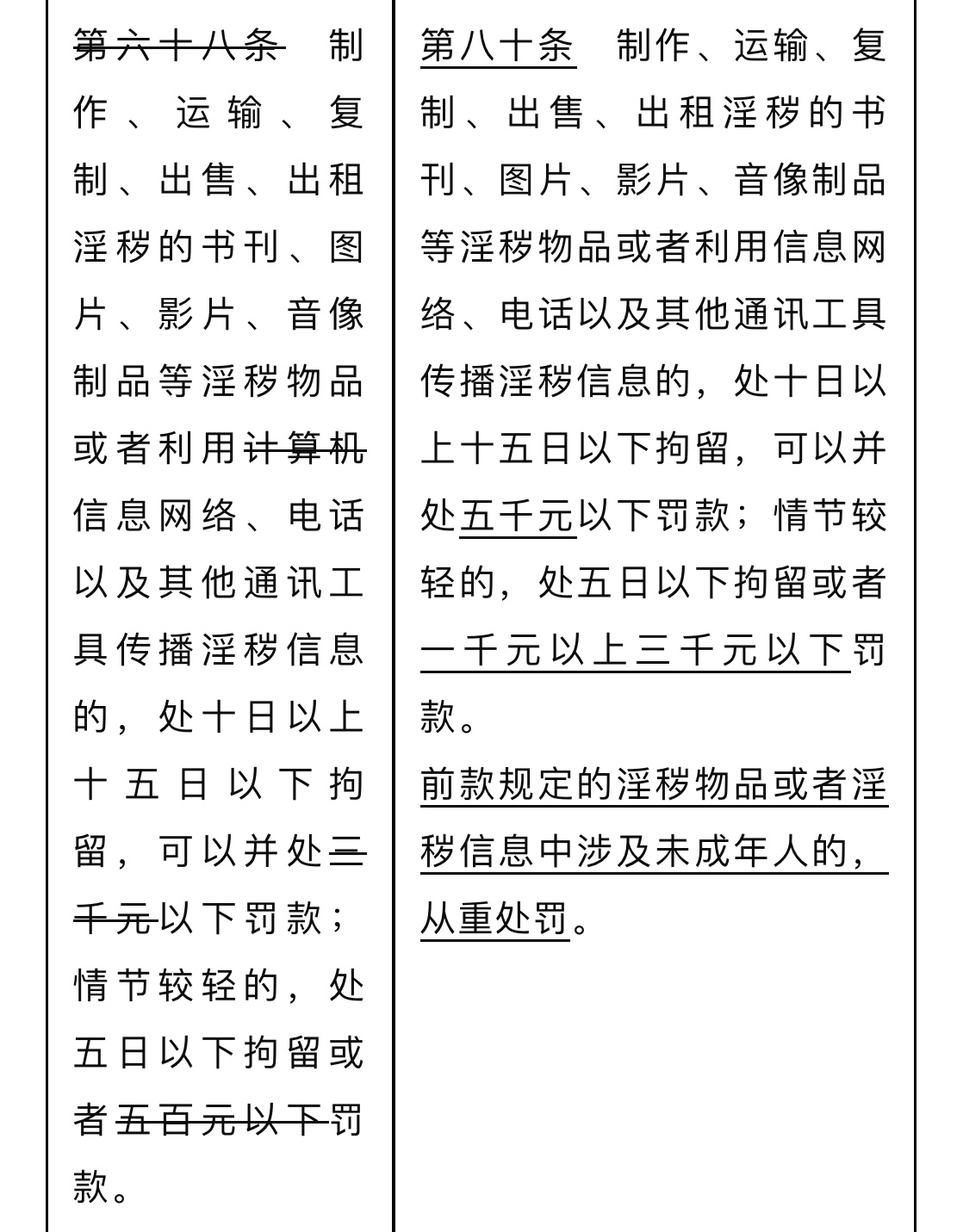
Core Viewpoint - The new amendments to the "Public Security Administration Punishment Law" will take effect on January 1, 2024, increasing penalties for the dissemination of obscene materials, which has sparked widespread discussion online [3][9]. Group 1: Legal Changes - The revised law stipulates that using information networks to disseminate obscene materials can result in detention for 10 to 15 days and fines up to 5,000 yuan, with lighter offenses facing detention of up to 5 days or fines between 1,000 and 3,000 yuan [5][6]. - The new law broadens the scope of punishment by removing the term "computer," thus including all forms of communication tools in the regulation of obscene material dissemination [6][7]. - The maximum fine has been increased from 3,000 yuan to 5,000 yuan, and the minimum fine for lighter offenses has been adjusted from below 500 yuan to between 1,000 and 3,000 yuan, raising the cost of violations and enhancing legal deterrence [6][7]. Group 2: Interpretation and Misconceptions - The new law eliminates the concept of "scene" in the dissemination of obscene materials, correcting the public misconception that private sharing of such content is merely a moral issue [6][10]. - There is a distinction between "obscene" and "indecent" content; the law specifically prohibits the dissemination of "obscene" materials, which are clearly defined, as opposed to the vaguer term "indecent" [10][11]. - Concerns have been raised regarding the allocation of law enforcement resources to handle private exchanges of intimate photos between couples, with some questioning the practicality of such regulations [8].


哪些情况下“发送私密信息”可能违法,律师详解
Di Yi Cai Jing· 2025-12-23 12:03
Core Viewpoint - The new regulations under the amended Public Security Administration Punishment Law, effective January 1, 2024, clarify the distinction between "obscene information" and "private information," addressing concerns about the legality of sharing private content among friends and partners [1][4]. Summary by Sections Legal Changes - The amended law stipulates that the production, distribution, or transmission of obscene materials via information networks can result in detention of 10 to 15 days and fines up to 5,000 yuan, with lighter offenses facing up to 5 days of detention or fines between 1,000 and 3,000 yuan [1][3]. - The law has updated terminology from "computer information network" to "information network," reflecting advancements in technology since the previous law was enacted in 2005 [1][2]. Enforcement and Penalties - The new law increases penalties for violations, raising the maximum fine for general offenses from 3,000 yuan to 5,000 yuan, and for lighter offenses from 500 yuan to between 1,000 and 3,000 yuan, enhancing legal deterrence [3]. - There is a specific provision for harsher penalties when minors are involved, aligning with the principles established in the 2020 revision of the Minor Protection Law [3]. Public Concerns and Clarifications - Public anxiety regarding the potential criminalization of sharing private photos or videos among couples is noted, but legal experts clarify that the law targets "obscene information," not private exchanges that do not involve explicit content [4]. - The application of the law follows a principle of restraint, indicating that private behaviors that do not disrupt social order are generally not subject to legal intervention [4].
十四届全国人大常委会第十六次会议在京闭幕 表决通过新修订的反不正当竞争法等
news flash· 2025-06-27 07:04
Core Points - The 16th meeting of the 14th National People's Congress Standing Committee concluded in Beijing, where new amendments to the Law on Administrative Penalties and the Anti-Unfair Competition Law were passed [1] - President Xi Jinping signed orders No. 49 and No. 50 to promulgate the new laws [1] - The meeting also approved the resolution on the 2024 central budget and removed Miao Hua from the position of member of the Central Military Commission [1]