电力中长期市场

Search documents
关于印发《电力中长期市场基本规则》的通知
国家能源局· 2025-12-26 11:07
Group 1 - The article outlines the issuance of the "Basic Rules for the Long-term Electricity Market" by the National Development and Reform Commission and the National Energy Administration to accelerate the establishment of a unified national electricity market [2][3] - The revised rules aim to deepen the construction of the long-term electricity market and standardize trading behaviors in response to the needs of electricity reform and development [3][4] - Local electricity trading institutions are required to draft implementation details for the long-term electricity market by March 1, 2026, and submit them for record to the National Development and Reform Commission and the National Energy Administration [4]


两部门:统筹推进电力中长期市场、电力现货市场建设
智通财经网· 2025-12-26 09:55
Core Viewpoint - The National Development and Reform Commission and the National Energy Administration have issued the "Basic Rules for the Medium and Long-term Electricity Market," aiming to enhance the construction of the medium and long-term electricity market and the spot electricity market, ensuring a stable operation of the electricity market and accommodating the characteristics of renewable energy output fluctuations [1][5]. Group 1: Market Structure and Functionality - The medium and long-term electricity market is defined as a market where registered entities conduct transactions for electricity products or services for future delivery, covering various time frames from years to months [3][4]. - The rules emphasize the importance of integrating medium and long-term trading with spot market operations, facilitating flexible and continuous trading to stabilize long-term consumption space [5][6]. Group 2: Market Participants and Responsibilities - Market participants include power generation companies, electricity sales companies, electricity users, and new business entities, all of which must adhere to market rules and avoid price manipulation [4][5]. - Responsibilities of power generation companies include compliance with market rules, timely completion of electricity payment settlements, and provision of necessary operational information [8][9]. Group 3: Trading Mechanisms and Pricing - The medium and long-term trading includes various delivery cycles such as multi-year, annual, and monthly transactions, with specific trading methods like centralized trading and bilateral negotiations [13][15]. - Pricing mechanisms are determined by market forces, with the government setting overall principles for price formation, ensuring that prices reflect supply and demand dynamics [16][17]. Group 4: Transaction Organization and Management - The organization of cross-regional and provincial electricity trading will be managed by designated electricity trading centers, ensuring a structured approach to market operations [19][20]. - The trading platform must support continuous operations and provide functionalities for registration, transaction clearing, and market monitoring [37][38]. Group 5: Information Disclosure and Compliance - Market information must be disclosed periodically, ensuring transparency and allowing stakeholders to access relevant data for decision-making [35][36]. - Compliance with the rules is mandatory for all market participants, with penalties for violations to maintain market integrity [40][41].
《电力中长期市场基本规则》正式发布!直接参与市场交易的经营主体,不人为规定分时电价水平和时段
中关村储能产业技术联盟· 2025-12-25 23:33
Core Viewpoint - The article discusses the recently released "Basic Rules for the Medium and Long-term Electricity Market" by the National Development and Reform Commission and the National Energy Administration, aimed at establishing a unified national electricity market and regulating medium and long-term electricity trading behavior [2][8]. Overall Requirements - The construction of the medium and long-term electricity market and the spot electricity market will be coordinated, ensuring smooth transitions in trading sequences, clearing, and market settlements to balance long-term supply and demand [3]. - Cross-regional trading will be promoted, encouraging innovative mechanisms for inter-provincial trading and resource sharing [3][4]. - Market operators will conduct registration, trading organization, settlement, and information disclosure according to unified standards [3]. Participant Registration - Electricity users can purchase all their electricity through wholesale or retail markets but cannot participate in both simultaneously. Users not directly participating can have their electricity purchased by grid companies [5][20]. Pricing Mechanism - The overall principles for market pricing will be set by the State Council's pricing authority, with local authorities developing specific implementation details [6]. - Transaction prices will be formed by market participants, with no third-party interference, and green electricity prices will consist of energy prices and environmental values [6][7]. - The government will set price limits to prevent market manipulation and ensure fair pricing [7][39]. Trading Types and Price Mechanism - Medium and long-term trading will include various delivery periods, with green electricity trading being a significant focus, allowing for the purchase of renewable energy [34][35]. - Contracts can be transferred to third parties, and green electricity contracts must ensure traceability of environmental values [36][38]. Transaction Organization - Cross-regional transactions will be organized by designated electricity trading centers, with monthly trading calendars published by trading institutions [41][42]. - Key parameters for transactions must be clearly defined before trading begins, and adjustments cannot be made during the trading process [44]. Contract Management - All market participants must sign medium and long-term trading contracts, which will serve as the basis for execution [64][65]. - In emergencies, the electricity dispatching agency can prioritize safety in scheduling and report incidents to regulatory bodies [68]. Measurement and Settlement - Settlements will generally occur monthly, with specific reference points for pricing established based on market clearing prices [72][73]. - Green electricity transactions will have separate settlements for energy and environmental values, ensuring compliance with sustainability pricing mechanisms [78]. Information Disclosure - Market information will be disclosed periodically, with a retention period of at least two years [81][82]. Technical Support System - The electricity trading platform will include various functional modules to support market operations and ensure data interoperability among different systems [84][86].

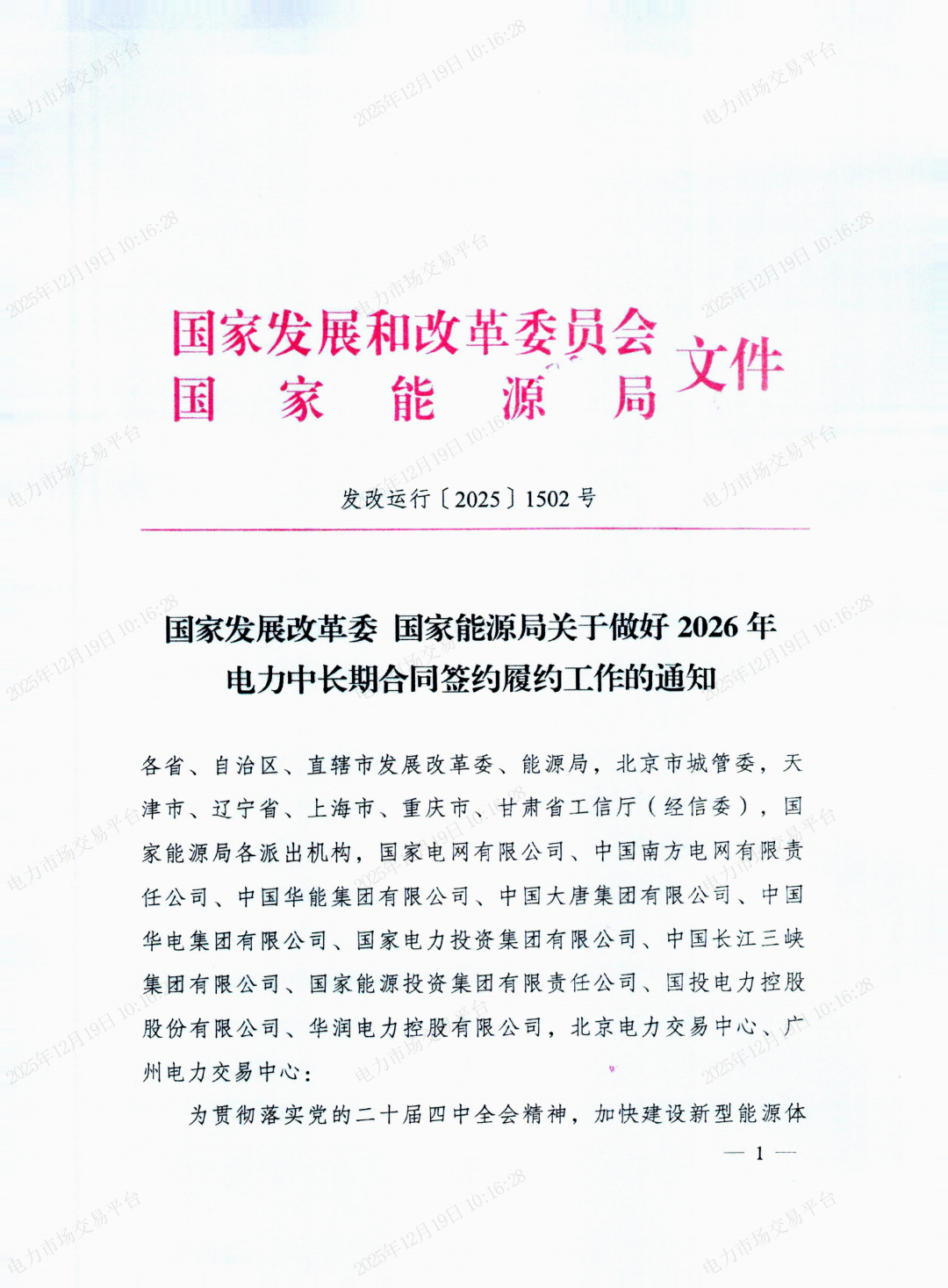
两部门:优化电力中长期价格形成机制,直接参与市场用户不再执行政府规定的分时电价
Xin Lang Cai Jing· 2025-12-19 12:44
Core Viewpoint - The National Development and Reform Commission and the National Energy Administration have issued a notice to enhance the signing and performance of medium- and long-term electricity contracts for 2026 through four key measures, aiming to ensure effective implementation and quality of these contracts [22][25]. Group 1: Contract Signing Requirements - The total signed electricity volume for medium- and long-term contracts by coal-fired power enterprises in each province should not be less than 70% of the actual online electricity volume from the previous year, with monthly contract signing volumes not less than 80% of the expected market-based online electricity volume [10][26]. - The electricity consumption side must ensure that the monthly contract signing volume is not less than 80% of the expected electricity consumption [2][27]. - For cross-provincial and cross-regional contracts, there should be clear arrangements for supporting renewable energy in transmission projects, encouraging green electricity trading to fulfill priority generation plans [3][28]. Group 2: Quality Improvement Measures - There should be a mechanism for time-segmented and curve-based signing in annual electricity medium- and long-term transactions, with at least 24 trading periods in regions where the electricity spot market is operational [5][28]. - The pricing mechanism for medium- and long-term electricity contracts should be flexible, allowing for adjustments based on market supply and demand, and not mandating fixed prices [6][29]. - A balance management system for electricity supply and demand should be established to avoid significant discrepancies in electricity volume across trading periods [12][29]. Group 3: Efficient Contract Performance - Continuous and flexible trading of medium- and long-term contracts within provinces should be promoted, considering the characteristics of renewable energy generation and load [8][30]. - The quality of cross-provincial and cross-regional medium- and long-term transactions should be improved by enhancing trading frequency and optimizing transaction organization [14][30]. - Monitoring of medium- and long-term trading behaviors should be strengthened to prevent market manipulation and ensure compliance with regulations [15][31]. Group 4: Contract Assurance Mechanism - A mechanism to promote high-quality signing and performance of medium- and long-term contracts should be established, ensuring compliance with policy requirements [16][32]. - The priority generation plan for cross-provincial and cross-regional electricity should be effectively implemented, ensuring that annual delivery needs are met [17][33]. Group 5: Timeline - Local government departments and the National Energy Administration should complete the necessary preparations for the medium- and long-term electricity market by December 10, 2025, and finalize cross-provincial contract signing by December 25, 2025 [18][34].